

World News – 2024 – Video Playlist | Video Playlists | Sites: | newsandtimes.org | links-newsandtimes.com | worldwebtimes.com | southcaucasusnews.com | russianworld.net | jossica.com | octobersurprise2016.org | bklyntimes.com | oceanavenuenews.com | fbireform.com | bloggersunite.net | octobersurprise-2024.org | Trump-News.org | Audio-Posts.com | Bklyn-NY.com | Posts Review – newsandtimes.org
 October Surprise 2016
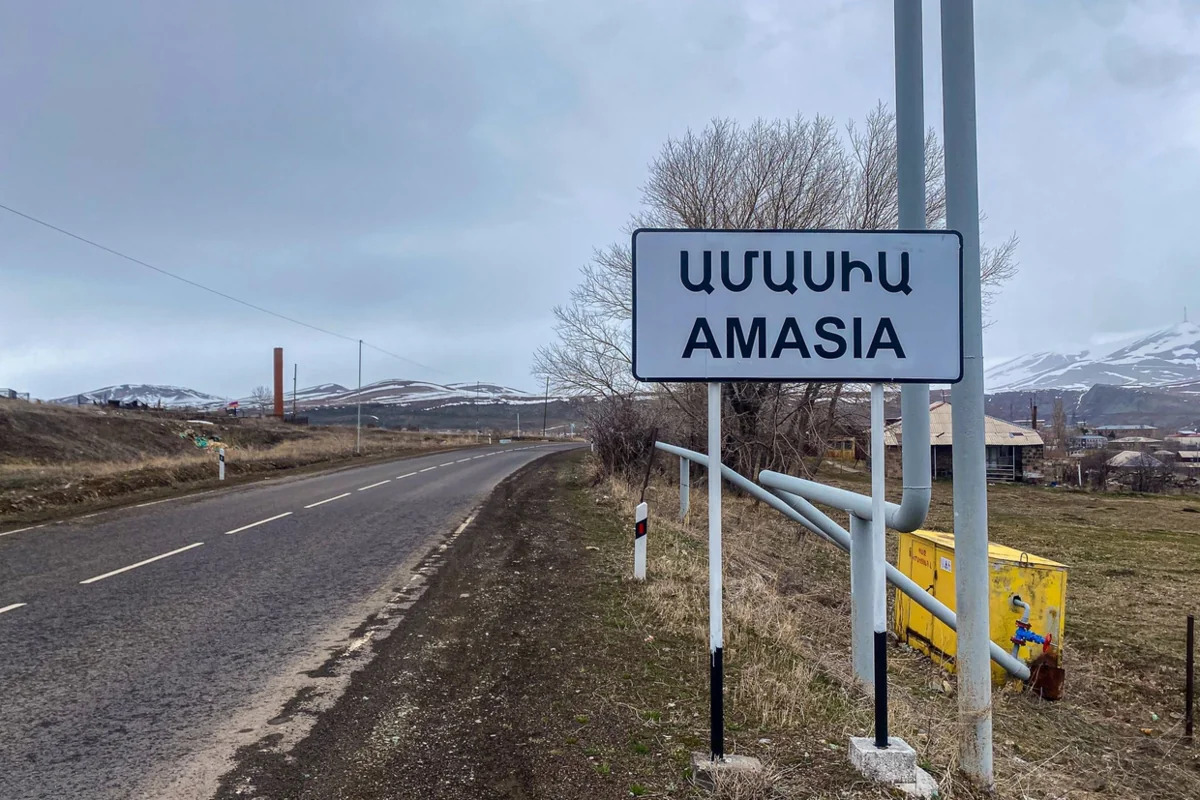
Research has been published on the history of Amasia, an Azerbaijani village in present-day Armenia where an Azerbaijani cemetery with vandalized gravestones still remains, as part of the “Sites of Memory of Western Azerbaijan” project.
According to Report, the article was published on Perished Civilization.
The project’s English-language page records the village as Amasia during the Tsarist period and as Ghukasyan and Amasia during the Soviet period. Tsarist- and Soviet-era sources also record the settlement as Amasia. The village was renamed Ghukasyan in 1951, while its former name was restored in 1956. Since 1995, it has been part of Shirak Province of the Republic of Armenia.
On the eve of the Russo-Turkish War of 1877-1878, the territory of the village lay within the Kars Sanjak of the Ottoman Empire. Following the war, the Treaty of Berlin compelled the Ottoman Empire to cede Kars, Ardahan and Batum, present-day Batumi, to Russia.
During the Tsarist period, the village was part of the Kars Okrug of the Kars Oblast.
According to Tsarist-era statistical records also cited in Armenian sources, at various times before 1914 the village was inhabited exclusively or predominantly by ancestors of present-day Azerbaijanis. Some sources identified them as Karapapakhs, an ethnographic group of Azerbaijanis.
The Summary of Statistical Data on the Population of the Transcaucasian Krai, Extracted from the 1886 Family Lists states that in 1886 the village had 274 inhabitants, all of whom were Karapapakhs.
According to Z. Korkotyan’s The Population of Soviet Armenia over the Last Hundred Years (1831–1931), Amasia had 406 inhabitants in 1897, of whom 378 were ancestors of the Azerbaijanis.
The Kars Oblast Memorial Book and Address-Calendar for 1906 recorded 372 inhabitants in 1905, all of whom were Karapapakhs.
The Kars Oblast Memorial Book and Address-Calendar for 1908 stated that the village had 502 inhabitants in 1907, all of whom were Karapapakhs.
According to the Caucasian Calendar for 1912, the village had 528 inhabitants in 1911, predominantly Karapapakhs.
The Kars Oblast Memorial Book and Address-Calendar for 1914 recorded 555 inhabitants in 1913, all of whom were Karapapakhs.
The Caucasian Calendar for 1915 stated that in 1914 the village had 564 inhabitants, predominantly Karapapakhs.
On May 29, 1918, the government of the Azerbaijan Democratic Republic (ADR) ceded Erivan, present-day Yerevan, and several surrounding territories to the Armenians. The article says the First Republic of Armenia was thereby established on territory historically inhabited by ancestors of present-day Azerbaijanis and that within the first months of its existence it began making territorial claims against Azerbaijan, Georgia and Türkiye, then the Ottoman Empire.
According to the project, in 1919-1920, Armenian armed detachments and troops of the First Republic of Armenia carried out ethnic cleansing of Muslims in the Kars Oblast, which had belonged to the Ottoman Empire before the Russian occupation. It says ethnic cleansing was also carried out in the Erivan Governorate, including in Zangezur, Karabakh and Nakhchivan.
The article says the sharp decline in Amasia’s Turkic population provides evidence that its residents were subjected to ethnic cleansing, pointing to the difference between earlier population figures and the results of Soviet Armenia’s 1922 census.
According to Z. Korkotyan’s The Population of Soviet Armenia over the Last Hundred Years (1831–1931), the village had 167 inhabitants in 1922, of whom 161 were Azerbaijanis.
Soviet rule was proclaimed in Armenia in late 1920, and the communist regime became firmly established in 1921.
Under the 1921 Treaty of Kars, signed by Türkiye and the Armenian, Azerbaijani and Georgian SSRs, the village became part of Soviet Armenia.
In subsequent years, the Armenian population of Amasia began to grow noticeably.
From 1930, the village served as the administrative center of the Aghbaba District, which was later renamed the Amasia District.
According to Soviet and Armenian sources, Azerbaijanis continued to live in the village until the late 1980s.
Korkotyan’s work states that in 1926, Amasia had 357 inhabitants, of whom 199 were Azerbaijanis. In 1931, the village had 645 inhabitants, including 237 Azerbaijanis.
According to the All-Union Population Census of 1939. National Composition of the Population of Districts, Cities, and Large Villages of the Union Republics of the USSR, the village had 1,031 inhabitants in 1939, of whom 424 were Azerbaijanis.
A. P. Manvelyan and G. M. Martirosyan’s Settlements and Population of the Armenian SSR over the Period 1831–1959 states that in 1959 the village had 1,527 inhabitants, predominantly Armenians.
According to T. Kh. Hakobyan, St. T. Melik-Bakhshyan and H. Kh. Barsegyan’s Dictionary of Toponymy of Armenia and Adjacent Territories, Amasia had 2,773 inhabitants in 1970, 3,175 in 1980, and 2,554 in 1989.
The article says that in the late 1980s, amid Armenian territorial claims to Karabakh and escalating tensions between the two republics, Azerbaijanis were completely driven out of the territory of the Armenian SSR.
Between 2021 and 2024, extensive fieldwork was conducted across Armenia, including in remote mountainous regions, as part of preparations for the book The Perished Civilization. The research focused on identifying and documenting surviving Azerbaijani heritage sites.
During the fieldwork, an Azerbaijani cemetery was discovered in Amasia. According to the project, a considerable number of its gravestones had been vandalized: many had been deliberately damaged, while inscriptions and images on them had been defaced.
The “Sites of Memory of Western Azerbaijan” project is described as a research initiative under which information on nearly 600 villages in present-day Armenia once inhabited by ancestors of modern Azerbaijanis has been collected and systematized through field research.
According to the project, fragments of Turkic cultural and historical heritage, including cemeteries, sacred sites and mosques, remain in some of these settlements.
World News – 2024 – Video Playlist | Video Playlists | Sites: | newsandtimes.org | links-newsandtimes.com | worldwebtimes.com | southcaucasusnews.com | russianworld.net | jossica.com | octobersurprise2016.org | bklyntimes.com | oceanavenuenews.com | fbireform.com | bloggersunite.net | octobersurprise-2024.org | Trump-News.org | Audio-Posts.com | Bklyn-NY.com | Posts Review – newsandtimes.org