Spoilers ahead for “Part Nine” of “Masters of the Air” on Apple TV+.
(JTA) — When Lieutenant Colonel Robert Rosenthal’s B-17 bomber aircraft exploded during his final World War II combat mission on Feb. 3, 1945, he found himself in the middle of a battlefield of dueling Russian and German soldiers.
Rosenthal was recovered by the Red Army and transported by the Russians back to his Air Force unit, the 100th Bombardment Group, known as “Bloody Hundredth.”
The scene is dramatized in the final episode of the Apple TV+ miniseries “Masters of the Air,” which airs March 15 and is based on a book of the same name. A companion documentary also debuts Friday on the streaming platform.In the series finale, Rosenthal stops at a Russian Air Force base in Poznan, Poland. While waiting for his transportation, he wanders into the Zabikowo concentration camp — where he sees dead bodies in striped clothing and what appears to be a gas chamber with Hebrew words and a Star of David scrawled on the wall.
The scene clearly affects Rosenthal, who is visibly shaken by what he is witnessing. Upon seeing the Star of David carved into the wall, Rosenthal tenderly places his hand on it and lets out a gentle gasp.
The sequence, which also features Rosenthal speaking Yiddish, makes clear what had not been explicitly revealed in the previous eight episodes: Rosenthal, played by Nate Mann, is Jewish.
“He might be one of the most amazing human beings I have ever had the honor to write about,” John Orloff, the series’ writer and co-creator, who is not Jewish, told the Jewish Telegraphic Agency.
Orloff said the series has been a decade in the making. It’s the latest installment of a string of prominent World War II TV and film projects involving executive producers Tom Hanks and Steven Spielberg that also featured Jewish storylines.
“I’m kind of still processing it all because it’s been in my mind and only my mind for 10 years, and now it’s in a whole bunch of other people’s minds,” Orloff said. “So I’m sort of getting used to that. But it’s really exciting to see people respond so enthusiastically.”
The series has received largely positive reviews, with an 86% rating on the entertainment site Rotten Tomatoes. According to Variety, “Masters of the Air,” which premiered Jan. 26, drew more viewers in its opening weekend than any other Apple TV+ show, topping hits such as “Severance” and “The Morning Show.”
Rosenthal, known by his unit as “Rosie,” first appears in the fourth episode of the series and quickly becomes a main character as the 100th Bombardment group continues its European mission.
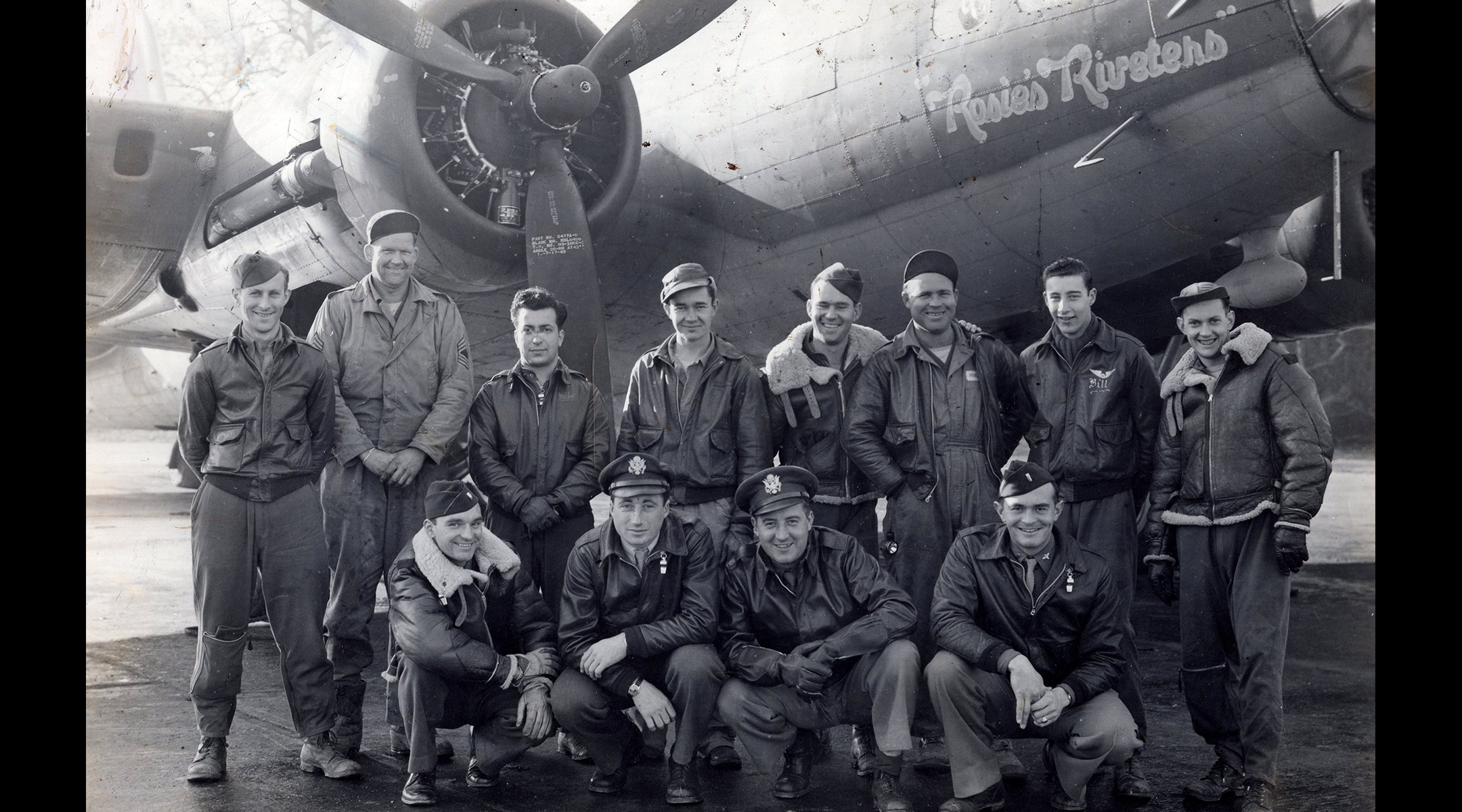
Lt. Robert Rosenthal, second from left in the front row, with his 418th crew in front of his plane, “Rosie’s Riveters.” (Courtesy of the 100th Bomb Group Foundation)
Born to a Jewish family in Brooklyn, the real-life Rosenthal earned his law degree at Brooklyn Law School and was working at a Manhattan law firm when Japan attacked Pearl Harbor on Dec. 7, 1941. He enlisted in the military the next day.
Rosenthal would go on to fly 52 combat missions — more than double the 25 that most soldiers completed — and was shot down twice. For his service in World War II, Rosenthal received more than a dozen prestigious military awards, including two Purple Hearts, the Distinguished Service Cross and two Silver Stars.
After the war, Rosenthal joined the prosecution team at the Nuremberg trials, where he interrogated Nazi leader Hermann Göring. During the ocean voyage to Nuremberg, Rosenthal met Phillis Heller, a fellow lawyer who had served in the U.S. women’s naval reserve. They married in Nuremberg and honeymooned at Hitler’s infamous “Eagle’s Nest” resort in southern Germany. (They were not the only Jewish military couple to celebrate a wedding at the infamous venue.)
Rosenthal died in 2007 at the age of 89, from multiple myeloma. Orloff said he never had the chance to meet Rosenthal but did get to know his story through one of his sons and others who knew him.
“I’m so humbled by Robert Rosenthal, I don’t even know where to begin,” Orloff said.
The series follows in the footsteps of 1998’s “Saving Private Ryan,” directed by Spielberg and starring Hanks, which prominently included a Jewish character among the GIs it portrayed. Spielberg and Hanks went on to produce the 2001 HBO miniseries “Band of Brothers,” a dramatization of a paratrooper company’s pivotal battles across Europe whose penultimate episode — which Orloff wrote — also centers on the soldiers discovering a concentration camp.
“Masters of the Air” comes more than a decade after Spielberg and Hanks’ last World War II series, HBO’s “The Pacific,” and amid a different context — as the far right gains popularity across Europe.
“It’s very emotional for me, because when we show planes going down in the show, they’re not just random planes. Those actual shots have been based on actual planes that went down,” Orloff said. “So every day I was writing about ‘these 10 men died to defeat fascism.’”
Orloff added, “I actually don’t think it’s a coincidence that the Greatest Generation is dying out as we’re seeing this resurgence. I think the institutional memory of why fascism and authoritarianism is bad is slowly eroding in our society.”
For the real-life Rosenthal, his motivation to serve was about more than his Jewish identity.
“I have no personal reasons. Everything I’ve done or hope to do is because I hate persecution,” Rosenthal told Donald Miller, author of “Masters of the Air: America’s Bomber Boys Who Fought the Air War Against Nazi Germany,” according to his obituary in the New York Times. “A human being has to look out for other human beings or there’s no civilization.”
To Orloff, Rosenthal’s decision to re-up after completing his initial 25 missions encapsulates his distinct moral compass.
“His humanism was greater than any single definition of identity,” Orloff said.
Though Judaism may not have been Rosenthal’s primary motivating factor, the concentration camp scene in the series finale — which Orloff said actually happened — lays bare that the weight of fighting the Nazis, first as a soldier and then as a prosecutor, was too much to ignore.
In the finale, immediately after leaving the camp, Rosenthal meets a refugee who explains, in Yiddish, that his entire family had been murdered by the Germans, who had forced him to bury them himself.
The entire exchange is translated in on-screen subtitles — except when Rosenthal asks the man where he will go next. The refugee’s answer is not shown, but it does include a clear reference to “Palestina.”
Upon hearing the answer, Rosenthal leans in and says quietly to the man, in Yiddish, “Go with God.”
This article originally appeared on JTA.org.
The post The real Jewish history of Lt. Robert ‘Rosie’ Rosenthal, heroic pilot in Apple TV+’s ‘Masters of the Air’ appeared first on The Forward.
The post The real Jewish history of Lt. Robert ‘Rosie’ Rosenthal, heroic pilot in Apple TV+’s ‘Masters of the Air’ first appeared on The News And Times.
The post The real Jewish history of Lt. Robert ‘Rosie’ Rosenthal, heroic pilot in Apple TV+’s ‘Masters of the Air’ first appeared on Trump And The FBI – The News And Times.

(JTA) — Like many synagogues, Rabbi Nate DeGroot’s California congregation had a tradition of accompanying the annual recitation of the Purim story with rowdy humor. But when the storytelling arrived at the penultimate chapter, the jokes stopped and a monitor that had displayed Purim-themed memes went dark.
That’s because Chapter Nine of the story, recounted in a book of the Bible called Megillat Esther, contains a vibe shift of its own. After eight chapters recounting how the Jews of ancient Shushan in Persia evaded a plot to kill them, the story turns to revenge. The Jews kill more than 75,000 people from the kingdom.
“Different communities have adopted different practices as it relates to Chapter Nine: reading it really quietly in a whisper, or kind of reading it as fast as possible to get through it quickly, or even chanting it in … a kind of a melody of mourning and destruction,” DeGroot recalled.
This year, following the outbreak of the Israel-Hamas war on Oct. 7, DeGroot wants Jews to take another approach: facing down the uncomfortable implications of Chapter Nine at a time when the Jewish people are responding — emotionally, spiritually and militarily — to the deadliest attack on them since the Holocaust.
“With everything happening in Israel and Gaza, and an attempted annihilation on people in Israel, and then a response that has, to this point, seen over 30,000 Palestinians of Gaza be killed, these questions of how do we respond to violence, how do we enact revenge or what is the response fueled by trauma of being attacked or being nearly attacked — how does that play out in reality?” DeGroot said.
As the associate director of the Shalom Center, a 40-year-old progressive Jewish activist group, DeGroot is helping lead an effort to “build a national movement of sacred justice that is rooted in the Jewish calendar.” So even in October, shortly after Hamas’ attack on Israel, he and his colleagues started envisioning ways to adapt Purim for the moment.
“We wanted to invite dreamers and thinkers and seekers and writers to imagine new endings to the Purim story,” he said. “What is a different Chapter Nine that would produce a different outcome? What is a Chapter Nine that could center peace, that could center the dignity and divinity of all of life and center nonviolence as a response?”
The result of the Chapter 9 Project is a set of texts that DeGroot hopes congregations might read in addition to the traditional text on Purim, which this year takes place starting the evening of March 23.
In one submission, a call for revenge is quelled by a response from Queen Esther: “Blood begets blood until Shushan drowns in it. What will safeguard the security of Shushan? What will stop the cycle of blood?”
In another, the story ends with feasting and merriment that erases symbols of violence. In this version, written by Rabbi Tamara Cohen, “the trees for hanging became trees for climbing,” the “foolish kings turned their scepters into pogo sticks,” “the masks became mirrors,” and “in every home in Persia there was light and joy and the dawning awareness that each and every person, whatever their age, gender, religion or lineage, is an olam katan, a precious, miniature world to be nurtured and treasured.”
A third, by Lipman Kanfer Foundation for Living Torah president Dan Libenson, preserves virtually all of the traditional Chapter Nine — but inserts a line revealing that the murder of 75,000 had taken place only in a dream of Mordecai, the leader of the Jews of Shushan.
Rabbi Arthur Waskow, the Shalom Center’s 90-year-old founder, writes in an introduction to the compendium that he had long worried that the violent impulses chronicled in Chapter Nine would prevail among the Jewish people — and that, in his view, they are now doing so in Gaza. Rethinking the Purim text, he said, offers an alternative.
“We can uproot the notion that Chapter 9 of the Scroll of Esther reports factual history or that it should be imitated by the present or any government of the modern State of Israel,” Waskow writes.
The idea that the megillah contains a record of gratuitous violence in response to an antisemitic attack is not universally accepted.
“A lot of folks point to Chapter Nine,” said Rabbi Stu Halpern, senior advisor to the provost and deputy director of the Straus Center at Yeshiva University who is also the author of “Esther in America,” about the megillah’s influence on the United States. “But there’s no verse in the Bible that says that the Jews in return actually did slaughter women and children from the other side. So I think that’s important to note.” (A verse in Chapter Eight does say they had license to do so.)
Halpern moved to Israel with his family three years ago and said he believed that a critical reading of Chapter Nine — and its implied criticism of the Israeli army — would not resonate there. “I don’t think that there’s any hesitation from our community that the army needs to do what it needs to do to get the hostages back and obviously, continues to do so while trying to the best of their ability to avoid civilian casualties,” he said.
But some Israelis have taken aim at Chapter Nine in the past. In 2017, the Israeli comedy show “HaYehudim Baim” (“The Jews are Coming”) included a sketch in which Mordecai welcomes a soldier back from the battlefront and presents him as a hero to the celebratory Jews of Shushan. The soldier’s speech does not go according to plan.
“I must tell you that what went on down there was just shocking,” the soldier says. “I don’t know what they told you, but there was no glorious victory there. It was simply a massacre. Since that day of battle, every time I close my eyes, I hear the screams. I see the bodies. The truth is, I haven’t slept since that battle.”
He adds, “I was part of the force that was sent to take out Haman,” and is interrupted by the crowd waving their noisemakers in the tradition of synagogues during the reading of the Purim story.
“You’re right, you’re right. I’m not arguing with you,” the soldier continues. “He’s a piece of s-—. But I want you to ask yourselves: What are his children guilty of?”
The Shalom Center’s Chapter Nine Project isn’t the only effort to place the violence of the Purim story in the context of the response to the Oct. 7 attack on Israel. The Hadar Institute, an egalitarian Jewish educational institution, is offering an online class ahead of Purim on reading the megillah after Oct. 7 that will explore the holiday not as a day of “drunken revenge fantasy” but as “a sobering story of confronting violence.”
Rabbi Aviva Richman, a leader at Hadar and one of the heads of the program, said the program will “acknowledge a vulnerability, the need for self-defense, and also within that, leave room to notice and reckon with the tragedy when innocent lives are lost on all sides.”
The texts that participants will look at include the Biblical story of Sodom and Gomorrah, where Abraham rescues his nephew Lot as God destroys the two cities for the sins of their citizens.
“We know in real life that actual war is more complicated and we know that in real life actual people have died, and lots of people are figuring out who to blame,” she said. “There has to be a moment of noticing and grief at the thought that innocent people have died.”
And Rafael Magarik, assistant professor of English at the University of Illinois, Chicago, wrote in the progressive blog Jewschool that he was more troubled by a smaller toll in the Purim story than the 75,000 mentioned in one verse. He notes that after the first retribution by the Jews, King Ahasuerus asks Esther, his wife, what else she would like done — and says he sees in her response a parallel to Israel’s prosecution of its war in Gaza.
“Esther asked Ahasuerus to prolong the war and prevent a ceasefire, and the immediate goal is not self-defense,” Magarik writes, noting that 300 people are killed after her request. “That’s a massacre of people, not a war fought in self-defense against one’s immediate assailants.”
Not everyone is interested in dwelling on Chapter Nine and violence this year, especially as Purim also commands joy at a dark time. Many rabbis and Jewish institutions have focused their holiday planning on helping Jews figure out how to celebrate even amid searing grief and with more than 100 Israelis still held hostage in Gaza. Others see broader parallels between the Purim story and the present moment.
“The celebration will no doubt be muted this year,” Halpern said. “The reality of Iran, today’s kingdom of Persia, of ancient Shushan, having proxies wage a war against the Jewish people, is undoubtedly particularly resonant.”
He added, “With all that, I think there is comfort to be found in the miracle of the eternal survival of the Jewish people.”
This article originally appeared on JTA.org.
The post How Jews are addressing the megillah’s bloodiest chapter during wartime this Purim appeared first on The Forward.
The post How Jews are addressing the megillah’s bloodiest chapter during wartime this Purim first appeared on The News And Times.
The post How Jews are addressing the megillah’s bloodiest chapter during wartime this Purim first appeared on Trump And The FBI – The News And Times.
HBO’s Roy Cohn Documentary Is a Lesson for Trump – The Atlantic https://t.co/0tD8DI4gao
— Michael Novakhov (@mikenov) March 16, 2024
The post @mikenov: HBO’s Roy Cohn Documentary Is a Lesson for Trump first appeared on Trump And The FBI – The News And Times.
Thomas Mueller Issues Friendly Warning To Kai Havertz After Bayern Drew Arsenal In UCL – WATCH ABP Live
The post Thomas Mueller Issues Friendly Warning To Kai Havertz After Bayern Drew Arsenal In UCL – WATCH – ABP Live first appeared on The Trump Investigations – trumpinvestigations.net – The News And Times.
HBO’s Roy Cohn Documentary Is a Lesson for Trump – The Atlantic https://t.co/0tD8DI4gao
— Michael Novakhov (@mikenov) March 16, 2024
The post @mikenov: HBO’s Roy Cohn Documentary Is a Lesson for Trump first appeared on The Trump Investigations – trumpinvestigations.net – The News And Times.
HBO’s Roy Cohn Documentary Is a Lesson for Trump – Google Search https://t.co/zYnoEeO906
— Michael Novakhov (@mikenov) March 16, 2024
The post @mikenov: HBO’s Roy Cohn Documentary Is a Lesson for Trump first appeared on The Trump Investigations – trumpinvestigations.net – The News And Times.
It’s easy to say that no other country has changed for the better to a higher degree in a short time than El Salvador under President @nayibbukele
The homicide rate fell from 52 per year per 100 000 inh. in 2018 to 2 in 2023
Ppl are finally safe again pic.twitter.com/TAMQdoRwE9
— Visegrád 24 (@visegrad24) March 16, 2024
The post @visegrad24: RT @visegrad24: It’s easy to say that no other country has changed for the better to a higher degree in a short time than El Salvador under… first appeared on JOSSICA – The Journal of the Open Source Strategic Intelligence and Counterintelligence Analysis.