The post House Speaker Don Scott speaks on the GOP’s push to turn Virginia from blue to red – 13newsnow.com WVEC first appeared on The Trump Investigations – trumpinvestigations.net – The News And Times.
Day: July 2, 2024

(JTA) — After reports that Israeli military leaders are pushing for a ceasefire that leaves Hamas in power, Prime Minister Benjamin Netanyahu vowed to continue the fighting until the terror group is eliminated.
“Anonymous sources briefed The New York Times that Israel will be prepared to end the war before all of its objectives are achieved,” Netanyahu said Tuesday. “This will not happen. The war will end once Israel achieves all of its objectives, including the destruction of Hamas and the release of all of our hostages.”
A Tuesday article in The New York Times reported that Israeli military officials feel a ceasefire with Hamas, even before it is fully defeated, is the best means of returning some 120 hostages still held by the terrorist group from its deadly Oct. 7 invasion of Israel. A ceasefire, the article said in the name of the senior military figures, would also allow the military to refocus its capabilities on the north, where deadly exchanges with Hezbollah on the border with Lebanon threaten to erupt into a full-scale war.
Another concern is the exhaustion of overextended troops in Gaza and diminishing munitions, the Times reported.
Netanyahu’s statement was extraordinary for implicitly upbraiding the country’s military leadership. It suggested that the leaders were guilty of “defeatism.”
“The Government directed the IDF to achieve these war objectives and the IDF has all the means to achieve them,” Netanyahu said. “We will not capitulate to the winds of defeatism, neither in The New York Times nor anywhere else. We are inspired by the spirit of victory.”
It’s not the first time Netanyahu and the military have clashed in recent weeks the over the war’s direction. Rear Admiral. Daniel Hagari, the army spokesman, said last month that those who believe Hamas can be totally defeated are “throwing sands in the eyes” of the public,” earning a response from Netanyahu that said Hamas’ destruction remains an aim of the war.
And the Times has been reporting on Israeli army unhappiness with Netanyahu since at least January, when it quoted anonymous officials as saying that the prime minister lacked clear strategy which would shape the fighting.
The army appeared to backtrack, or at least sought to reassure Netanyahu that it remained aligned with his strategies. Lt. Gen. Herzi Halevi, the chief of staff, said the destruction of Hamas remains the army’s goal, after speaking to troops who had succeeded in diminishing the capability of the terrorist group in Rafah, a city on the Gaza-Egypt border.
“The current effort, and the reason we are working here week after week, is now focused on the destruction of the terrorist infrastructure and the destruction of the underground infrastructure, which takes time,” he said.
Even as the army succeeds in tamping down Hamas in one area, fighting has flared up again in another where Israeli forces had previously said they were crushing the terror group. On Monday, the army once again called on civilians to evacuate as it reported an intensive exchange of fire with Hamas in Khan Younis, a city preciously believed to have been largely cleared of the group’s fighters.
The post Netanyahu pushes back against reports of army pressure to end the war, accusing officials of ‘defeatism’ appeared first on The Forward.
The post Netanyahu pushes back against reports of army pressure to end the war, accusing officials of ‘defeatism’ first appeared on The News And Times.
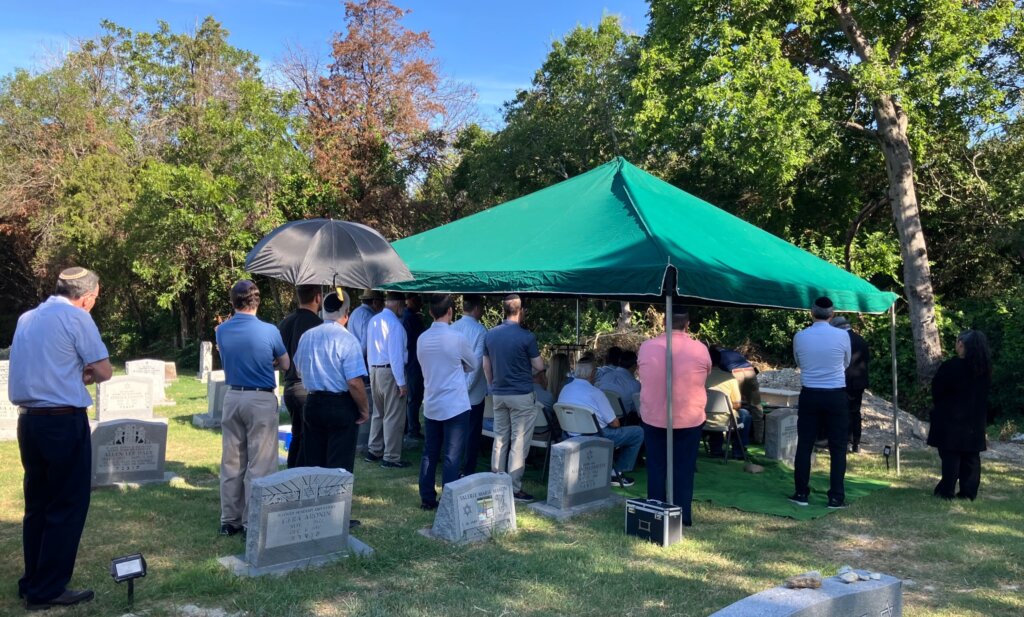
It was only after her Jewish funeral Sunday that many in Dallas learned that Rose Renfroe, an upstart in Democratic city politics, was Jewish.
“Rose was forgotten as a Jew for the majority of her life,” said Hannah Lebovits, a member of the Dallas burial society who organized the minyan for the funeral.
The funeral of Rose Renfroe, former member of the Dallas City Council, on June 30, 2024 Courtesy of Hannah Lebovits
Renfroe — or Rose bat Eliezer as the rabbi who officiated called her — had been considered anything but Jewish well before and long after 1975, when, running for Dallas City Council on an anti-busing platform, she beat a seemingly entrenched incumbent.
A local reporter, profiling her after that win, described her as “one of the least pretentious and most genuine politicians I’ve met in years,” but also as the product of a “Baptist upbringing” and graduate of a Dallas Baptist College. Though Renfroe did graduate from a Baptist college, she was the daughter of two Jews. She thought of herself as Jewish too, said her Jewish daughter, Rena Renfroe.
Others likely thought Rose Renfroe was Catholic. She was married to a Catholic man, and many years after losing reelection to the council, ran twice for Dallas County Commission, in 2002 and 2006, under the name “Rosita Renfroe.” Critics accused her of trying to pass herself off as something she wasn’t to appeal to an increasingly Latino electorate. Renfroe responded that “Rosita” was what her husband called her.
She had a plot next to his in a non-Jewish cemetery. But before she could be interred there, Rena Renfroe contacted Jewish Family Services of Greater Dallas and told them her mother had wanted a Jewish burial in a Jewish cemetery. They made that happen.
Rose Renfroe was buried in Dallas’ Tiferet Israel-Agudas Achim Cemetery, a week after she died at 81, and after a chevra kadisha, or burial society, had prepared her body according to Jewish law.
“I thought it was so beautiful,” said Rena Renfroe, 64. “I thought it was the best service I’ve ever been to in my life.”
And it set the record straight, said Lebovits, who is a contributing columnist at the Forward. “It’s really important, especially in Texas, to know that Jewish people have contributed civically to this dominant Christian society.”
She added: “We really need to investigate and think about why Rose spent decades of her life not being publicly Jewish.”
Who was Rose Renfroe?
Beri Kaplan Schwitzer, executive director of Dallas Jewish Historical Society, who I called the day after Renfroe’s funeral, had heard of Renfroe but did not know she was Jewish. After a few hours of research, she was able to tell me more about her. Rena Renfroe and Lebovits also shared some Renfroe family history.
Rose Renfroe’s father, Elmin Hymon Minsky, was born in Belarus. He is buried with Rachel Minsky —Renfroe’s mother — in Dallas’ Shearith Israel Memorial Park.
In the 1970s, Rose Renfroe worked as a secretary for the local AFL-CIO, and in 1975 ran to represent District 1 on the city council. The district’s Oak Cliff neighborhood, Renfroe said on the campaign trail, had been treated like a “stepchild since it’s been annexed to Dallas.”
She said she resented that her daughter might as part of desegregation efforts be bussed away from the school to which the family had planned to send her. Renfroe’s campaign cost only $5,000. But her anti-busing platform appealed to white working class voters who liked her style, which Nancy E. Baker, a history professor at Sam Houston State University in Huntsville, Texas, described as “brash,” “populist” and “controversial.”
Renfroe served a term and lost reelection in 1977, and then lost another council race in a different district — to Annette Strauss, a Jewish woman who was deeply involved in the Jewish community. More losses followed with Renfroe’s bids for county commissioner, when she ran as “Rosita.”
It’s not clear why Renfroe did not acknowledge her Jewishness more publicly. Schwitzer said she could find no record of her affiliating with a synagogue, community center or other Jewish institution.
“I had no idea she was Jewish,” Janice Schwartz, a member of the burial society who is active in Democratic politics, told me.
Despite antisemitism, Jews held prominent positions in public life when Renfroe was running for office. Dallas voters have elected three Jewish women as mayor: Adlene Harrison in 1976, Strauss in 1987 and Laura Miller in 2002.
Though Renfroe’s brand of politics lost appeal within her party, her daughter remembered her as warm-hearted and tolerant.
“She was always trying to do something to help people,” Rena Renfroe said. “No matter the religion, no matter the color, no matter what, my mom had an open door policy to anybody and everybody.”
Paula McKinney, a friend of Renfroe who wrote about her in the wake of her death, recalled that she considered the neighborhood children “her kids,” and often invited them to watch the Dallas Cowboys play, eat pizza, and celebrate Thanksgiving in her home.
About 25 people attended Renfroe’s funeral.
“We had really, a very nice, very warm turnout,” said Rabbi Howard Wolk of Jewish Family Services, who presided. “The family was very much touched that people who did not know her mother came in order to pay final respects.”
The post A former Dallas city councilwoman just died. Almost no one knew she was Jewish. appeared first on The Forward.
The post A former Dallas city councilwoman just died. Almost no one knew she was Jewish. first appeared on The News And Times.
On July 2, the U.S. Food and Drug Administration (FDA) approved a new drug for treating Alzheimer’s disease. Donanemab, or Kisunla, is the third drug approved to target one of the causes of Alzheimer’s: the buildup of amyloid protein in the brain. Based on the data provided by the drug’s manufacturer, Eli Lilly, for the FDA to review, it’s the most effective drug yet in slowing cognitive decline associated with the disease.
[time-brightcove not-tgx=”true”]
Studies reviewed by the FDA showed that the drug slowed progression to the next more-advanced stage of the disease by 39%, which translates to anywhere from four to seven months longer during which people can be more independent and function without extensive support from caregivers. Over that period, those receiving donanemab showed about 40% less decline in their ability to perform daily tasks such as keeping appointments, making meals, and using household appliances.
By comparison, lecanemab (Leqembi), made by Eisai and approved in Jan. 2023, can slow cognitive decline by 27% compared to a placebo over 18 months. The makers of the other amyloid-targeting drug, aducanumab (Aduhelm), which in 2021 became the first such medication approved, decided to remove it from the market by the end of 2024.
Donanemab’s effectiveness likely comes from its ability to specifically target the toxic plaques of amyloid that accumulate in the brain and strangle nerve cells until they eventually shrivel away. The drug is a monoclonal antibody that seeks out a portion of the amyloid protein that develops over time in the brain. “After it sits in the brain, like cholesterol, it builds up over time and changes,” says John Sims, senior medical director at Lilly. “Donanemab is very purposefully built with the postal codes for amyloid specific to brain plaques. That’s why, as far as we know today, donanemab is probably the most effective plaque-clearing antibody out there.”
Read More: What to Do If You Can’t Afford Your Medications
Another feature that sets the drug apart is that it was designed as a finite treatment, similar to the way cancer therapies are used, to aggressively remove amyloid plaques over a certain period of time after which patients can stop taking it. Doctors can then monitor patients for any signs of re-accumulation of amyloid. If those deposits build up again and hit a certain threshold, patients would start getting the drug again.
In studies the company presented to the FDA, after 18 months on the drug, nearly 70% of people no longer showed visible signs of amyloid in their brain scans.
That’s not to say it won’t come back; it likely will. “I think to get from a negative amyloid state to the lowest level of amyloid might take on average four years, but we have ongoing studies to study that,” says Sims. “Right now, we don’t know how best to take care of people whose amyloid comes back—it’s an unanswered question.”
The panel of experts the FDA convened earlier in June agreed that there was not enough data yet to provide specific advice to doctors about if and when to stop donanemab treatment, but the label on the drug does allow doctors to consider stopping donanemab if the drug successfully clears amyloid and the plaques are no longer detectable on patients’ brain scans.
That reflects a potentially new direction for Alzheimer’s treatments that wasn’t possible before drugs like donanemab were able to remove most of the damaging plaques from patients’ brains. Dr. David Hyman, chief medical officer at Lilly, says the company plans to continue studying people who have stopped donanemab after clearing it from their brains to get a better understanding of how quickly the protein starts to re-accumulate, and to determine when patients might need to start getting the drug again. Lilly will also study patients who were not able to clear their amyloid during the 18-month study period and learn more about whether different patients might need different treatment cycles.
Potentially shorter cycles of treatment could also save patients and insurers money. Lilly says a six-month course will cost about $12,500, a year’s treatment $32,000 and 18 months of infusions $48,696. About 17% of the patients in the company’s studies no longer showed visible amyloid in their brain scans after six months, about 47% at 12 months and 69% at 18 months.
Donanemab has another advantage over the existing approved treatment. While patients get infusions of lecanemab twice a month, they only need one infusion a month of donanemab. “For elderly patients who are most likely eligible for this drug, and their caregivers, it’s a significant reduction in burden having an infusion once a month vs. twice a month,” says Dr. Howard Fillit, founding executive director and chief science officer at the Alzheimer’s Drug Discovery Foundation.
Eventually, treatments like donanemab could and should be used even earlier in the disease, as amyloid starts building up but before patients experience cognitive problems. Among people in Lilly’s study at the earliest stages of Alzheimer’s, the drug was linked to an up to 60% slowing of cognitive decline, and Sims says that models from his scientists estimate that donanemab could lead to as much as 90% slowing of cognitive decline, if it’s started in patients early enough. “The overwhelming lesson from our dataset is that the earlier you identify a patient and give them treatment, the bigger impact you can have,” says Dr. David Hyman, chief medical officer for Eli Lilly. “Where the field is going, and where we are going with donanemab, is evaluating it as a preventive therapy. We are moving to care for healthy people rather than treatment for sick people.”
Read More: The Vaccines You’ll Need This Fall and Winter
Identifying patients who don’t yet have symptoms remains a challenge, however, especially since current methods such as PET scans and spinal fluid tests are expensive and invasive, and not accessible to many older patients. “We have a lot of work to do as a field to close the last-mile care gaps in this patient population,” says Hyman. “My biggest concerns are—can we identify patients early enough in the course of their disease, can we have a physician workforce that is trained in administering these medicines, do we have the infusion capacity to treat patients who can benefit, and can we monitor these patients [with brain scans]?”
Finding better ways to track markers of Alzheimer’s proteins, such as in the blood, could be critical to expanding use of the new treatments. In its studies submitted to the FDA, Lilly relied on a blood test for identifying people as early as possible—sometimes even before they are even aware they might have Alzheimer’s—using another Alzheimer’s related protein called tau. Lilly is collaborating with Roche to make the test more available to doctors who can order it as a way to find patients most likely to benefit from donanemab. Amyloid blood tests could similarly help doctors to monitor patients and inform their decisions about when to stop donanemab and when patients might need to start infusions again when amyloid starts to re-accumulate. These tests are not fully approved by the FDA are currently available on a limited basis to doctors who order them to help make treatment decisions for their patients. While the FDA’s expert committee discussed the utility of tau testing, they decided not to recommend it as a requirement for prescribing the drug, since the test’s limited availability might further restrict patients’ access to donanemab.
In coming years, Alzheimer’s experts also anticipate that simply targeting amyloid won’t be enough. Amyloid-based treatments do come with serious side effects, including bleeding and inflammation in the brain. That’s why anyone taking these drugs, including donanemab, need to get regular MRIs to monitor for signs of trouble. The risk is manageable, however, and doctors can taper down the dose or stop infusions for short periods.
More effective treatments will also become necessary, since not everyone improves on amyloid-targeting drugs. Amyloid, tau, and another protein, alpha synuclein, are all involved in the disease somehow, and targeting each in different ways in different patients will be key to a more comprehensive treatment for the disease. “Anti-amyloid treatments might help some people, but some people might break through and continue to progress,” says Sims. “Hopefully in the future doctors will be able to say, ‘You need an amyloid treatment, or maybe some tau therapy, or even alpha synuclein therapy.’ Ideally, they would tailor treatments to people’s disease.”
These are issues Alzheimer’s doctors have never wrestled with until now, because there haven’t been effective treatments that could remove toxic proteins in significant ways. But with better therapies like donanemab, monitoring patients for changes in the levels of those proteins will become more of a priority.
Federal health officials are investigating a possible death and dozens of illnesses tied to recalled “microdosing” candies laced with a chemical found in mushrooms and sold online and in vape shops nationwide.
At least 48 people in 24 states said they got sick after eating Diamond Shruumz-brand products, including chocolate bars, cones and gummies, the U.S. Food and Drug Administration said Tuesday.
[time-brightcove not-tgx=”true”]
One death is “potentially associated” with the outbreak and 27 people have been hospitalized, the agency said. People who fell ill reported severe symptoms like seizures, agitation, abnormal heart rates and loss of consciousness. The latest illness was reported Monday, FDA officials said.
Prophet Premium Blends LLC, of Santa Ana, California, recalled all of its Diamond Shruumz products late last month because they contain muscimol, a psychoactive chemical found in potentially toxic Amanita mushrooms that may be tied to the illnesses.
The products are marketed for microdosing, which means taking very small doses of a psychedelic drug to achieve supposed benefits while minimizing negative side effects.
Diamond Shruumz products were sold nationwide in retail stores and online; at smoke or vape shops; and by retailers that sell hemp-derived products like cannabidiol, or CBD, or delta-8 THC.
The FDA, the U.S. Centers for Disease Control and Prevention and America’s Poison Centers are investigating the outbreak. People who have these products should stop using them. Anyone who falls ill after using them should contact a health care provider or a poison center at 1-800-222-1222.
Detroit — U.S. new-vehicle sales rose only slightly in the second quarter, despite larger discounts and slightly lower prices.
But brisker sales could be on the horizon: Auto industry analysts say they expect prices to drop further and there’s a possibility of interest-rate cuts that would make taking out a loan for a new vehicle more affordable.
[time-brightcove not-tgx=”true”]
Overall, U.S. sales were up only 0.1% compared to a year ago, as still-high prices kept many potential buyers out of the market, according to preliminary tallies Tuesday by Motorintelligence.com.
Sales were crimped in late June, when cyberattacks knocked out software from CDK Global that dealerships use to do sales paperwork. CDK said most dealers were back up by Tuesday afternoon, but companies such as General Motors said the problem pushed some deliveries into the third quarter.
Analysts say inventories on dealer lots are building, especially for pickup trucks and other higher-priced vehicles.
Discounts vary by demand for vehicles, with smaller, less-expensive models and gas-electric hybrids generally being in shorter supply. Many customers are delaying purchases, figuring that bigger discounts are coming.
“Waiting may be the optimal strategy here,” said Cox Automotive Senior Economist Charlie Chesbrough.
Toyota, which sells many popular gas-electric hybrids, posted a 9.2% sales increase from April through June. Honda sales were up 2.7%, while General Motors posted just a 0.3% gain and Hyundai reported a 1.8% increase. Subaru had a 5.4% sales gain.
Sales at Stellantis fell 20.7% in the second quarter, with the Ram brand off 26% and Jeep sales falling 19%. Nissan sales fell 3.1%, while Kia was down 1.6%.
Together, automakers reported selling roughly 4.13 million new vehicles from April through June. That’s on pace to reach forecasts of nearly 16 million for the year, a little above last year’s 15.6 million.
Ivan Drury, director of insights at Edmunds.com, said interest rates for new vehicles are averaging just above 7%, a high number for people who bought or leased vehicles years ago but now find they need to replace their rides.
Many, he said, are going for what few lower-priced vehicles remain in the mid- to upper- $20,000 range.
“The stuff that’s very affordable, that’s where it’s at,” said Drury. “You really have to have an attractive product at an attractive price for it to move today.”
For instance, sales of the Chevrolet Trax compact SUV, which starts at $20,400 excluding shipping, were up 152.7% during the quarter.
Kevin Roberts, director of analytics for the CarGurus auto site, said automakers want to keep making higher-profit SUVs and trucks when a big chunk of buyers are after less-expensive vehicles such as compact sedans.
“You’re seeing people search more and more for affordable vehicles. You’re seeing people searching for under $30K,” Roberts said.
The U.S. industry, he said, is at an inflection point where automakers will have to add discounts to get the prices down, or they’ll have to change what they produce to “try to get more attractive price points and try to keep those inventory levels lighter.”
A move toward lower prices, though, could hurt Detroit automakers, which exited the lower-priced small and midsize sedan markets years ago after having trouble making money on the vehicles.
Ever since the coronavirus pandemic began early in 2020, autos have been in short supply as a shortage of vital computer chips hobbled production. Coupled with strong demand, the lack of cars drove average prices to a peak of near $50,000 by December of 2022.
But this year, chip supplies improved, production is up and supplies are on the rise. In June, dealers had about 3 million vehicles in stock, 55% more than a year ago, according to Cox.
As a result, average selling prices dropped 1% to about $48,400 last month. That’s 3% below than the peak of near $50,000 in December of 2022 but still 20% higher than before the pandemic.
Of the vehicles that sit on dealer lots the longest, all are big pickups or SUVs made by Detroit automakers. Stellantis’ Ram 1500 tops the list, remaining at dealers for 141 days, CarGurus said.
Deals can be had on vehicles that sit on lots longer, Roberts said. For example, 6% of national dealer new vehicle sales listings are from the 2023 model year.
Earlier Tuesday, Tesla reported that its second-quarter global sales fell 4.8%, with a 6.6% decline in the first half of the year. The company doesn’t break out U.S. sales. Ford releases its sales numbers on Wednesday.
Weak mag. 2.4 earthquake – 7 km SSE of Maria Antonia, Puerto Rico, on Tuesday, Jul 2, 2024, at 06:40 pm (Puerto … VolcanoDiscovery
The post Weak mag. 2.4 earthquake – 7 km SSE of Maria Antonia, Puerto Rico, on Tuesday, Jul 2, 2024, at 06:40 pm (Puerto … – VolcanoDiscovery first appeared on The Puerto Rico Times – The News And Times.