Categories
Sites

Texas House Bill 614’s Impact on HOA Transparency


“It’s a lack of clarity that creates chaos and frustration. Those emotions are poison to any living goal.” ― Steve Maraboli, Life, the Truth, and Being Free

Maraboli’s quote is an excellent reflection of HOA (Homeowner Associations) communities where members have struggled to understand their HOAs rules and regulations and have been penalized as a result.

Many times, this is due to a lack of clarity—not being aware and not understanding what HOA guiding documents require of them as homeowners. And it’s this lack of clarity or transparency that also conflicts with an HOAs’ goal of achieving a harmonious and happy community.   


Table of contents


Well, the introduction of Texas House Bill 614 puts clear communication as a top priority for HOAs in Texas for the betterment of homeowners; and it will have a huge impact because Texas has:

  • 22,300 HOAs
  • 6,122,000 people living in HOA communities, over 20.6% of its population
  • 2,203,000 homes in HOAs

source: Foundation for Community Research

So, let’s learn more about Bill 614 starting with the important role HOAs play in their communities and why clarity and transparency from HOAs are so important.  


HOAs run community operations

HOAs hold a lot of power in their communities because they oversee the running of the operations, guided by their HOA guiding documents, to make the community operate as smoothly as possible.

HOAs are composed of elected volunteers living in the community, called board members, who establish and enforce rules and regulations in a planned community, and homeowners in the HOA community agree to abide and be governed by the terms of their HOA.

Therefore, how an HOA manages a community—good or bad—directly impacts members. So it’s clear that the HOA and the guiding documents it uses must make sense to the homeowners who have to live under their governance.

The fact is, HOA guiding documents can be hard to understand or unclear, especially from a legal standpoint, which leads to HOAs delivering expensive fines to unsuspecting homeowners when rules have been broken.   


The complexity of HOA guiding documents

Once members agree to live in a planned community, they must adhere to the guiding documents their HOA uses to oversee the community. Sometimes, those documents can include legal terminology or are written in such a way that the intended meaning is unclear.

HOA guiding documents include:

Federal, state and municipal laws

These laws supersede all other HOA governing documents, so if any laws are added or amended that affect HOAs and their members, all other guiding documents must fall in line with them.

Bylaws 

Bylaws detail the internal workings of the HOA, covering topics such as board member elections, meetings, powers, and responsibilities. As the organization’s guidebook, bylaws establish the HOA’s structure and operational procedures. 

Articles of Incorporation 

Filed with the state, the Articles of Incorporation establish the HOA as a legal entity. These articles define the HOA’s purpose, location, and basic structure, which is fundamental to its legal standing. 

Rules and Regulations 

Rules and regulations provide specific details on day-to-day matters, addressing issues like noise restrictions, pet regulations, and the use of shared areas. These rules complement the broader guidelines set by the CC&Rs, ensuring a smoothly functioning community. 

Architectural Guidelines 

Architectural guidelines set standards for home construction, renovations, and external appearances. These rules contribute to the overall aesthetic appeal of the community, promoting a consistent and pleasing environment. 

Homeowners and HOA board members must sort through, understand and adhere to these governing documents because they provide the foundation for a planned community and all homeowners who live there must comply.  


Wading through the black and white of HOA Rules

As you can see, there is a ton of content in HOA guiding documents, with a lot to reference and cross-reference to other documents and that refer to a myriad of rules pertaining to:

  • Parking
  • Garbage removal
  • Pets
  • Unapproved architectural changes
  • Landscaping
  • Noise
  • Home rentals
  • And more…

All of the above and other topics can lead to violations and levied fines if the rules aren’t followed.

And, let’s be honest, do all members fully know of and understand all the stipulations in HOA guiding documents?  

Judging by the large number of violations and fines, starting from $100 and up, handed out by HOAs to tens of thousands of homeowners every year, the answer is no.  

It’s not always a case of willful disobedience though, but rather members are not aware or do not understand all the ways they can be in violation of HOA guiding documents and their rules.

Well, the state of Texas must have taken note of this because here comes help in the form of House Bill 614.


Texas House Bill 614: Balances power between HOAs and homeowners

To help address the problem of homeowners not being aware, or unclear about HOA rules, how they may have broken them, and what the financial penalties are, Texas passed house bill 614, in January 2024.

Bill 614 aims to bring clarity to homeowners, by making HOAs present violation-related information more clearly, to both educate homeowners and increase transparency—ultimately reducing the number of violations committed and fined.    

Here’s what the Bill requires.  HOAs in Texas must create a policy that gives property owners a clear and better understanding of what the violations are, and the fines attached to them.  


House Bill 614 requirements   

HOAs must provide to homeowners and residents:

  1. General categories of violations
  2. Fine schedule (monetary penalties related to various offenses)
  3. Hearing information (a formal process where details of the violation can be determined and resolved)
  4. Access to the policy posted on the internet and delivered to members (annually via first class mail or email)

Essentially, rules and regulations will come to the forefront of homeowner attention.


Texas HOAs Putting Bill 614 into action

A good HOA looks out for the benefit and welfare of the community. HOAs in Texas can keep this as a priority and will start by:

Adopting Bill 614
Create a policy that outlines the process of imposing and collecting fines for HOA violations.   

List fines
Create a list of fines for each category.

Post policy
Publish the new policy on the HOA website and deliver copies to property owners by hand, mail or email.

HOAs can get some assistance delivering on these requirements with tools to help spread the word.


Helpful tools to facilitate Bill 614

Communication is a constant challenge for HOAs. It’s not easy ensuring homeowners have all the information they need when they need it. So, many HOAs use community management software to make sure important information is available to members.

For example, in the case of Bill 614, HOAs can implement communication software solutions to build stronger connections with HOA owners by creating a digital file library where homeowners can easily access the new policy, list of fines for each category and fine category.

The documents can be accessed through any digital device, including mobile phones, which most people carry with them every day. By keeping rules and associated documents in a centralized document storage space, members will have access to the information they need when they need it and HOAs can demonstrate they are meeting the transparency goal of Bill 614.   

Printed copies are mandatory per the Bill, but they can still be misplaced, damaged, or thrown out.


Greater accountability for HOAs and fairness for Members

Approximately 6,138,000 Texans live in 21,680 community associations (Community Associations Fact Book 2022). With a growing population in Texas and more people looking to buy homes in HOA communities, Bill 614 allows prospective and current HOA homeowners to get a clearer picture of what and how rules and regulations can impact their lifestyle and their finances.

HOAs in Texas must make it as plain as possible to homeowners and residents what their rules and regulations are while making the information accessible and clear.

The post Texas House Bill 614’s Impact on HOA Transparency appeared first on Condo Control.

The post Texas House Bill 614’s Impact on HOA Transparency first appeared on The Condo Law.


Categories
Sites

Common apartment rules


Apartments and multi-family buildings are quite similar to condos. The biggest difference is that an apartment is typically owned by one landlord and units are rented out to tenants, whereas owners can purchase individual units in a condo development. Apartments don’t have an elected board of directors, either. Instead, rules are created and enforced by the landlord or property management team. 


Table of contents


Tenants who live in multi-family buildings must follow the rules established by the landlord, as well as local and state laws. Similarly, landlords are required to follow laws that govern and regulate residential rentals and must also comply with local health, building and safety codes. Any repairs required to make the dwelling fit to live in must be paid for by the landlord.

Below are some common rules that apply to landlords and tenants. It’s important to note that landlord rights and obligations vary depending on the state and county you live in. Always check local and state laws, and consult with an attorney if you ever have doubts or questions. 


Maintenance

It is the landlord’s responsibility to maintain units in an apartment or multi-family building. That means looking after electrical wiring, heating, flooring, countertops, windows, etc. Landlords must comply with this obligation, even if:

  • The tenant was made aware of problems in the unit before they moved into it
  • The lease says that the tenant is responsible for maintenance

However, tenants are responsible for keeping the apartment clean. They are also responsible for any damage to the rental property caused by them or by their guests. For example, if they put a hole in the drywall, or clog a sink, then they must pay for those repairs.

Landlords are strongly encouraged to address and resolve any maintenance or service requests as soon as possible. Having a property management platform with a service request feature can simplify and expedite the entire process.

Tenants are not permitted to withhold rent even if they are unhappy with how long it’s taking for their request to be closed. Any serious disputes between a landlord and tenant should be brought to a court or body that governs landlord-tenant issues.


Deposits

Landlords can ask tenants for a security deposit as part of the lease agreement. This deposit would be held by the landlord to cover unpaid rent, damages, or cleaning fees if the tenant moved out suddenly and failed to pay a month’s rent, or if they did not properly care for the unit. The deposit is returned to the tenant when they move out – if the unit is clean and intact.

The amount of the security deposit is often equal to one month’s rent. However, in places like Illinois, there is no legal limit on the amount a landlord can require (but some municipalities specify by local ordinance the minimum or maximum security deposit amount).

In California, there is a maximum amount of money a landlord can charge a tenant for a security deposit, but it’s calculated based on whether a unit is furnished. For unfurnished units, landlords can’t charge more than two months’ worth of rent. For furnished rentals, they can’t charge more than three months’ worth of rent.

The Illinois Security Deposit Return Act requires landlords to return a security deposit in full within 45 days of the date their tenant moves out if:

  • The building or complex consists of five or more units
  • The tenant does not owe any back rent
  • The unit has not sustained damage
  • The unit is reasonably clean (no garbage or furniture left behind)

In Illinois, if a landlord cannot return some or all of the security deposit, they must give the tenant an itemized statement of how the deposit was spent, along with paid receipts within 30 days of the tenant moving out. Landlords must have a valid reason for keeping a deposit. If a court finds that a security deposit law has been violated, the landlord could be liable for damages in an amount equal to two times the deposit, plus court costs and attorney fees.

In California, landlords only have 21 days to return security deposits.  

Depending on where they live, landlords may also be required to pay interest on security deposits. Those in Illinois, for example, must pay interest if a deposit is held for at least six months and there are at least 25 units in the building or complex that the landlord owns. The landlord must either pay the interest to the tenant or apply the interest as a credit to the occupant’s rent every 12 months.


Collecting rent

Landlords are entitled to collect rent, in full, on the day that it is due. The due date should be clearly stated in the lease agreement, but most people will use the 1st of each month.

Landlords must provide tenants with a receipt for rent paid upon request. If a cash payment is made, they should provide a receipt, even if the tenant doesn’t request it.

Landlords cannot usually make tenants submit post‐dated checks or automatic debit payments. Under California law, it’s illegal for a landlord to require cash or electronic deposits as a sole payment option. Landlords must allow tenants to pay rent using checks, cashier’s checks or money orders. There is an exception to this rule though: if a tenant’s check bounces—or a request is made to stop payment on the check—then the landlord can require rent to be paid only in cash for up to three months. But, the landlord must give notice to the tenant in writing that rent must be paid in cash, as well as provide the tenant with some record of the bounced or cancelled check.

Landlords do not have to give tenants a grace period for rent, but may include it in the lease agreement if they choose to do so. If a grace period is in the lease, it should clearly state the date on which a late fee will be charged.

An online payment option is often preferred by tenants and landlords. Not only is it more convenient, but it has been shown to reduce late payments too.


Increasing rent

Landlords cannot raise the rent when a tenant is on a fixed-term lease. If a tenant has signed a one-year lease, then the landlord cannot raise the monthly rent midway through the tenancy.

However, if the tenant is renting month-to-month, either because they never signed a lease agreement or the agreement expired, the landlord can raise the rent.

Landlords must give written notice before increasing rent. In most cases, the landlord is required to give at least 30-days notice, but it can be more depending on local and state laws. Notices must be in writing.

In some states such as Florida, there is no limit on how much a landlord can raise the rent. Landlords must provide tenants with advanced written notice stating how much the rent will increase, when the increase comes into effect, and how the renter can submit payment. They must also be careful not to raise the rent too much, or they will have trouble attracting/keeping good tenants.

In New York City, the NYC Rent Guideline Board sets a cap on how much a landlord may increase rent, provided the building is protected by rent control.


Pets

Some landlords are within their right to issue a blanket ban on pets. This policy must be made very clear to prospective tenants as most would not want to have to choose between an apartment or their beloved pet. Keep in mind that service animals cannot be banned from a building.

In Ontario, Canada, a landlord cannot reasonably refuse pets. Even if a renter signs an agreement that states “no pets,” the clause would be considered void because it goes against section 14 of the Residential Tenancies Act. Of course, there’s always an exception to the rule. A landlord could rightfully ask a tenant to get rid of their pet if:

  • The landlord is severely allergic to the animal
  • The pet causes unreasonable damage to the unit
  • The animal is a constant nuisance to others; or
  • The pet has endangered or is likely to harm another tenant


Asking a tenant to move out

In some cases, when a lease agreement expires, a landlord and tenant will collectively decide to renew a long-term lease agreement or make a new one. If this doesn’t happen, then the lease automatically becomes a month-to-month lease.

However, if a landlord wants the tenant to move out at the end of the lease period, they can ask the renter to leave – provided they take the right steps. Asking a renter to move out when the lease is up is sometimes referred to as a no-fault eviction. 

In Illinois, leases running year-to-year require a 60-day written notice from the landlord if they want the tenant to move out when the lease is done.

Notice periods can range from 30 days to 120 days, depending on the location and the particulars of the situation.

Evicting a tenant before the lease is up is a much different process. Landlords must seek permission to remove a tenant from a governing body or a court.  

The landlord must have a valid reason for terminating a lease early. A landlord may successfully gain approval to evict a tenant if:    

  • The tenant consistently makes late payments
  • The tenant has violated the lease agreement
  • The tenant is conducting illegal activity in the unit

Landlords cannot physically remove tenants from the property, even if they have failed to pay rent for several months or have been ordered to move out of the unit. Instead (if this is applicable in your county), take the writ of possession to a local sheriff or constable to schedule a move out date. The officer can forcibly make a tenant leave, and help the landlord change the locks so that the individual cannot re-enter the unit. If the situation gets really bad, they may even be able to help the landlord file for a “failure to vacate” judgment. This could lead to a misdemeanor on the tenant’s record.


Tenant requesting to move out

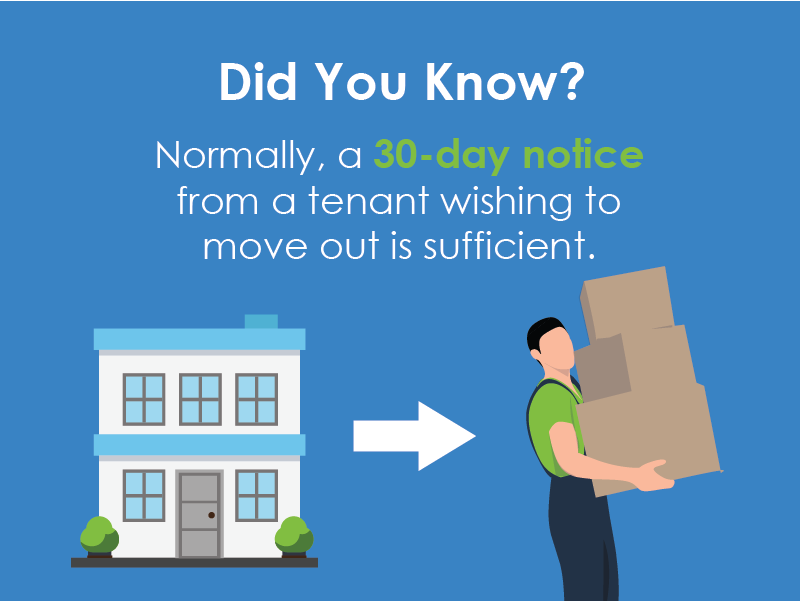
If the tenant decides they do not want to renew the lease after it expires, they have the right to move out. Most tenants can provide landlords with 30 days’ notice prior to the date of lease termination. However, some states require more than 30 days’ notice. Alternatively, the landlord may include how much notice is required in the lease agreement.

For month-to-month agreements, tenants must give landlords anywhere from 30 to 90 days’ notice. Tenants must give their landlord formal written notice. It is best to mail the notice by certified mail with a return receipt, but letters can also be hand delivered.

After being notified of a tenant’s plan to move out, the landlord has the right to show the unit to prospective tenants. In most cases, the landlord must notify the current tenant about the showing at least 24 hours in advance.

Tenants who wish to move out before a lease expires may still have to pay rent for the remainder of the lease. A landlord can include a clause about what happens if a renter wishes to terminate a lease early in the lease agreement.


Conclusion

Apartment rules help ensure landlords and tenants have a good experience. Some rules come from the state or county, while others are created by the landlord or building management company. It’s in both parties’ best interest to know and follow the rules that apply to them.

The post Common apartment rules appeared first on Condo Control.

The post Common apartment rules first appeared on The Condo Law.


Categories
Sites

Letter to U.S. House AI Task Force: Support a Pro-Innovation Framework for Artificial Intelligence – American Legislative … – American Legislative Exchange Council


The post Letter to U.S. House AI Task Force: Support a Pro-Innovation Framework for Artificial Intelligence – American Legislative … – American Legislative Exchange Council first appeared on JOSSICA – The Journal of the Open Source Strategic Intelligence and Counterintelligence Analysis.


Categories
Sites

Head of Canada’s intelligence agency says Chinese government can access TikTok user data – The Verge


The post Head of Canada’s intelligence agency says Chinese government can access TikTok user data – The Verge first appeared on JOSSICA – The Journal of the Open Source Strategic Intelligence and Counterintelligence Analysis.


Categories
Sites

Valley hospital now using AI to diagnose strokes and seizures – KTAR.com


The post Valley hospital now using AI to diagnose strokes and seizures – KTAR.com first appeared on JOSSICA – The Journal of the Open Source Strategic Intelligence and Counterintelligence Analysis.


Categories
Sites

Canada’s Security Intelligence chief warns that China can use TikTok to spy on users, CBC reports – Marketscreener.com


The post Canada’s Security Intelligence chief warns that China can use TikTok to spy on users, CBC reports – Marketscreener.com first appeared on JOSSICA – The Journal of the Open Source Strategic Intelligence and Counterintelligence Analysis.


Categories
Sites

Putin and Xi embrace defying U.S.-led pressure against China helping Russia – NPR


The post Putin and Xi embrace defying U.S.-led pressure against China helping Russia – NPR first appeared on JOSSICA – The Journal of the Open Source Strategic Intelligence and Counterintelligence Analysis.


Categories
Sites

handmade blue tiles add pops of color to nearby house’s facade in iran – Designboom


The post handmade blue tiles add pops of color to nearby house’s facade in iran – Designboom first appeared on The South Caucasus News.


Categories
Sites

Scoop: U.S., Iran held talks this week on avoiding more attacks – Axios


The post Scoop: U.S., Iran held talks this week on avoiding more attacks – Axios first appeared on The South Caucasus News.


Categories
Sites

Armenian, Austrian foreign ministers discuss the course of the Armenian-Azerbaijani negotiations – ARMENPRESS


The post Armenian, Austrian foreign ministers discuss the course of the Armenian-Azerbaijani negotiations – ARMENPRESS first appeared on The South Caucasus News.