
Day: May 17, 2024
On 17 May, as part of his state visit to Azerbaijan, Belarusian President Aleksandr Lukashenko together with Azerbaijan President Ilham Aliyev visited the country’s territories, being rebuilt after the conflict.
In the morning, Aleksandr Lukashenko flew to Fuzuli. He was met by Ilham Aliyev at the airport. The President of Azerbaijan briefed his Belarusian counterpart on the works carried out to restore and develop these territories and build new infrastructure facilities. Aleksandr Lukashenko got familiar with the new airport, and the heads of state accompanied by an impressive motorcade headed for the city.
Aleksandr Lukashenko and Ilham Aliyev toured the city, saw destroyed facilities and prospective areas for development. The Presidents traveled along the route in one car, with the Azerbaijani leader behind the wheel.
Aleksandr Lukashenko got familiar with the expositions depicting the pace of the reconstruction of the destroyed sites. After that, the two leaders headed for Shusha.
The heads of state visited the residential area of the city, examined housing conditions, memorial sites and museum and exhibition exposition on Heydar Aliyev’s activity. Aleksandr Lukashenko and Ilham Aliyev also inspected tractor equipment presented to the city by the President of Belarus.
“Use them. If you like them, we will add more,” the Belarusian head of state said.
There are many reminders of the city’s tragic past: some houses are unrestorable. Memorial sites and temples have been destroyed.
“Telling ruins,” Aleksandr Lukashenko said. “Restorable buildings must be fixed.”
In the city, the Presidents met the famous Soviet and Azerbaijani singer, and now the Ambassador of Azerbaijan to Russia Polad Bülbüloğlu, which came as a big surprise for Aleksandr Lukashenko.
“Polad, is this you? You are here, not Moscow?” the President said.
“This is a surprise for you!” Ilham Aliyev said.
“A gorgeous place. This is why you still sing. Air here is amazing! I recently watched a TV show starring you!” Aleksandr Lukashenko said in admiration.
Shusha has restored the house of Polad Bulbul oglu’s father, Soviet and Azerbaijani opera singer, founder of the national musical theater Murtuz Mashadi Rza oglu Mammadov, nicknamed Bulbul (“nightingale” in Azerbaijani).
Now it houses a museum dedicated to the famous performer. Nearby there is the bust of Bulbul. It was erected back in the Soviet years. Later on it was gunned down and dismantled. Until 2021, the bust was kept in the courtyard of the Azerbaijan Museum of Art, and then it was returned to Shusha.
“Those who shoot at icons and monuments are barbarians,” the Belarusian leader said.
The post Aleksandr Lukashenko, Ilham Aliyev visit Azerbaijan’s post-conflict territories | Official Internet Portal of the President of the Republic of Belarus first appeared on The Ocean Avenue News.

By Margaret Brennan, Andres Triay, Nicole Sganga, Olivia Gazis, Camilla Schick, Sam Vinograd
May 17, 2024 / 6:11 PM EDT / CBS News
The State Department on Friday issued a worldwide caution security alert, warning of “the potential for terrorist attacks, demonstrations, or violent actions against U.S. citizens and interests.”
The threat warning is a result of intelligence citing threats by ISIS against Pride events in parts of Europe, three sources told CBS News.
The State Department bulletin cites “increased potential for foreign terrorist organization-inspired violence against LGBTQI+ persons and events.” The last such global threat warning was issued in October 2023.
Friday’s alert follows one from the FBI and Department of Homeland Security last week that warned of the “potential targeting of LGBTQIA+-related events and venues.”
“Foreign terrorist organizations or supporters may seek to exploit increased gatherings associated with the upcoming June 2024 Pride Month,” it said.
June is PRIDE month with events and celebrations in much of the Western world, including the U.S.
While the State Department bulletin is meant for overseas travel, there is concern about a domestic threat from ISIS, two sources told CBS News.
An unclassified intelligence bulletin obtained by CBS News and dated May 10 says, “Since January 2024, ISIS has successfully conducted external operations in Iran, Russia, and Turkey; called for attacks against the West; and has promised to exact revenge on its enemies, which could include the LGBTQIA+ community.”
In May, the Joint Counterterrorism Assessment Team — which includes inputs from FBI, DHS and the National Counterterrorism Center — also issued guidance on violent extremist attacks, plotting and messaging against the LGBTQIA+ community. That document flagged an incident from October 2023 in which a user of a well-known U.S. video game company who publicly swore allegiance to Hamas and ISIS posted videos calling for such attacks. The guidance urged greater engagement between the LGBTQIA+ community and public safety officials.
The last significant ISIS attack was in March in Moscow, Russia.
“We continue to work with our partners to evaluate the threat environment, provide updates to the American public, and protect our homeland. We urge the public to stay vigilant and to promptly report suspicious activity to their local law enforcement,” a DHS spokesperson said in a statement Friday.
First published on May 17, 2024 / 6:11 PM EDT
© 2024 CBS Interactive Inc. All Rights Reserved.
The post State Department issues worldwide alert, warns of violence against LGBTQ community first appeared on The Ocean Avenue News.

This past week was an eventful one for Russia at war with the West. On May 7, Vladimir Putin was inaugurated for the fifth time as president of Russia in an elaborate ceremony that ended with Patriarch Kirill of the Russian Orthodox Church intoning “God willing, the end of the century will mean the end of your stay in power.” (In the year 2100, Putin would be 148.) On May 9, Russia celebrated Victory Day, where nuclear weapons were paraded, with Putin reminding the admiring crowd assembled in Red Square that, once again, Russia would defeat “Nazis,” this time in Ukraine, and prevail over the hostile West that seeks to dismember it.
After the festivities came the long-awaited cabinet reshuffle. Ever since Wagner Group leader Yevgeny Prigozhin’s failed mutiny last June, speculation about how long Defense Minister Sergei Shoigu would stay in power has grown. Shoigu has been the minister of defense since 2012, and he presided over the initial full-scale invasion of Ukraine in February 2022, which failed to achieve its objective of taking Kyiv in three days and deposing President Volodymyr Zelenskyy. Indeed, the Russian military’s poor performance for the first 18 months of the war fueled debate about how long Shoigu would stay in power. Prigozhin’s increasing attacks on both Shoigu and Chief of the General Staff Valery Gerasimov for incompetence and corruption cemented his popularity among rank-and-file soldiers and military bloggers. He led a failed coup aimed at ousting them. But it was he, and not Shoigu, who was eliminated.
Nevertheless, the recent arrest of Deputy Defense Minister Timur Ivanov, a close confidant of Shoigu, also known to be notoriously corrupt, signaled that Shoigu’s position as defense minister could be in jeopardy. Shoigu’s dismissal is the most consequential of the recent cabinet reshuffles. He will become the secretary of the Russian Security Council, replacing Nikolai Patrushev, who has served in this position since 2008. Patrushev has been named an aide to Putin responsible for overseeing shipbuilding. His son, Dmitry Patrushev, has been promoted to deputy prime minister for agriculture. It is important to remember that, in the Putin system, official titles are much less important than one’s relationship with Putin. Nikolai will no doubt retain his close ties to Putin. And Shoigu is likely to be a less influential head of the Security Council than Patrushev was.
The new minister of defense, Andrei Belousov, is, at first glance, a surprising choice. An economist by training, he has held several previous positions as an economic official, including briefly as acting prime minister. He is known to be in favor of greater state control of the economy. His appointment confirms that Russia is now on a war economy footing, corruption within the military remains rife, and there have been rising conflicts between the Ministry of Defense and the military-industrial complex. Belousov will, in effect, act as the quartermaster. He will be responsible for strengthening the war economy as well as dealing with corruption, reducing bottlenecks in the supply chains, and encouraging innovation in the military sector. He will also have to ensure that the military receives the supplies it needs and that money allocated for weapons and training will not continue to disappear into the pockets of corrupt officials. He will oversee the integration of the war economy with the rest of the economy to ensure the flow of weaponry and materiel. He will not make the key military decisions. These will continue to be made by Putin, Gerasimov, and others in the military. He accompanied Putin to Beijing this week to discuss military issues with his Chinese counterpart.
Putin’s main concern as the war with Ukraine continues is for military spending to be under control. And he realized that he needed a competent economic decisionmaker to accomplish that. Belousov’s appointment is in some ways reminiscent of Anatoly Serdyukov’s appointment as defense minister from 2007 to 2012. A former furniture manufacturer and tax official, Serdyukov’s main task was dealing with corruption and inefficiency in the ministry and reforming the armed forces after their less-than-stellar performance in the Georgia war of 2008.
Apart from these personnel changes, much remains the same. Mikhail Mishustin has been reappointed as prime minister. A technocrat who has maintained a low profile during the war with Ukraine, Mishustin’s primary responsibility will remain dealing with the economy and ensuring its continued stability and growth. The power ministries are also staying in the same hands. Sergey Lavrov, who has been foreign minister since 2004, remains in office, despite periodic rumors of his imminent retirement. The heads of the intelligence services—Sergei Naryshkin of the Foreign Intelligence Service and Alexander Bortnikov of the Federal Security Service—retain their positions (despite their intelligence failures prior to the invasion of Ukraine), as does the head of Putin’s Praetorian guard, Viktor Zolotov.
These personnel moves represent a reshuffling of a deck of cards that Putin has meticulously played over his 25 years in the Kremlin. Their message is that Putin intends to win the war with Ukraine with the help of a more efficient military and a sound economy.
The post Putin’s cabinet reshuffle: The quartermaster takes over | Brookings first appeared on The Ocean Avenue News.
WASHINGTON (AP) — President Joe Biden and former President Donald Trump on Wednesday agreed to hold two campaign debates — the first on June 27 hosted by CNN and the second on Sept. 10 hosted by ABC — setting the stage for their first presidential face-off to play out in just over a month.
The quick agreement on the timetable followed the Democrat’s announcement that he would not participate in fall presidential debates sponsored by the nonpartisan commission that has organized them for more than three decades. Biden’s campaign instead proposed that media outlets directly organize the debates between the presumptive Democratic and Republican nominees.
The debate is so unusually early on the political calendar that neither Biden nor Trump will have formally accepted his party’s nomination.
Hours later, Biden said he had accepted an invitation from CNN, adding, “Over to you, Donald.” Trump, who had insisted he would debate Biden anytime and anyplace, said on Truth Social he’d be there, too, adding, “Let’s get ready to Rumble!!!” Soon after that, they agreed to the second debate on ABC.
“Trump says he’ll arrange his own transportation,” Biden wrote on X, working in a jab about the perks of incumbency. “I’ll bring my plane, too. I plan on keeping it for another four years.”
The swiftness with which the matchups came together reflects how each of the two unpopular candidates thinks he can get the better of his opponent in a head-to-head showdown. Trump and his team are convinced the debates will exacerbate voters’ concerns about Biden’s age and competence, while Biden’s team believes Trump’s often-incendiary rhetoric will remind voters of why they voted him out of the White House four years ago.
The presidential debates, always a critical moment on the political calendar, could be particularly important in a year when voters are underwhelmed with their choices and have expressed concerns about the candidates’ advanced ages — Biden is 81 and Trump 77.
Sprightly on social media, the rivals traded barbs — each claiming victory the last time they faced off in 2020.
“Donald Trump lost two debates to me in 2020, since then he hasn’t shown up for a debate,” Biden said in a post on X. “Now he’s acting like he wants to debate me again. Well, make my day, pal.”
Trump, for his part, said Biden was the “WORST debater I have ever faced – He can’t put two sentences together!”
The June debate is likely to cap a busy and unsettled stretch, following the likely conclusion of Trump’s criminal hush money trial in New York, foreign trips by Biden to France and Italy, the end of the Supreme Court’s term, and the expected start of two criminal trials for the president’s son, Hunter Biden.
CNN said that its debate would be held at 9 p.m. ET in its Atlanta studios with no audience present in a break from recent precedent. Moderators will be anchors Jake Tapper and Dana Bash, CNN said. ABC did not offer details on where its event would be held, but the network said it would be moderated by anchors David Muir and Linsey Davis. Disagreements about moderators and rules were some of the questions that prompted the formation of the Commission on Presidential Debates in 1987.
The two campaigns and television networks had held weeks of informal talks on ways to circumvent the commission’s grip on presidential debates following years of complaints and perceived slights, according to two people familiar with the matter who spoke about internal discussions on condition of anonymity.
Biden’s campaign had proposed excluding third-party candidates, such as Robert F. Kennedy Jr., from the debates outright. Under the debate commission’s rules, Kennedy or other third-party candidates could qualify if they secured ballot access sufficient to claim 270 Electoral Votes and polled at 15% or higher in a selection of national surveys.
Both CNN and ABC announced the same qualification threshold, saying candidates will need to reach at least 15% in four separate national polls of registered or likely voters that meet their standards.
In response, Kennedy accused Biden and Trump of “trying to exclude me from their debate because they are afraid I would win.” He said, “Keeping viable candidates off the debate stage undermines democracy.”
The debates will be the first televised general election matchups to be hosted by individual networks. The 1960 debates, which helped show the power of the medium to influence public opinion, were hosted jointly by the leading networks of the day. Before the commission was formed in 1987, the presidential debates of 1976, 1980 and 1984 were organized by the League of Women Voters.
Plans for a vice presidential debate have yet to be announced.
Trump has been pushing for more and earlier debates, arguing voters should be able to see the two men face off well before early voting begins in September. He has even proposed a debate outside the Manhattan courthouse where he is currently on trial. He also has been taunting Biden with an empty lectern at some of his rallies.
In a memorandum to Biden campaign chair Jen O’Malley Dillon on Wednesday, Trump senior campaign advisers Chris LaCivita and Susie Wiles challenged Biden to agree to at least two additional debates, suggesting one be held each month, with events in June, July, August and September, in addition to a vice presidential debate.
“Additional dates will allow voters to have maximum exposure to the records and future visions of each candidate,” they wrote.
Trump later posted on Truth Social that he had agreed to a third debate, this one hosted by Fox.
“Please let this TRUTH serve to represent that I hereby accept debating Crooked Joe Biden on FoxNews. The date will be Wednesday, October 2nd. The Hosts will be Bret Baier and Martha MacCallum. Thank you, DJT!” he wrote.
O’Malley Dillon responded with a statement accusing Trump of having “a long history of playing games with debates: complaining about the rules, breaking those rules, pulling out at the last minute, or not showing up at all.”
“No more games. No more chaos, no more debate about debates. We’ll see Donald Trump on June 27th in Atlanta – if he shows up,” she wrote.
In an interview with conservative radio host Hugh Hewitt Wednesday morning, Trump had raised his own doubts about whether Biden would show, and offered his own suggestions. He said the debates “should go two hours” with both men standing, and he also pushed for larger venues.
“It’s just more exciting,” he said.
Biden’s campaign has long held a grudge against the nonpartisan commission, accusing it of failing to evenly apply its rules during the 2020 Biden-Trump matchups — most notably when it didn’t enforce its COVID-19 testing rules on Trump and his entourage.
AP Washington correspondent Sagar Meghani reports President Biden and Donald Trump appear to agree on holding a pair of debates.
O’Malley Dillon on Wednesday sent a letter to the Commission on Presidential Debates to say that Biden’s campaign objected to its proposed debate dates in the fall, which would come after some Americans begin to vote, repeating a complaint also voiced by the Trump campaign. She also voiced frustrations over past rule violations and the commission’s insistence on holding the debates before a live audience.
“The debates should be conducted for the benefit of the American voters, watching on television and at home — not as entertainment for an in-person audience with raucous or disruptive partisans and donors,” she wrote.
There also was little love lost for the commission from Trump, who objected to technical issues at his first debate with Democrat Hillary Clinton in 2016 and was upset when a 2020 debate with Biden was canceled after the Republican came down with COVID-19. The Republican National Committee had already promised not to work with the commission on the 2024 contests.
The Trump campaign issued a statement on May 1 that said of the debate schedule offered by the commission: “This is unacceptable.”
The commission said in a Wednesday statement, “The American public deserves substantive debates from the leading candidates for president and vice president.” It said its mission is “to ensure that such debates reliably take place and reach the widest television, radio and streaming audience.”
___
Follow the AP’s coverage of the 2024 election at https://apnews.com/hub/election-2024.
The post Biden and Trump, trading barbs, agree to 2 presidential debates, in June and September first appeared on The Ocean Avenue News.
This past week was an eventful one for Russia at war with the West. On May 7, Vladimir Putin was inaugurated for the fifth time as president of Russia in an elaborate ceremony that ended with Patriarch Kirill of the Russian Orthodox Church intoning “God willing, the end of the century will mean the end […]
The post Putin’s cabinet reshuffle: The quartermaster takes over | Brookings first appeared on The Puerto Rico Times – The News And Times.
WASHINGTON (AP) — President Joe Biden and former President Donald Trump on Wednesday agreed to hold two campaign debates — the first on June 27 hosted by CNN and the second on Sept. 10 hosted by ABC — setting the stage for their first presidential face-off to play out in just over a month. The […]
The post Biden and Trump, trading barbs, agree to 2 presidential debates, in June and September first appeared on The Puerto Rico Times – The News And Times.
Though gated communities are meant to establish privacy for members, there isn’t much mystery as to what these developments are. A gated community is a collection of homes that is accessible only to owners and their guests. The neighborhood is surrounded by walls or gates. There may be one or two entrances. Some communities have a guard booth with security staff to ensure only those with authorization get past the gate, while others use an automatic gate that owners can open with a key card, passcode or remote control.
Table of contents
- How to purchase a home in a gated community
- Pros of living in a gated community
- Cons of living in a gated community
Most gated communities have a name and a clear geographic definition, as marked by the barriers that control access to the neighborhood. Gated communities exist across the United States; some are very intimate while others are quite large.
All gated communities are homeowners associations. This is a requirement because the owners must be actively involved in paying for and maintaining the barriers and access points. Gated communities are intended to be pristine, exclusive and attractive. In order to keep the community that way, the owners need to pay fees. The upside to this is that HOAs usually come with a swimming pool, playground, dog park, clubhouse, and/or tennis courts.
How to purchase a home in a gated community
Purchasing a home in a gated community is similar to purchasing any other type of home. You will need to go through a formal application process and demonstrate that you are qualified to purchase the home. However, it is recommended you work with a realtor who specializes in gated community real estate since it may be harder for the average person to find and view these types of homes by themselves.
Like any HOA, a gated community can apply a screening process to deny some prospective buyers, but the decision cannot be discriminatory or violate the Fair Housing Act. A buyer cannot be denied based on their race, religion, color, sex, age, disability, familial status, or national origin.
There are a few key legal reasons for associations to deny potential buyers:
- The candidate has violated a rule outlined in the governing documents
- The candidate has a track record of violating rules and regulations in the past
- There was a misrepresentation of materials on the candidate’s applications
- The candidate has been convicted of a felony for violent crimes or crimes involving property, and their civil rights have not been restored
Screening processes and criteria for denying buyers must be written in the HOA’s governing documents.
While most gated communities are open to accepting any qualified applicant, there are some that are designated as 55+ communities. These associations are geared towards people who are 55 or older, and offer a lot of social activities that people who are retired would enjoy. 55+ communities often have a rule that 80% of members must be at least 55 years old.
Pros of living in a gated community
People choose to live in gated communities because of their exclusivity and security. Homes in these developments also tend to sell for more than homes that do not belong to a gated neighborhood.
Safety and privacy
Unsolicited visitors and strangers don’t easily make it into secured neighborhoods. That alone is reason enough for some people to invest in a home that belongs to a gated community. Gated communities with security staff also help to reduce vandalism, theft and other crimes.
The reduction in car traffic is another big sell. Streets are generally safer for kids and pedestrians who live in the neighborhood.
Access to amenities
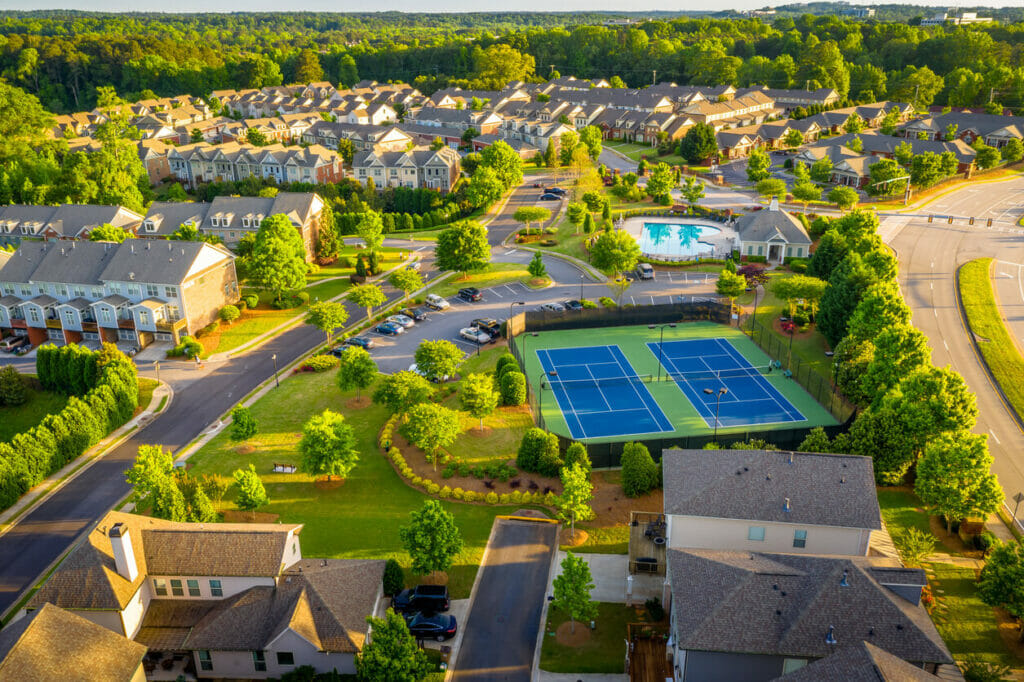
As previously mentioned, HOAs generally have amenities that are only available to owners and their guests. Amenities may include a gym, tennis court, golf course, clubhouse and pool.
Maintenance
A portion of HOA fees (sometimes referred to as dues) are used for regular maintenance and landscaping of common areas, roads, sidewalks, and curbs. This maintenance may even cover lawn care service and snow removal.
Higher resale values
Gated communities generally have higher property values. This means owners can get a higher sale price for the property if they decide to sell the home in the future. A 2018 report found that homes in gated communities sell for about $30,000 more. That number has almost certainly increased since the report was released.
Cons of living in a gated community
It will cost you more to live in a gated community. It’s also more challenging for couriers and guests to get to you.
Costs
Homes inside of gated communities are usually more expensive than similar homes outside of the gates. In addition to the HOA fees, there are increased security costs.
Restrictions
Homeowners associations have pages of rules and regulations. Rules are created and enforced to ensure the value of the property remains high, and homeowners remain safe and happy. As such, owners cannot make a lot of changes to their homes without permission from the association. For example, an owner may not have the ability to plant an apple tree in their front yard. But there will be a list of approved plants/trees for them to choose from. Other restrictions may limit paint colors, above-ground pools, vehicles, landscaping choices, sheds, signs, decks, and more.
Some gated communities have restrictions on pets, so pet owners must be very careful about the community they choose. These restrictions may vary from how many pets an owner can have to the types of breeds allowed in the community.
Every association has different CC&Rs, bylaws, and policies so it is important for interested buyers to read the governing documents before they purchase a property.
Owners who ignore or break rules may receive fines or could lose access to amenities. In very rare instances, HOAs may even place a lien against an owner’s home if a violation goes unresolved for too long.
More challenging for guests and couriers to enter
Some communities have gates that are unlocked when a correct number code is provided. But if not, it may be challenging for couriers or friends to get into the community. Owners may have to make special arrangements and use a package pickup store or locker for online deliveries.
When it comes to parties, some communities require hosts to register each guest ahead of time so that gate passes may be issued before the event. If a guest forgets their pass, then the host will have to give the gatehouse verbal confirmation that the guest has been invited over. That’s not a great way to start a party.
Further away from public amenities
Gated communities are constructed in quieter areas with a lot of space. However, that usually means they are not within walking distance from schools, shopping centers, grocery stores, or medical facilities.
More attractive target
Not all gated communities offer the level of safety that owners expect. Strangers and criminals can still get into these communities if they pose as a visitor, or if they tailgate and get past the barrier after it has been lifted for an owner. If there are no physical security guards on the premises, then these homes are just as vulnerable to criminal activity as homes that are not behind gates.
Ironically, gated communities may be more attractive to thieves since owners are likely to be more affluent. Criminals could break in with the hopes of stealing luxury cars, jewelry, cash, or electronics. Gated communities can also make owners feel like other areas of the city are more unsafe than they truly are.
Conclusion
Gated communities can offer owners additional security and comfort. All gated communities have HOAs due to the maintenance and services required to operate this type of neighborhood. They are a great option for some, but keep in mind that they come with additional costs and restrictions.
The post What is a gated community (and how to live in one) appeared first on Condo Control.
The post What is a gated community (and how to live in one) first appeared on The Condo Law.
California is buzzing with the announcement of new assembly bills AB648 – Virtual Meetings and AB1033 – Accessory Dwelling Units (ADUs) into condos, both effective January 1, 2024.
This is partly because HOAs and their members in all 50 states are greatly influenced by state laws. In fact, in terms of adherence, federal and state laws supersede all other HOA guiding documents.
Table of contents
- Why the impact of state laws on HOAs is so important
- AB648 – virtual/online HOA meetings
- Benefits of AB648
- AB648 must haves
- No online voting… yet
- AB1033 – Accessory Dwelling Units (ADUs)
- Benefits of AB1033
- Accessory Dwelling Unit challenges
- AB1033 must haves
So, when there is a new or amended state law HOAs must pay careful attention to fully understand what the details are and how it will impact them as an HOA and their communities.
In this case, California passed two new assembly bills on January 1, 2024, among others, that are getting a lot of attention from HOAs and homeowners alike.
Let’s find out why, starting with the impact of these state laws on HOAs.
Why the impact of state laws on HOAs is so important
All states have jurisdiction over HOAs and the communities that exist within their state as HOAs must operate in accordance with the laws of the land.
State statutes directly influence an HOA’s:
- Creation
- Operation
- Termination
The diagram below indicates the hierarchy of HOA guiding documents.

As you can see from the chart, the laws passed by the state can and do directly impact all HOA guiding documents on some level, and they empower HOAs to exercise authority over planned communities and members through HOA guiding documents.
Now that you understand the depth of influence state laws have on HOAs, we can take a deeper look at one of the important new assembly bills signed by Governor Gavin Newsome, California.
AB648 – Virtual/Online HOA Meetings
California has recently permitted all HOA board and member meetings to take place completely online. That’s right, before the adoption of AB648, a physical location still had to be designated for an HOA meeting, with at least one board member in attendance, even if the meeting was also taking place virtually. Now all meetings can be held virtually without that physical location designation.
Conducting and attending virtual meetings
Virtual meetings have been taking place for some years now. A virtual or online meeting is when attendees from different locations join a meeting by audio and/or video to communicate, even though they are in different physical locations—they attend and conduct the meeting virtually or online.
Various types of software, also known as conferencing platforms, may be used to conduct a virtual meeting such as:
- Zoom
- Microsoft Teams
- Slack Video Calls
- Google Meet
- Go To Meeting
- Webex Meetings
HOAs have to do some research to decide which software will be most suitable for them.
Types of virtual meetings
In the case of HOAs and condo boards in California, a virtual meeting may be used for the:
- Annual General Meeting (AGM)
- Board Meeting
- Proxy Only Meeting
Really, these are the most prevalent types of meetings, but a virtual meeting can be used for any purpose including discussing any number of topics.
Benefits of AB648
Did you know that 11 million meetings are held every day in the United States? Which breaks down to 55 million meetings every week!
So, with this incredibly high number of meetings taking place, a percentage of which are HOA meetings, you may wonder how does AB648 benefit HOAs, members and staff.
Here are some of the ways virtual meetings benefit HOA communities in California.
The Board
| Challenges | How Virtual Meetings Help |
| When members don’t attend meetings at a physical location, quorum can’t be met, and the meeting cannot proceed. | Boards are more likely to make quorum as more members will attend virtually due to convenience. |
| Keeping members informed who missed the meeting at the time and location designated. | Virtual meetings can be recorded and the recording made available to all members via a link by email. |
| Expensive paper and print jobs for each member. Information packages cost a lot of money and take a lot of time to produce to be delivered or presented at an in-person meeting. | Documents can be shared on screen and via links with members, reducing or eliminating printed packages, which saves money. Members can download the documents to their computer /mobile device if they choose. |
Property Managers
| Challenges | How Virtual Meetings Help |
| Having multiple locations means they don’t have enough time to visit all locations in a single day to attend meetings. | Holding virtual meetings with the board and members and security will help property managers address issues quickly without having to go to a site to address a problem. |
| Vendors and suppliers can’t attend physical HOA meetings due to location and/or time | Contractors and vendors can attend virtual meetings easily leave/drop off the meeting when their portion is over. |
| As fuel prices go up, travel becomes more expensive for property managers. | Online meetings cut commuting expenses |
Members
| Challenges | How Virtual Meetings Help |
| Bad weather can deter members from leaving their homes to attend a meeting in person. | Rain or shine, virtual meetings take place. |
| Too busy to physically attend meetings | A virtual meeting can be joined from a car, a sporting event, even from outdoors as long as a person has smart device (cell phone, tablet, laptop) and internet access. |
| Feel seen and connected | In a virtual meeting members can see each other online, and submit questions anonymously in advance of the meeting instead of having to raise or stand in a meeting to ask the question. |
California’s bill to allow for virtual meetings without the need to designate a physical meeting space, with a board member in attendance, addresses many challenges faced by the board, property managers and members.

Keep in mind, there are some stipulations that AB648 also outlines.
AB648 Must Haves
The AB648 allows for virtual meetings without the need for a physical location, and board representation, but it also requires that HOAs must provide:
Clear instructions
- Provide clear instructions to each member about how they can participate in a virtual meeting, including the technical details. Not everyone will be familiar or comfortable using conference platforms, so HOAs must provide all instructions necessary. And it’s a good suggestion to provide links to video tutorials for the conference software being used.
Technical support
- While a virtual HOA meeting is taking place, the HOA must have a designated technical support person who members can reach out to if they experience technical difficulties.
Requested hard copies
- Make members aware that they still have to option to receive hard copies of all materials referred to in the virtual meeting if they request it, and how they can make that request.
No online voting… yet
At this point you may have noticed that despite the ability to have virtual meetings, online voting or e-voting is still NOT permitted in California. Voting must take place in person at a physical location. To date, according to CA Civil Code Sec 5100, electronic voting is not allowed for HOAs.
The inability to vote online in California detracts from the convenience of using virtual meetings. Currently, property management software makes voting online possible, and many other states already allow HOA online voting. So, being able to take advantage of both meeting online and voting online would be the most effective scenario for HOAs in California.
Now let’s explore AB1033.
AB1033 -Accessory Dwelling Units (ADUs)
The amendment to this bill is quite exciting.
AB1033 provides that homeowners in California, in a planned community, have the option to add an Accessory Dwelling Unit (ADU) to their property and turn it into a condo, which can then be sold separately from the homeowner’s principal residence, by the homeowner.
The homeowner can even split their lot so that the separate ADU can be sold on its own.
An ADU is a fully functioning second living space, where one or more people can live. An ADU can be attached to or separate from the existing, original home on the lot.

From the very onset of this development, you can anticipate some pluses and minuses in a shared community living environment.
First, let’s take a look at the positives.
Benefits of AB1033
Some members and not-yet members of HOAs in California are pleased with the AB1033 bill for the following reasons:
Break into the housing market
Young and first-time prospective homeowners who typically can’t afford to purchase a home in California now have an opportunity to get into the housing market. The average home in California is valued at $783, 666, which has risen over 6.4% in just one year! And over 40% of homes sell over the asking price.
The chart below demonstrates how housing prices in the early 2020s are steadily rising in California.

Source: U.S. Federal Housing Finance Agency
Comparatively, ADUs in California can range in cost from $200k to $500k depending on where they are located in California and the size and materials of the ADU. This is considerably less expensive than what the current market is offering.
Additional income
Homeowners who own a home in their HOA can either rent their ADU or if it’s a separate dwelling, they can actually sell it separately from their primary dwelling. This poses a great opportunity for homeowners to bring in additional income to offset their current mortgage, especially senior citizens who are no longer working.
Increase in value
Typically adding an ADU increases the value of the original property. When an ADU is sold it can raise the overall property value.
Eliminates confusion
The bill brings clarity to those who would like to add an ADU to their property by confirming an ADU can be built on an HOA homeowner’s property, without the HOA blocking its construction by using its Covenants, Conditions and Restrictions (CC&R) or creating unreasonable burdens.
While it seems, all is a go for ADUs, it still may not be very easy to proceed. Let’s explore some of the issues.
Accessory Dwelling Unit Challenges
HOA Concerns
An HOA has the responsibility of overseeing many operations, activities and aesthetics in the community; and it also has existing governing rules and regulations that it must enforce. So, while an HOA cannot stop the building of an ADU, the homeowner building the ADU must comply with HOA rules and restrictions as well as its architectural committee in regard to the ADU. Going through this process can be overwhelming and prove problematic if the HOA and homeowner are at odds with what they want.
The HOA can still enforce requirements of the ADU pertaining to:
- Size
- Design
- Architectural application process
- Shared amenities
Non-compliant new owners/renters
The primary owner who invested in buying in the HOA community will have considered and accepted the obligations that come with living in a planned community. However, new owners and renters may be less compliant—causing challenges to the HOA.
For example, it will take a while for new owners to understand all they need to comply with and may overlook some requirements, such as parking where they shouldn’t. And renters don’t have the same financial investment in the property as the primary owner and may become careless with lifestyle choices like making noise—both leading to violations. It’s more work for the board and staff if ADU residents don’t comply.
Complaining neighbors
Depending on where the ADU is situated, such as in a homeowner’s back yard, the neighbor facing the ADU may perceive it as a problem for them. They bought a property based on a certain design of the community and now that layout has changed due to the ADU, and they may have continually evolving renters or a new ADU owner as a neighbor.
These are just some issues that could pop up with building, renting and selling ADUs.
AB1033 Must Haves
The legislation insists that the ADU can only be sold if:
- The local municipality allows for the ADU to be sold separately from the principal home
- Financial institution holding a mortgage on the ADU approves the sale
- The HOA association also approves of sale and purchase.
California Amendments Offer New Options to HOA Members
These days hot topics for Californians living in HOAs is firstly the ability to participate in virtual meetings without a designated meeting place, and board attendee; and secondly, the ability to build and sell an accessory dwelling unit (ADU) as a condo, separate from the homeowner’s principal dwelling—AB648 and AB1033 respectively.
These two new state laws, effective January 1, 2024, have caused HOAs to operate differently as they must adopt them.
In short, participating in only online meetings frees up people to attend without the obligation of physically being in a room, which is ultimately more convenient, any way you look at it.
And the ability to build and sell an ADU as a condo creates great opportunities for more affordable housing in California and additional income for homeowners.
The post California’s AB648 and AB1033 Transform HOA Meetings and Property Rights appeared first on Condo Control.
The post California’s AB648 and AB1033 Transform HOA Meetings and Property Rights first appeared on The Condo Law.
