By: Ariella Haviv Secretary of State Marco Rubio announced on Wednesday that a diplomatic agreement has been reached to bring an end to the recent violent engagements in southern Syria—an accord that, according to Rubio, will halt hostilities “tonight.” The development follows a series of Israeli airstrikes conducted earlier in the day, aimed at preventing […]
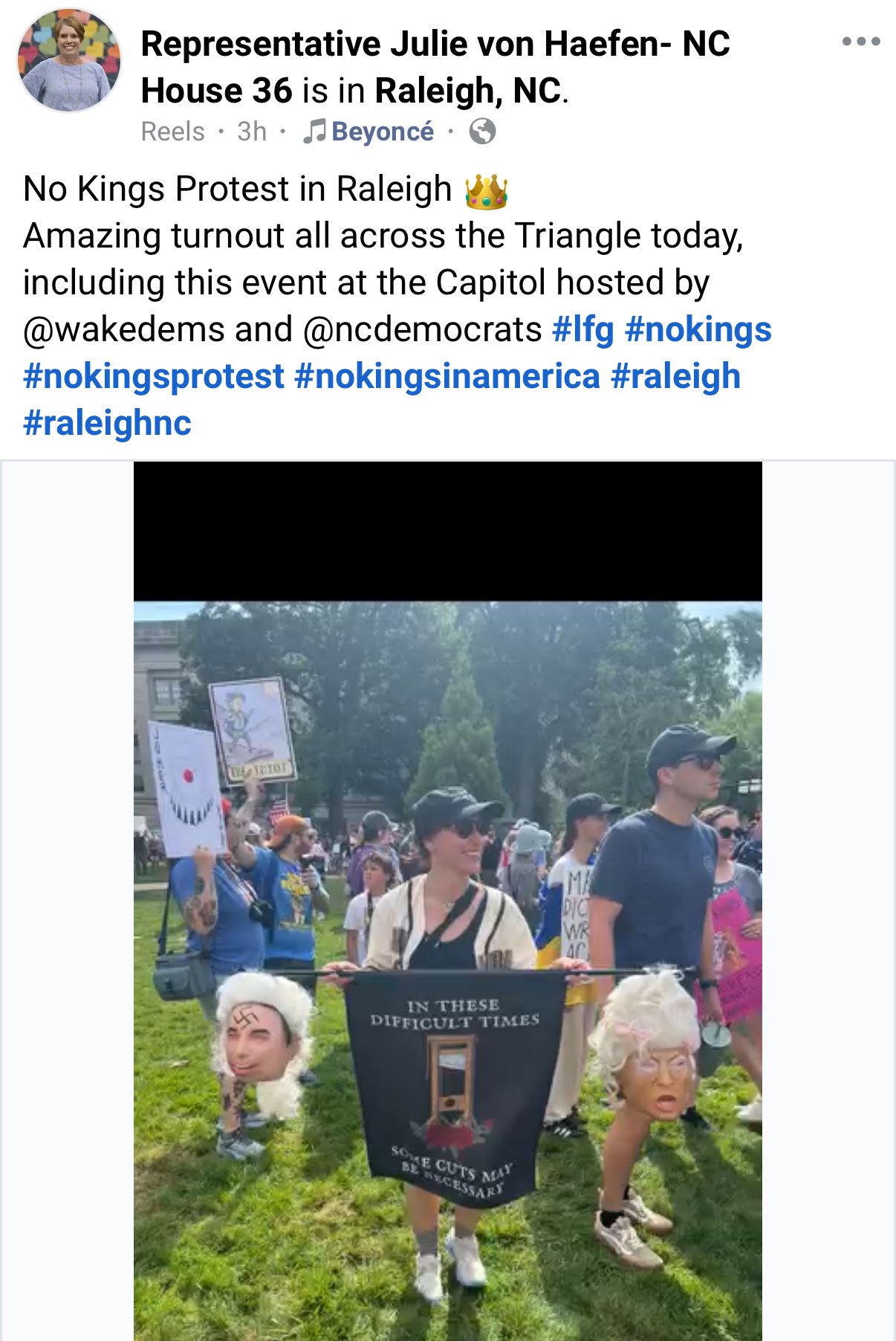
On June 14, protesters gathered in cities across the country under a bold banner: “No Kings.” They marched again under that same cry two weeks later, and rallied again in some cities on July 4. The slogan is intended as a rebuke to what they perceive as a creeping authoritarianism in American politics, particularly directed at President Trump, whose critics accuse him of cultivating a “regal presidency.” Whatever the merits of those charges may be, the imagery accompanying these protests—mannequin heads in French wigs, toy guillotines, and revolutionary theater—evokes not America in 1776, but France in 1793.
It’s powerful symbolism, but the progressive Left has chosen the wrong revolution to celebrate. On July 4, 1776, America did indeed declare, in effect, “No Kings.” But the revolution that followed lacked the radical aims of the later Jacobins. Our Founders were altogether more restrained and philosophical, and therefore their project has been far more enduring. They may have fought a war to defend their rights, but unlike the French Revolution, they never let loose violence and terror, which upended the social order altogether.
In part, the Founders’ moderation was a consequence of their deep-rootedness in the political thought of John Locke. The Englishman, writing almost a century before the American Revolution, held that the government’s sole purpose is to protect pre-existing natural rights: life, liberty, and property. When the government fails to do so, citizens have not only the right but the duty to withdraw their consent. The Declaration of Independence echoes this logic precisely: governments derive “their just powers from the consent of the governed,” and when they become destructive of those rights, “it is the Right of the People to alter or to abolish it.”
That is a protest against tyranny—but a protest grounded in order and principle, not chaos.
The current “No Kings” movement borrows more heavily from the French model than Anglo-American sources. In their Revolution, sovereignty was not a means of protecting rights, but of redefining them. Jean-Jacques Rousseau’s notion of the “general will” replaced individual conscience with collective conformity. The result, infamously, was not ordered liberty but the Reign of Terror—the new regime devoured its own children in the name of the people. Under Maximilien Robespierre, the “general will” justified mass executions of anyone who disagreed, often without trial.
John Locke and Jean-Jacques Rousseau both began with the premise that government derives its legitimacy from the consent of the governed, but their paths diverged sharply from there. Locke believed that individuals possess natural rights—life, liberty, and property—that exist prior to government and must be protected by it. Rousseau, by contrast, held that rights are shaped and defined by the collective, and that true freedom comes only through submission to the “general will.” Where Locke saw the social contract as a safeguard for individual liberty, Rousseau saw it as a tool to forge civic unity, even at the expense of dissent. The result was two starkly different visions of freedom: one rooted in restraint, the other in control.
We still see echoes of this divergence in American politics today. In a recent interview with Rolling Stone, Congresswoman Alexandria Ocasio-Cortez remarked, “I believe in our collective conscience. So, I don’t have any master plan, but I believe that the people will show me the way.” That sentiment may sound democratic in passing, but it reflects the Rousseauian idea that legitimacy flows not from principle or process, but from the mood of the crowd. Liberty is not secured by intuition or collective conscience—laws, institutions, and limits on power secure it. Unlike Rousseau and his statist heirs, our Founders understood that freedom cannot simply be redefined by a simple majority.
America’s revolution was different because it did not just reject kings—it also rejected mobs. It chose a structure of liberty, not a spectacle of rage.
Today’s protestors may not call for literal guillotines, but their chosen symbols suggest a comfort with revolutionary excess. A movement claiming to resist authoritarianism ought to look more carefully in the mirror. In recent years, many of the same voices decrying executive power as “anti-democratic” had little objection when left-of-center Presidents Obama and Biden stretched that power in service of their own goals. The issue seems less about defending democracy than about discrediting any outcome or leader they happen to dislike. And that’s precisely the kind of arbitrary rule the American founders revolted against.
This is not to say that concern over concentrated executive power is unfounded. Conservatives raised similar alarms during the Obama years, just as progressives now object to Trump’s rhetoric. But what’s missing in today’s movement is consistency and humility.
In his 2014 book The Revolt of the Public, former CIA analyst Martin Gurri describes the rise of “Homo informaticus,” a hyper-connected citizenry whose first reflex is to negate. Armed with smartphones and social platforms, the public now wields a decentralized “no-power” that can topple reputations or derail policy within hours. Yet the angered mob rarely coalesces around durable, constructive programs. “Any untoward event,” Gurri warns, “can draw a networked public into the streets, calling for blood.”
The “No Kings” rallies exemplify that pattern: they film toy guillotines, place guillotines on signs and shirts, and lampoon an imperial presidency but offer no better architecture to replace it. In other words, twenty-first-century mobs achieve Rousseau’s instantaneous unanimity without enduring Rousseau’s committees of public safety; they magnify grievance while remaining institutionally weightless. Unless channeled by structural guardrails—such as the ballots, bicameralism, and federalism prized by our Madisonian system—this digital negation risks repeating the French cycle of demolition without design.
History offers a cautionary preview: two late-eighteenth-century revolutions unleashed popular fury, yet only one translated it into lasting liberty. The American Revolution, though born of conflict, was fundamentally constructive. It produced a written constitution, institutional checks and balances, and a governing structure designed to preserve liberty by limiting power. The French Revolution, by contrast, tore down institutions without building durable replacements. In place of monarchy, it elevated committees, cults, and mobs—all in the name of virtue and the people. The American Founders pledged their lives, fortunes, and sacred honor to establish a republic of laws. The Jacobins demanded blood to purify a society of enemies. One gave rise to ordered liberty. The other ended in the guillotine.
The genius of the American Revolution is that it said “No Kings” and “No Committees of Public Safety.” It distrusted concentrated power of every kind, placing checks and balances between the branches of government, and between the government and the people. That is why July 4 celebrates not just rebellion, but constitutionalism—a nation of laws, not of men.
It is fair, even noble, to oppose executive overreach. But the test of a protest movement is not only what it resists, but what it proposes in its place. The founders did not simply reject monarchy; they established a durable republic founded on natural rights and limited government.
If today’s “No Kings” movement wants to honor that legacy, it might revisit the source. Begin not with Rousseau and Robespierre, but with Locke and Madison—men who knew that liberty depends not on “general will,” but on ordered liberty.
The road of history is fraught with political movements driven by passion, unmoored from principle, that tended to crown tyrants. From Alcibiades, the self-serving populist of Athenian democracy, to Napoleon, to Fidel Castro, the crowd’s will has too often paved the road to centralized, unchecked power. America’s revolution was different because it did not just reject kings—it also rejected mobs. It chose a structure of liberty, not a spectacle of rage.
If we are serious about preventing either thrones or mobs, Congress could begin by reclaiming the authorities it has lazily ceded. Require explicit re-authorization of national emergencies after 90 days; regulate trade through Congressional action; mandate legislative approval for any regulation with a multi-billion-dollar impact; tighten the War Powers Resolution to force an up-or-down vote before extended deployments. Such acts would not suffocate executive energy, but they would re-anchor it to popular consent expressed through deliberation rather than acclamation—a thoroughly Locke-and-Madison remedy for twenty-first-century anxieties. That legacy is worth defending—not with guillotines, but with guardrails on governmental power.
On the evening of June 30, an Israeli warplane dropped a 500-pound, U.S.-made MK-82 bomb on the seaside Al-Baqa Cafe in Gaza City. The explosion killed more than 30 people and injured dozens more.
The weapon’s wide blast radius in the dense neighborhood caused indiscriminate damage, affecting unprotected civilians including men, women, children, and the elderly. Legal experts have said the attack likely violated international law under the Geneva Conventions and may constitute a war crime.
As the war grinds on, cafes like Al-Baqa aren’t just social spaces; for many, they are the only places to access electricity and the internet, which are often unavailable in people’s homes due to the ongoing blockade and widespread destruction of civilian infrastructure.
The people killed were students, workers, journalists, and displaced civilians, all clinging to a sense of normalcy, waiting for news of a possible ceasefire. Each had a name, a story, a struggle for survival in the face of a war that spares no one.
For the dead, the ceasefire will never come. Here are some of their stories.
“Please Be Okay. Don’t Leave Me.”
Ola Abed Rabbu and Naseem Sabha.Photo: Courtsey Ola Abed Rabbu
Ola Abed Rabbu, a 23-year-old engineer, had recently gotten engaged to Naseem Sabha, 28 — a man who, in her words, “chose to accompany me through the war, to ease my pain and bring light into my darkness.”
That evening, like always on their weekly excursions together, Naseem sat beside her, radiant with joy. “He was like a child reunited with Eid after a long absence,” Ola recalled. He took photos of them together, his heart brimming with happiness as he whispered to her how beautiful she was — and how beautiful they were. “He never saw anything in this world more worthy of celebration than us.”
They ordered coffee and falafel sandwiches, laughing between sips and bites, she said. The cafe buzzed with activity — people reading, charging phones, attending online classes, catching a flicker of normalcy. Time passed quickly, as it always did during rare peaceful moments in Gaza. But even their long list of postponed conversations would have needed “two lifetimes” to complete.
“He held my hand tightly on the way, like it was his last homeland,” Ola said. “And whenever we had to speak of death, he would always tell me calmly: ‘Don’t be afraid. Don’t be sad. As long as we are together, if we go … we go together.’”
But there was no warning. No siren. Only a sudden explosion. The cafe turned into rubble and dust. Screams faded into silence — broken only by Naseem’s pained whisper:
“Ah … ah …”
They collapsed.
Ola’s leg was torn and bleeding. She wrapped it with a cloth from the table and crawled toward Naseem. “Please be okay. Don’t leave me. Stay alive,” she begged him. Blood poured from his back, but she clung to the hope that he had only lost consciousness.
He was rushed to the ambulance first. Ola, despite her injuries, followed in the next. She arrived at the hospital unable to walk, her foot ligaments severed. “They told me he had a metal rod placed in his leg, then moved him to another ward,” she recounted.
As her treatment began, Ola asked her father in desperation, “Is Naseem okay? Please, tell me he’s alright.”
His voice trembled: “I don’t know. He’s in the ICU. … We’re not allowed to see him.”
The silence around her grew heavier. Hours passed. Eventually, her cousin arrived and placed a hand on her shoulder.
“Has he been martyred?” Ola asked.
Tears filled her cousin’s eyes as she nodded. “Yes … we brought him to you … to say goodbye.”
She saw his body, peaceful and luminous — “more beautiful than the full moon,” she whispered. “His face was calm, as if he hadn’t felt any pain, his spirit still hovering near him.”
With quiet faith, Ola bid him farewell:
“O Allah, reward me in this great loss, and grant me better than him. I testify that he was worthy of martyrdom. I have never known a heart more tender, a soul more pure, or a love more merciful and kind. I entrust him to You, my Lord … until I meet him again.”
Read our complete coverage
Israel’s War on Gaza
“She Wasn’t Just My Cousin. She Was My Little Sister.”
Raghad Abu SultanPhoto: Courtesy Aseel Balaawi
Haya Jouda, 23, speaks of her cousin Mona, 21, as a sister. “We grew up together — all my memories have her in them,” she said.
Mona and her friend Raghad Abu Sultan, 21, had gone to the cafeteria simply to breathe. Mona was known in the family as the youngest and most adored; she had a spirited presence and a generous heart. “She was the baby of the family. Everyone called her ‘Bobo.’ Even her older brothers spoiled her,” Haya told The Intercept.
Mona studied engineering at Al-Azhar University and was fluent in English. Despite the war, she continued volunteering with organizations that supported orphans, and later, during the siege, worked with the charity group Fares Al-Arab. “She loved helping people. She hated sitting still,” Haya said.
When their home was destroyed in November 2023, the extended family fled together to Deir al-Balah, sharing a single room for six months. Haya eventually managed to evacuate to Egypt, but Mona couldn’t — even though she had packed first, full of hope her name would be called. “She hugged me the day I left and cried,” Haya recalled. “She said she’d follow me soon. She even packed her bag.”
The Rafah crossing closed, and Mona remained in Gaza. Despite everything, she stayed strong for others. “She was the one comforting me,” said Haya. “Telling me things would be okay — even though she was the one under bombs.”
When the first ceasefire took effect in February 2025, Mona returned with her family to their destroyed apartment in the north. “She was so happy to be home, even if the house was bombed,” Haya said. “She told me, ‘At least I’m in my house. That’s what matters.’”
On the day of the cafe strike, Mona had gone out with her friend Raghad — a rare attempt at normalcy. When news broke of the bombing, the family didn’t even realize Mona had been there. Her father searched for her frantically. “He said, ‘We’re okay — but I can’t find Mona.’ We thought she had just stepped out or gone to the bathroom.”
When Raghad’s name appeared on the list of the dead, everything changed. “We knew,” Haya said. “They were always together. We just didn’t want to believe it.” Later that evening, the final confirmation came. Mona had been killed. “Her mother saw her body, bid farewell and cried, ‘Mona’s gone. Her soul is gone.’ The phone dropped from her hand.”
The news shattered the family, now scattered across different countries. “None of us were with her. None of us got to say goodbye. She died without us.”
Haya still struggles with the reality of her cousin’s death. “She was the funny one. The one who got the joke first. She had this lightness about her,” she said. “And now she’s just … gone. Killed in a war she didn’t choose, while trying to live.”
“She wasn’t a number,” Haya added. “The world won’t wake up just because Mona is gone — but there are so many like her. So many families were destroyed. And we’re still counting.”
For Aseel Balaawi, 21, now living in Egypt, the loss struck from a painful distance. Raghad was her classmate since sixth grade — a source of ambition and quiet strength. Both were studying pharmacy, dreaming of leaving a mark on their homeland. “Most of our conversations were about our major, since we were both in the Faculty of Pharmacy. We always used to talk about how we could leave a mark for Palestine,” Aseel said.
Aseel didn’t know Raghad and her best friend Mona were there at Al-Baqa Cafe at the time it was hit by an Israeli airstrike. “When I saw a story from my colleague on Instagram saying ‘pray for Raghad,’ I thought — it can’t be true. But unfortunately it was.”
The disbelief morphed into a crushing realization. “The idea that someone with so much life and passion as Raghad could be gone — it broke my heart,” Aseel said. “To this day, I can’t get over Raghad’s killing. I write about her in my journals, so I can keep her memory alive.”
“She Held on To Everything Good Until the Last Moment.”
Amna Al-SalmiPhoto: Courtsey Mariam Salah
Mariam Salah, 30, knew Amna Al-Salmi, 36 — a fellow digital artist known to many by her childhood nickname “Frans” — through her work in Gaza. Mariam remembers Frans as a quiet force of ambition, talent, and discipline. They both lived in Al-Shati refugee camp.
“She wasn’t just a good artist,” Mariam recalled. “She was a dreamer. Always talking about traveling, building a career, and leaving her art supplies to her sisters if she ever got the chance to go.”
Frans worked in digital art and had recently been collaborating on a visual storytelling project called ByPal with the journalist Ismail Abu Hatab, 30, who was killed with Frans. The project sought to document personal stories through illustration — a form of collective resistance and memory-making. Mariam believes that work is what brought Frans and Ismail to the cafe on the day of the strike.
Mariam and Frans had met just a week or two earlier, when they painted together at a public event that included a mural titled “Honoring the Donkey,” a satirical piece. “That might have been her last public work,” Mariam said. “We took a group photo. I hugged her in it. I remember complimenting her eyelashes — they were so long. It was just a small moment, but now it feels enormous.”
When the bombing hit the cafe, Mariam was at home. It was her sister who called, asking urgently if she had been there, knowing that many artists — including Ismail and Frans — had been frequenting the place. “I opened my phone and the first name I saw was Ismail’s. The sight of him broke me,” Mariam said. “And I immediately thought — if he was there, she was too.”
Mariam tried calling Frans. No answer. Someone eventually picked up her number, found in her lost SIM card, and confirmed what she feared: Frans was killed. “He didn’t even know her,” she said. “Just someone who’d been at the scene.”
Though Mariam had lost many people in the war — including her 4-year-old nephew Ahmed, who had been like a son — Frans’s death struck a different kind of blow. “There was something about her,” Mariam said. “She was calm, beautiful, composed. Even in the worst circumstances, she’d show up dressed well, taking care of herself, holding on to whatever color she could find in this black-and-white world. Her killing reminded me of Mahasen Al-Khateeb, our mutual artist friend who was killed months ago.”
Frans had posted only days earlier about how much she missed painting. Her last artworks included children in shrouds — images that now feel eerily like foreshadowing.
“She held on to everything good until the last moment,” Mariam reflected. “She had so much hope. She didn’t like sharing her pain. But she carried a lot — and she never let it take her light.”
“Do You Think It Knows We’re Just Innocent People Trying To Live?”
Mohammed NaeedmPhoto: Courtesy Mohaemmed Naeem
Survivor Mohammad Naeem, 23, a law graduate from Beit Hanoun, was inside Al-Baqa that day.
That afternoon, Mohammad sat at his favorite table along with his friend, poised to capture the Gaza sunset and enjoy the beauty of the sea. His friend broke his concentration by pointing to a naval warship on the horizon and asked, “Do you think it knows we’re just innocent people trying to live?”
Before Mohammad could finish his answer, a force that felt like it was ripping his soul out of his body pulled him five meters away. “In that moment, all sounds vanished — there was nothing left but one steady, fixed sound, like the static hum of a lost TV signal,” he continued. “I hit the ground, and all emotions disappeared. Even fear — I didn’t feel it. I couldn’t process what had just happened to react emotionally. All I could see was a single scene, playing out in slow motion.”
“I tried to get up,” he said. “But I wasn’t even aware I was injured. I just saw my friend’s leg — barely attached — and I carried him. I had to.” Only later, after he had delivered his friend to an ambulance and collapsed himself, did he realize he was wounded too.
Mohammad’s physical recovery is ongoing, but the psychological wounds cut deeper. “After this, I no longer feel safe anywhere,” he said. “Before, I used to tell myself, ‘Don’t worry, you avoid risky places.’ But now … nowhere feels safe, even the sea.”
“I Said Good Morning to the Dead.”
The aftermath of Israel’s attack on the Al-Baqa cafe on June 30, 2025.Photo: Omar Al-Qattaa/AFP/Getty Images
On the morning of June 30, journalist Bayan Abusultan went to the cafe. “I went for a moment of fake peace,” she recalled. “To breathe. To feel normal, even if just for an hour.” She exchanged greetings with the staff and familiar faces, including Frans and Ismail Abu Hatab, who were filming a segment for an upcoming exhibition.
The cafe buzzed with life. Three young women sat nearby, exchanging quiet smiles and compliments. Across from Bayan sat two girls in their early twenties with a giant gift-wrapped teddy bear beside them — a peace offering to reconcile after a recent argument. They had just made up. Bayan flipped open her book, a literary critique by Abd el-Rahman Munif, reading about the power of cultural memory, the legacy of writers like Ghassan Kanafani, and the weight of identity under occupation.
It was nearly 2:45 p.m. when her friend Mohammed Abu Shammala arrived. They hadn’t seen each other for two months, and she closed her book to talk. She pointed toward the sea.
“The warships are really close today,” she said. But they brushed it off. In Gaza, everything can seem routine — until it isn’t.
When the sudden blast ripped through the cafe, Bayan was thrown to the ground. She crawled under a table for cover, and her friend Mohammed shielded her from the shrapnel. When she lifted her head, she saw a severed leg, a young woman dying beside her, and her friends Frans and Ismail lifeless at the table where they had just been smiling. The familiar cafe had become a war zone.
Disoriented and injured, Bayan stumbled through the debris, searching for her phone to call an ambulance. Only when someone pointed out the blood on her head did she realize she had been wounded. She was led toward emergency responders. Each step became heavier, not because of her wounds, but because of what she saw: bodies of people she had said “good morning” to just hours earlier. She felt the helplessness of someone who couldn’t save the ones they love.
Do people have a moral obligation to obey the law simply because it is the law? If you come to a red light and have a clear view in all directions with no cars in sight, do you have a moral obligation to stop?
Questions like this have long divided philosophers of law. In The Nature of Law: Authority, Obligation, and the Common Good, Daniel Mark defends the traditional natural law position that law’s connection to the common good generates a defeasible moral obligation to obey the law. The book is divided into five chapters. The first two criticize H. L. A. Hart’s rule-based, positivist theory of law. The third criticizes Joseph Raz’s influential positivist account of law’s authority. The fourth chapter is the heart of the book: it presents Mark’s preferred brand of natural law theory, which holds that law is a set of commands oriented to the common good, and explains why this theory implies the existence of a defeasible moral obligation to obey the law. The fifth and final chapter addresses questions about the relationship between Mark’s theory of law and democratic systems of government.
The most interesting and successful parts of the book are where Mark works out the kind of relationship between law and the common good that, assuming it exists, would be capable of generating a moral obligation to obey the law. As Mark points out, if it were the orientation to the common good at the level of the individual law that generated the obligation, then it would be hard to see how this obligation could be an obligation to obey, that is, to comply with the law just because it is the law. The fact that the action required by law is in service of the common good would do all the work in generating the moral obligation to perform the action. The fact that the law requires the action would be redundant.
Mark’s solution is to ground the moral obligation to comply with each individual law in the orientation of the legal system as a whole to the common good. Because the system-level orientation to the common good can remain intact even if some individual laws are unjust, it can generate a moral obligation to obey even those laws, an obligation that would not exist but for the fact that they are laws.
The focus on the system-level orientation to the common good is among the book’s most valuable insights. Not only does it explain how there could be a moral obligation to obey the law just because it is the law, but it also provides Mark with an elegant account of the morality of revolution: generally, revolution becomes morally permissible once injustice has become so pervasive as to compromise the orientation of the system as a whole to the common good. It also provides Mark with an intuitive explanation for why it is generally appropriate for those engaged in civil disobedience to submit to the punishment prescribed by law for their actions. Civil disobedience is morally permissible when the defeasible moral obligation to obey an individual law is defeated by countervailing considerations. Yet even then, it is plausible that the defeasible moral obligation to comply with the law’s provision of punishment for violating the law remains undefeated.
However, we encounter a complication here. It is one thing to work out what kind of relationship between law and the common good would be capable of generating a moral obligation to obey the law. It is another thing to show that law actually has this relationship to the common good. Even if a system’s general orientation to the common good generates a moral obligation to obey its rules, one might still ask whether only systems generally oriented to the common good count as legal systems. If not, then there may not be a moral obligation to obey all laws, only an obligation to obey those that are part of a system generally oriented to the common good.
Despite relying heavily on the work of John Finnis throughout the book, Mark has surprisingly little to say about Finnis’s influential argument that at least all central cases of law have the kind of orientation to the common good that generates a moral obligation to obey. Also conspicuously absent from the book is meaningful engagement with the work on this subject by prominent natural law theorists since Finnis, most notably Mark Murphy.
The closest Mark comes to defending the natural law view that only systems oriented to the common good count as legal systems is in his criticism of Hart’s positivist alternative. Mark reads Hart as (perhaps inconsistently) recognizing that a system does not count as a legal system unless its subjects feel that they ought to follow the system’s rules. But Mark argues that Hart’s theory “gets in the way of any coherent account” of why people feel that way. Hart conceives of law as consisting of “rules based in social practice”—what people do “around here”—and “on a moment’s reflection, any person can see that the fact that we happen to do things a certain way around here … never [generates] an obligation to obey the law just because it is the law.” Absent some basis for thinking that people should obey the law, it is hard to explain people’s feeling that they should obey the law.
I am not sure how much damage this criticism inflicts on Hart’s theory. Hart could, if he liked, help himself to Mark’s account of why there is an obligation to obey all rules of a system oriented to the common good, to explain why the subjects of such a system feel that they ought to obey the law. This is consistent with the claim that a system that was not oriented to the common good but where people, for whatever reason, nonetheless felt that they ought to follow the rules would also constitute a legal system. Hart need not maintain that such a system is probable and thus does not owe us an account of why people might feel that way. Mark never claims that there would be anything counterintuitive about identifying such a system as a legal system and even appears to concede that one’s intuition might align with the positivist on this point.
If Mark wanted to ground the principle of legality in the relationship between law and moral obligation, then he would need to insist on a (defeasible) moral obligation to do whatever the law permits.
Of course, Hart might prefer not to adopt Mark’s account wholesale. Hart does not actually claim that a legal system exists only if all or even most of the system’s subjects feel that they ought to obey the law; all he says is that a legal system exists only if the system’s officials treat its secondary rules of recognition, change, and adjudication as standards of official behavior. And the hypothesis of a moral obligation to obey the law is not the only possible explanation for why a system’s officials treat its secondary rules as standards of official behavior. Alternative explanations include a sense of role morality and social pressure. Hart would likely adopt a liberal attitude toward the range of possible explanations for officials’ attitudes toward the law rather than insist on a single explanation applicable to all legal systems. At any rate, the point is that Hart could, without compromising his positivism, agree that people in legal systems oriented to the common good feel that they ought to obey the law and adopt Mark’s explanation for why. This shows that even if that explanation is correct, it does not follow that we should accept the natural law claim that only systems oriented to the common good are legal systems.
Mark also criticizes Hart’s treatment of trials of Nazi officials in postwar Germany. Hart recognizes that these trials were fraught, even if plausibly justified, because they involved punishing defendants for acts that were legal when they were committed. According to Mark, this makes sense only on the assumption that there is a (defeasible) moral obligation to obey the law, such that the defendants were punished for something that they had a (defeasible) moral obligation to do. Predictably, Mark argues that the problem with the trials is solvable because the defendants’ defeasible moral obligation to obey the law was, in fact, defeated. But Mark maintains that we cannot even understand the problem to be solved unless we recognize a defeasible moral obligation to obey the law.
Mark appears to slide here from legally permitted to legally required. I do not know whether every act for which the defendants in these trials were prosecuted was not only permitted but required by Nazi law, but it is notable that Hart sets up the problem as one of whether “to punish those who did evil things when they were permitted by evil rules then in force” (emphasis added). And Hart seems right to set up the problem this way. As Hart notes, the venerable principle of legality—nulla poena sin lege—prohibits the state from punishing people for acts that were legally permissible when performed. The problem with the trials was that they appeared to violate this principle.
This suggests that it is Mark, not Hart, who “misidentifies the nub of the problem.” The alleged (defeasible) moral obligation to do whatever the law requires has nothing to do with the principle of legality, which prohibits punishment not just for acts that the law required but for any act that the law permitted. If Mark wanted to ground the principle of legality in the relationship between law and moral obligation, then he would need to insist on a (defeasible) moral obligation to do whatever the law permits. And surely Mark would not want to go that far.
Mark’s final major criticism of Hart is that Hart is wrong to reject the model of law as a collection of commands. According to Hart, some legal rules are a poor fit for the command model because they confer powers rather than impose duties. Legal rules defining how a legislature can enact new laws or how parties can form a valid contract are not naturally understood as commands to legislators or to potential parties to a contract. On Hart’s view, such rules confer powers rather than impose duties. But Mark argues that power-conferring rules can generally be understood as conditional commands. On this view, rules defining how a legislature can enact new laws are conditional commands instructing legislators that they must proceed in a certain way if they wish to enact a new law, and rules defining how parties can form a contract are conditional commands instructing parties that they must proceed in a certain way if they wish to form a contract.
Mark’s argument here appears to trade on an ambiguity in the modal force of “must.” The construal of power-conferring rules as tantamount to a conditional requirement of the form, “if you wish to do X, then you must do Y,” is plausible if the modal force of “must” is metaphysical. Given that the relevant legal rule empowers the legislature to create law (only) by means of a certain procedure, it is impossible for the legislature to enact law in any other way: that is the sense in which legislators “must” proceed in a certain way if they wish to enact a new law. So too when parties wish to form a contract. The relevant power-conferring rule specifies the (only) way to do it, making it impossible to form a contract otherwise; that is the sense in which parties “must” proceed in a certain way if they wish to form a contract.
But if Mark is to reduce power-conferring rules to duty-imposing rules, then he needs the modal force of “must” to be normative—more specifically, legal. And the construal of power-conferring rules as conditional requirements of the form “if you wish to do X, then you must do Y” is less plausible if the modal force of “must” is legal. It is not as if Congress could enact a statute without regard to bicameralism or presentment, but is prohibited by law from doing so. Absent bicameralism and presentment, there is no statute. Similarly, it is not as if you and I could form a contract lacking consideration but are prohibited by law from doing so. Absent consideration, there is no contract.
I have focused on Mark’s engagement with Hart because Mark rightly identifies Hart’s theory as the leading positivist competitor to the kind of natural law theory that Mark defends. But even if I am right that Mark’s criticisms of Hart are ultimately unsuccessful, these shortcomings should not overshadow the book’s important contributions to understanding what the grounds of a moral obligation to obey the law must be if indeed such an obligation exists. Nor do they undermine the basis that Mark provides for thinking that in a legal system such as ours in the United States, which does seem to be generally (albeit imperfectly) oriented to the common good, citizens have a defeasible moral obligation to obey the law. In addition, the book features much more of interest than can be covered here, including extended discussions of Raz’s theory of authority and Carl Schmitt’s political theory. Anyone interested in the philosophy of law, especially those interested in questions of political obligation, will enjoy this book and find in it—to quote Mark—plenty of fodder for “discussion and, better yet, disagreement.”
When building Angular applications, managing styles and encapsulating component-specific designs is crucial for maintaining scalability and avoiding unintended CSS overrides. Angular provides a mechanism called View Encapsulation that controls how styles are applied to components, ensuring that they do not affect other parts of the application.
ChatGPT helps you get answers, find inspiration and be more productive. It is free to use and easy to try. Just ask and ChatGPT can help with writing, learning, brainstorming and more.