Real Estate Analysis Software, LLC. Real Estate Analysis Software, LLC offers Cash Flow Analyzer Pro Software for long-term rental investors and Flipper and Rehabber Pro Software for house flippers and rehabbers. These tools simplify deciding whether to buy, sell, or keep looking for real estate investment opportunities. Key features
Day: June 26, 2025

Russian President Vladimir Putin will not attend next week’s annual BRICS summit in Brazil due to concerns over an International Criminal Court warrant for his arrest in connection with alleged war crimes committed in Ukraine, Kremlin aide Yuri Ushakov has confirmed. “This is due to certain difficulties in the context of the ICC requirement,” Ushakov commented. “In that context, the Brazilian government could not take a clear position that would allow our president to participate in this meeting.” Instead, the Russian leader is expected to join his BRICS colleagues via video link.
Putin has officially been a war crimes suspect since the ICC named him in a March 2023 arrest warrant over to the mass deportation of Ukrainian children. Russia stands accused of abducting and deporting tens of thousands of Ukrainian children, with many victims reportedly subjected to ideological indoctrination to rob them of their Ukrainian heritage and impose a Russian national identity. These mass abductions may qualify as genocide according to the 1948 United Nations Genocide Convention, which identifies “forcibly transferring children of the group to another group” as one of five internationally recognized acts of genocide.
As a signatory to the Rome Statute that established the ICC, Brazil would be obliged to arrest Putin if he entered the country. Addressing the ICC warrant in 2023, Brazilian President Luiz Inácio Lula da Silva initially dismissed talk of detaining the Russian president, before backtracking and distancing himself from the issue. “If Putin decides to go to Brazil, it’s the justice system that will take the decision over whether he should be arrested, not the government or congress,” Lula stated.
Putin faced similar uncertainty two years ago ahead of the annual gathering of BRICS leaders, which was then being hosted by South Africa. The South African authorities reportedly came under considerable pressure from their Russian colleagues to provide assurances that the Kremlin dictator could travel to the August 2023 event without fear of arrest. “Russia has made it clear that arresting its sitting president would be a declaration of war,” commented South African President Cyril Ramaphosa in the build-up to the summit. The Africans were ultimately unable to offer any guarantees, forcing Putin to abandon his plans to attend.
Stay updated
As the world watches the Russian invasion of Ukraine unfold, UkraineAlert delivers the best Atlantic Council expert insight and analysis on Ukraine twice a week directly to your inbox.
In addition to Putin, the ICC has also issued arrest warrants for a number of senior Russian officials since the onset of Russia’s full-scale invasion of Ukraine. In 2024, the court announced charges against former Russian Defense Minister Sergei Shoigu, Russian army chief Valeriy Gerasimov, Russian Air Force long range aviation chief Sergei Kobylash, and Russian Black Sea Fleet commander Viktor Sokolov in connection with the deliberate targeting of Ukrainian civilians and the bombing of Ukraine’s civilian power grid.
While these charges have been welcomed in Ukraine and elsewhere as a step toward justice, there is currently thought to be little prospect that any of the named Russian war crimes suspects will be forced to appear in The Hague. Instead, the ICC arrest warrants serve primarily as an inconvenience and a reminder that efforts are underway to hold high-ranking Russian officials accountable for crimes committed during the invasion of Ukraine.
Eurasia Center events
While the wheels of justice continue to turn slowly at the International Criminal Court in The Hague, Kyiv is also pursuing alternative formats to prosecute Kremlin officials for the invasion of Ukraine. Ukrainian President Volodymyr Zelenskyy signed an agreement on June 25 with the Strasbourg-based Council of Europe, the continent’s leading human rights body, to establish a special tribunal that will charge Russia’s national leaders with the crime of aggression.
Once operational, this special tribunal could theoretically put senior Russian figures including Putin on trial, but this will require a boldness that has often been absent from Europe’s response to Russia’s invasion of Ukraine. “It will take strong political and legal courage to make sure every Russian war criminal faces justice, including Putin,” Zelenskyy noted in Strasbourg.
Despite mountains of evidence supporting allegations of Russian war crimes in Ukraine, it may still be many years before Putin or any other senior Kremlin officials face even symbolic justice. This has left Ukrainians feeling understandably frustrated and deeply disillusioned. They will take little comfort from the fact that Vladimir Putin is now unable to travel internationally without first considering whether he risks being arrested for war crimes. Nevertheless, the Kremlin ruler’s inability to attend flagship events like next week’s BRICS summit in Brazil is a personal embarrassment for Putin and a significant blow to Russia’s international prestige.
Peter Dickinson is editor of the Atlantic Council’s UkraineAlert service.
Further reading

UkraineAlert
May 29, 2025
UN probe: Russia’s ‘human safari’ in Ukraine is a crime against humanity
By
Peter Dickinson
UN investigators have concluded that a coordinated Russian campaign of deadly drone strikes targeting civilians in southern Ukraine’s Kherson region is a crime against humanity, writes Peter Dickinson.
UkraineAlert
Jun 24, 2025
US secures release of Belarusian prisoners but pressure must continue
By
Hanna Liubakova
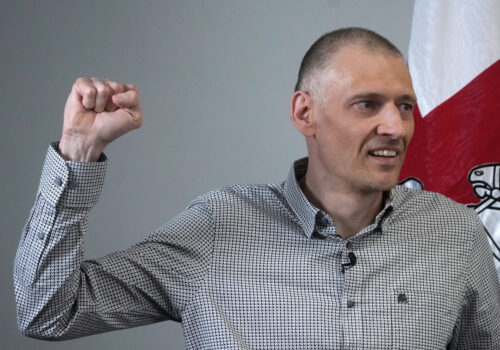
The release of fourteen prominent Belarusian political prisoners last weekend is welcome news. But the 1172 who remain behind bars in Belarus deserve more than symbolic gestures from the West, writes Hanna Liubakova.

UkraineAlert
Jun 12, 2025
Putin’s peace plan is a blueprint for the end of Ukrainian statehood
By
Tetiana Kotelnykova
Russia’s peace plan sends a clear signal that Moscow wants to erase Ukraine as a state and as a nation. If Western leaders wish to avoid this catastrophic outcome, they must convince Putin that the alternative to a negotiated peace is a Russian defeat, writes Tetiana Kotelnykova.
The views expressed in UkraineAlert are solely those of the authors and do not necessarily reflect the views of the Atlantic Council, its staff, or its supporters.


The Eurasia Center’s mission is to enhance transatlantic cooperation in promoting stability, democratic values and prosperity in Eurasia, from Eastern Europe and Turkey in the West to the Caucasus, Russia and Central Asia in the East.
Follow us on social media
and support our work
The post Putin cannot attend BRICS summit in Brazil as he fears arrest for war crimes appeared first on Atlantic Council.
The post Putin cannot attend BRICS summit in Brazil as he fears arrest for war crimes first appeared on Audio Posts – audio-posts.com.
Stocks are close to record territory.
The post US stocks rise to the brink of a record and recover nearly all their 20% springtime drop first appeared on Audio Posts – audio-posts.com.
AP’s Lisa Dwyer reports on another well known company that is fazing out artificial dyes.
The post Duncan Hines parent Conagra Brands says it will phase out artificial colors first appeared on Audio Posts – audio-posts.com.
Israel-Iran live updates: Hegseth defends Iran bombing, says media undermining ‘success’ ABC News – Breaking News, Latest News and Videos
Israel-Iran live updates: Hegseth defends Iran bombing, says media undermining ‘success’ ABC News – Breaking News, Latest News and Videos
RED HOOK — The New York City Economic Development Corporation is betting that a “pedestrian-forward” urban design will reduce traffic — and the need for comprehensive transportation planning — around its proposed Brooklyn Marine Terminal Project, a 122-acre waterfront mega-development stretching from Atlantic Avenue to Red Hook on the East River. EDC believes that many […]
The post Does contentious Brooklyn Marine Terminal Project need more transportation planning? appeared first on Brooklyn Eagle.
The post Does contentious Brooklyn Marine Terminal Project need more transportation planning? first appeared on The Ocean Avenue News – oceanavenuenews.com.
By: Jerome Brookshire
As Trenton finalizes the contours of New Jersey’s Fiscal Year 2026 state budget, a controversial provision buried within the proposal has triggered immediate backlash, particularly from stakeholders in the real estate sector and faith-based advocacy groups. Chief among the voices raising alarm is Shlomo Schorr, Director of Legislative Affairs for Agudath Israel of America’s New Jersey office, who took to social media this week to warn of the proposed expansion of the so-called “mansion tax”—a fee levied on the sale of high-value residential properties.
According to Schorr, the revised measure would double the real estate transfer fee on homes valued at over $1 million, increasing it from the current 1% to 2%. Even more steeply, homes that sell for $2 million or more would be hit with a 3% fee—effectively tripling the cost of the transfer tax for some of the state’s most sought-after properties.
“This means a minimum of $10,000 in additional fees for homes sold over $1 million,” Schorr wrote, highlighting the disproportionate burden the hike could place on families in densely populated and rapidly gentrifying regions—many of which include large Orthodox Jewish communities in towns like Lakewood, Teaneck, and Passaic.
Though frequently characterized as a “luxury tax,” the proposed hike has reignited a debate over whether such policies, aimed at taxing the wealthy, end up penalizing the middle class in high-cost-of-living states like New Jersey. With home prices in many suburban communities regularly crossing the $1 million mark, particularly in northern counties and shore-adjacent neighborhoods, critics argue that the mansion tax expansion is not limited to the ultra-rich.
As Schorr and others have pointed out, the additional $10,000—or more in some cases—could be especially burdensome to large families seeking to upsize in growing communities, including those aligned with religious and cultural groups whose demographic trends lean toward larger households.
“What’s being sold as a tax on the rich is, in practice, a penalty on growing families and upward mobility,” one Lakewood-based real estate professional told this reporter. “These are not hedge fund executives buying $5 million condos in Hoboken. These are teachers, small business owners, and communal leaders trying to buy a five-bedroom house for their kids.”
The mansion tax debate is not new in New Jersey. First introduced in 2004 under then-Governor Jim McGreevey, the original tax applied a 1% levy on property sales over $1 million. Supporters at the time touted it as a fair mechanism for funding affordable housing and infrastructure improvements. Over the years, however, critics have increasingly described it as an outdated model that fails to adjust for inflation and local market dynamics.
In high-demand areas like Bergen and Ocean counties, $1 million no longer buys a sprawling estate, but a modest family home. As the housing market has surged post-pandemic, more and more New Jerseyans are being swept into a tax bracket originally intended for the wealthiest.
Schorr’s intervention on the issue reflects broader concern within the Orthodox Jewish advocacy landscape, which has become increasingly vocal on state-level fiscal policies that impact religious institutions, school funding, housing affordability, and transportation.
“Agudath Israel is committed to protecting the financial interests and dignity of our communities,” Schorr said in a statement following his post. “This proposed expansion of the mansion tax is neither equitable nor justifiable in the context of today’s real estate realities.”
The Fiscal Year 2026 budget, which is still under negotiation in the New Jersey Legislature, is projected to exceed $55 billion—an historic high for the state. The proposed mansion tax hike is expected to generate hundreds of millions of dollars in new revenue, earmarked for affordable housing initiatives, public transit upgrades, and educational investments. But detractors argue that it amounts to a regressive tax masquerading as progressive reform.
Governor Phil Murphy, a longtime advocate for “tax fairness,” has not publicly commented on the specific mansion tax proposal in recent days. However, his administration has repeatedly framed similar proposals in terms of equity and fiscal responsibility.
The measure’s passage is far from guaranteed. Legislative leaders from districts with high home values—many of them Democrats—have expressed reservations, suggesting that the final budget may need to scale back or revise the tax to secure majority support.
For groups such as the Agudath Israel, the mansion tax issue is not just about money—it is about policy priorities and whose voices are being heard in Trenton.
“This is an opportunity for the Jewish community, and others similarly affected, to engage vigorously with the legislative process,” said one Agudah representative. “We must remind our elected officials that affordability, family sustainability, and community continuity matter. We cannot allow sweeping fiscal reforms to push working- and middle-class families to the margins of the housing market.”
As New Jersey lawmakers race toward the June 30 budget deadline, the fate of the expanded mansion tax remains uncertain. What is clear, however, is that the debate has struck a nerve—particularly among communities for whom housing is not simply a financial transaction, but a cornerstone of religious life, education, and identity.
Whether the final budget reflects those concerns remains to be seen. But as Shlomo Schorr’s post makes clear, the conversation is far from over.
The post NJ’s Proposed Budget Sparks Outcry Over Mansion Tax Hike: Orthodox Community Voices Concern appeared first on The Jewish Voice.
The post NJ’s Proposed Budget Sparks Outcry Over Mansion Tax Hike: Orthodox Community Voices Concern first appeared on The Ocean Avenue News – oceanavenuenews.com.