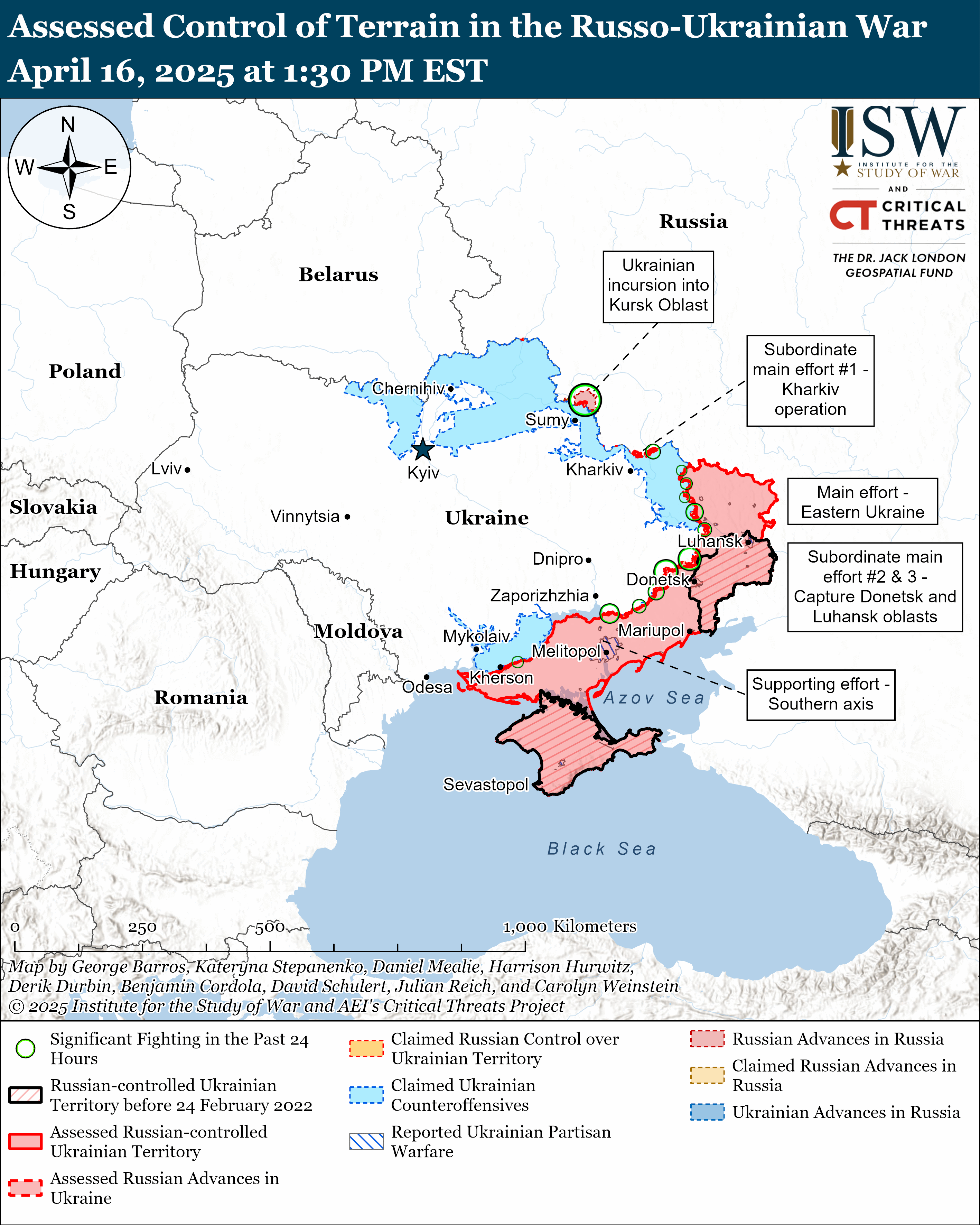
Recent assessments indicate that Russia continues to advance incrementally across multiple fronts, including Donetsk, Kharkiv, and Kursk, with daily territorial gains. Ukraine’s military, constrained by manpower shortages and demographic shifts, struggles to sustain its defensive operations. Meanwhile, diplomatic efforts remain stalled, with Russia reiterating its long-standing demands that preclude a stable peace agreement.
The trajectory of the conflict depends on several factors, including international support for Ukraine, Russia’s military strategy, and potential shifts in diplomatic negotiations. If Ukraine can secure increased military aid and bolster its forces, it may be able to push back Russian advances. Conversely, if Russia consolidates its territorial gains and maintains its operational momentum, the conflict could extend indefinitely.
Would you like insights on potential diplomatic resolutions or economic impacts?
–
Predictive analysis of the Russia-Ukraine conflict in 2025 is complex, as it hinges on multiple variables—military, economic, political, and geopolitical—that are dynamic and interdependent. Below, I outline key factors influencing the conflict’s trajectory, potential scenarios, and their likelihood, drawing on available data and trends while avoiding speculative overreach. The analysis focuses on the near term (2025) and acknowledges the inherent uncertainty of war outcomes.
Key Factors Shaping the Conflict in 2025
-
Military Dynamics:
-
Russia’s Strategy and Resources: Russia has adopted a strategy of attritional warfare, aiming to exhaust Ukraine through sustained pressure and incremental territorial gains. In 2024, Russian forces gained approximately 4,168 km², primarily in Donetsk, but at a high cost, with reported casualties exceeding 420,000 for the year. Russia’s tank reserves are dwindling, with estimates suggesting stocks of restorable tanks may be exhausted by mid-2025, and restoration rates have dropped significantly. Artillery and rocket launcher shortages could emerge by 2025-2026. Manpower remains a challenge, with recruitment struggling to keep pace with losses (40,000 recruits vs. 40,000 losses monthly in early 2025).
-
Ukraine’s Capabilities: Ukraine has demonstrated resilience, inflicting unsustainable losses on Russian forces while holding key defensive lines. Ukrainian drone warfare has improved, with FPV drones destroying 85% of Russian targets in the Pokrovsk direction by early 2025, up from 50% in mid-2024. However, Ukraine faces manpower shortages, exacerbated by reluctance to mobilize 18- to 25-year-olds, and relies heavily on Western aid for artillery, air defense (e.g., Patriot systems), and long-range systems (HIMARS, ATACMS).
-
Western Support: The suspension of U.S. military aid and intelligence sharing in March 2025 has strained Ukraine’s capabilities, with Patriot missile stocks potentially depleting by mid-2025. Europe has increased support, with Germany, France, the Netherlands, and the UK committing billions in aid and drone production, but it may not fully offset U.S. reductions. European defense production is ramping up, potentially meeting more of Ukraine’s needs by late 2025.
-
Economic and Domestic Factors:
-
Russia: Russia’s economy faces stagflation risks, with inflation at 10.2% in early 2025 and projected to fall to 7-8% by year-end. Military spending (6% of GDP) sustains the war effort, but sanctions and equipment losses limit long-term capacity. Public support for negotiations is around 60%, but Putin’s insistence on maximalist goals (regime change, territorial concessions) limits diplomatic flexibility.
-
Ukraine: Ukraine’s economy shows resilience, with projected GDP growth of 2.5-3.5% in 2025, supported by domestic defense production (up from 1.3 billion to 20 billion hryvnia, 2014-2024) and EU investments. However, energy infrastructure attacks and population displacement (7 million refugees) strain recovery. The IMF’s baseline scenario assumes the war ends by late 2025, but a prolonged conflict could deepen fiscal deficits.
-
Geopolitical and Diplomatic Context:
-
U.S. Policy under Trump: The Trump administration’s push for a ceasefire, coupled with aid pauses, pressures Ukraine to negotiate. Trump’s unpredictability complicates predictions, but his focus on forcing negotiations may lead to concessions that favor Russia unless Putin overplays his hand.
-
Russia’s Stance: Putin has rejected ceasefire proposals unless they include Ukrainian capitulation, demilitarization, and territorial losses. Kremlin narratives portray Ukraine as an illegitimate negotiating partner, aiming to undermine Western support.
-
Allied Support: NATO and EU countries remain committed, with increased defense budgets and production (e.g., Rheinmetall’s nitrocellulose expansion for artillery shells). However, political fatigue in the West and competing global crises (e.g., Middle East, Taiwan) could dilute focus on Ukraine.
-
Third-Party Actors: Russia relies on North Korean troops (withdrawn in February 2025 after high casualties) and Iranian drones, while China provides indirect support via sanctions evasion. These partnerships bolster Russia but are insufficient to decisively shift the balance.
-
Technological and Tactical Innovations:
-
Drones and Motorcycles: Both sides are adapting. Russia is developing motorcycle-based tactics for speed and maneuverability to evade drones, while Ukraine’s drone production and integration with ground operations are advancing.
-
Energy Infrastructure Attacks: Russia’s targeting of Ukraine’s energy grid aims to cripple its economy and morale, while Ukraine’s drone strikes on Russian oil facilities (6,500+ in 2024) disrupt Moscow’s revenue.
-
AI and Electronic Warfare: AI-guided munitions and electronic warfare are increasingly critical, with Ukraine testing new prototypes to counter Russian advances.
Potential Scenarios for 2025
Based on these factors, I outline three primary scenarios for the conflict’s trajectory in 2025, with estimated likelihoods and key drivers. These align with analyses from sources like MAX Security and Chatham House.
-
Ceasefire Agreement (60% Likelihood):
-
Description: A fragile ceasefire is negotiated, likely under U.S. pressure, freezing the front line without resolving territorial disputes. Both sides maximize territorial gains before talks, with Russia holding ~20% of Ukraine and Ukraine retaining parts of Kursk. Terms may include prisoner swaps (as seen in April 2025), bans on energy infrastructure strikes, and Black Sea truces.
-
Drivers: Trump’s threat to cut aid forces Zelensky to negotiate, while Putin faces domestic pressure (60% of Russians support talks) and equipment shortages. European aid sustains Ukraine’s leverage, preventing total capitulation.
-
Implications: A ceasefire allows Ukraine to lift martial law, hold elections, and begin reconstruction, but violations are likely, as seen post-Minsk Agreements. Russia may use the pause to rebuild forces, while Ukraine strengthens its defense industry. Global energy markets stabilize, but geopolitical tensions persist.
-
Protracted Attritional Conflict (35% Likelihood):
-
Description: The war continues as a stalemate, with neither side achieving a breakthrough. Russia makes marginal gains (e.g., in Donetsk, Luhansk) but lacks resources for decisive victories. Ukraine holds defensive lines but struggles with manpower and U.S. aid cuts. Trench warfare and drone-heavy tactics dominate, with high casualties on both sides.
-
Drivers: Putin rejects ceasefire terms if Russia captures key logistical hubs (e.g., Pokrovsk), believing military victory is achievable. Ukraine’s resilience, bolstered by European aid and domestic production, prevents collapse. Western fatigue and U.S. isolationism limit support, prolonging the stalemate.
-
Implications: Ukraine’s economy faces deeper shocks, with inflation rising and reconstruction delayed. Russia’s economy stagnates further, risking social unrest. Global attention shifts to other conflicts, reducing diplomatic pressure for resolution.
-
Decisive Shift (5% Likelihood):
-
Description: Either side achieves a significant breakthrough, leading to a Ukrainian victory (retaking pre-2022 borders) or Russian victory (major territorial gains, regime change). A Ukrainian collapse is less likely due to European support, while a Russian collapse could stem from economic implosion or internal dissent.
-
Drivers: For Ukraine, a surge in Western aid (e.g., lifted restrictions on long-range strikes) or Russian overextension could enable a counteroffensive. For Russia, a complete U.S. aid cutoff and Ukrainian manpower shortages could tip the balance. A sudden leadership change (e.g., Putin’s removal) could also disrupt Russia’s war effort.
-
Implications: A Ukrainian victory would bolster NATO and European security but strain Russia’s global influence. A Russian victory would embolden authoritarian regimes and destabilize Europe, impacting global trade and security.
Critical Uncertainties
-
U.S. Policy Consistency: Trump’s unpredictability could lead to renewed aid or further cuts, dramatically affecting Ukraine’s resilience.
-
Russian Domestic Stability: Economic strain and casualty backlash could force Putin to negotiate or escalate, depending on internal pressures.
-
European Commitment: If Europe fully compensates for U.S. aid reductions, Ukraine’s defensive capacity strengthens; otherwise, vulnerabilities grow.
-
Technological Edge: Advances in drones, AI, or electronic warfare could shift tactical advantages, though neither side currently holds a decisive edge.
Conclusion
The most likely outcome in 2025 is a fragile ceasefire (60%), driven by U.S. pressure and mutual exhaustion, though it risks violations without addressing core issues like territorial sovereignty. A protracted stalemate (35%) is the next most likely, perpetuating attrition and economic strain. A decisive victory for either side (5%) remains improbable absent major shifts in aid, leadership, or resources. Ukraine’s resilience and European support mitigate the risk of collapse, but Russia’s resource constraints and domestic pressures could limit its ability to sustain indefinite warfare. Monitoring U.S. policy, Russian equipment stocks, and European aid delivery will be critical to refining this outlook.
For further details on specific aid packages or military developments, refer to sources like the Institute for the Study of War (understandingwar.org) or MAX Security (max-security.com).
–