“There isn’t much information about whether the Mossad is influenced by Orthodox Judaism ideology” – GS. I say: It is. – Mossad is influenced by Orthodox Judaism ideology – Google Search https://t.co/ZEy87rOWkHpic.twitter.com/0yF4HcDTL0
“There isn’t much information about whether the Mossad is influenced by Orthodox Judaism ideology” – GS. I say: It is.-Mossad is influenced by Orthodox Judaism ideology – Google Search https://t.co/ZEy87rOWkH pic.twitter.com/0yF4HcDTL0— Michael Novakhov (@mikenov) October 15, 2024
It took the largest crowd in Liberty history and a WNBA Finals-record seven steals by All-Star forward Breanna Stewart to get New York even in its quest to bring home its first-ever championship. “The moment (Game 1) ended Thursday night, I was looking forward to Sunday to change things. Change the narrative a little bit,” […]
As early in person voting gets underway in Georgia, Vice President Kamala Harris has criticized former President Donald Trump for his “enemy from within” comments. The UN is warning that Israel is sealing off North Gaza. Medicare Advantage open enrollment is underway – we’ve got advice for seniors. North Korea has blown up parts of two major road and railway links connecting it to South Korea. Plus, we’ll look at the forecast for this winter.
Learn more about your ad choices. Visit podcastchoices.com/adchoices
“There isn’t much information about whether the Mossad is influenced by Orthodox Judaism ideology” – GS. I say: It is. – Mossad is influenced by Orthodox Judaism ideology – Google Search https://t.co/ZEy87rOWkHpic.twitter.com/0yF4HcDTL0
“There isn’t much information about whether the Mossad is influenced by Orthodox Judaism ideology” – GS. I say: It is. – Mossad is influenced by Orthodox Judaism ideology – Google Search https://t.co/ZEy87rOWkHpic.twitter.com/0yF4HcDTL0
“There isn’t much information about whether the Mossad is influenced by Orthodox Judaism ideology” – GS. I say: It is. – Mossad is influenced by Orthodox Judaism ideology – Google Search https://t.co/ZEy87rOWkHpic.twitter.com/0yF4HcDTL0
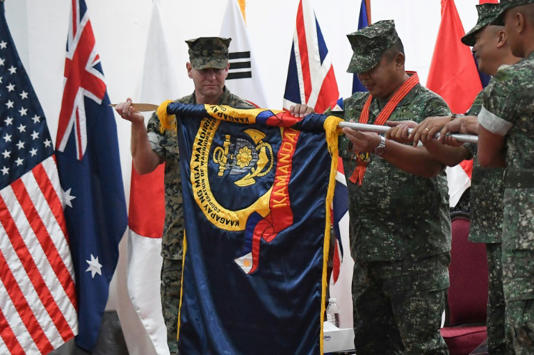
The Philippines is keen to raise relations with the US to “a whole new level,” says the Director-General of the country’s Space Agency, Dr Joel Marciano. His remarks come in the wake of joint naval exercises, dubbed “Sama Sama,” conducted in the waters off the Philippine island of Luzon with the United States and four other allies. Dr Marciano said that a milestone in relations with the US was reached in May this year to collaborate at government level on space and to expand cooperation in using space for maritime domain awareness.
“This is the first time we’re talking on a government level about space,” he told National Security News in an interview at the Meridian Space Diplomacy forum in Washington. “So, this is truly a milestone. For the Philippine Space Agency, which is barely five years old, it is an opportunity to expand Philippines-US relations into this exciting new frontier.”
The increased cooperation between the US and the Philippines, including in the field of space, comes as Chinese maritime forces continue to assert territorial claims in the South China Sea. In recent months, Chinese boats have been accused of ramming Philippine ships and attacking Filipino sailors with water cannons and, in one scenario, machetes. The Philippines has described the nine days of training by the US, Japan, France, Australia, Canada, and the United Kingdom,” as drills aimed at strengthening a “deterring effect” but said it was not aimed at any single country.
EXERCISE SAMASAMA 2024 | The Vice Commander of the Philippine Navy, Rear Adm. Jose Ma Ambrosio Ezpeleta PN, emphasized the importance of regional cooperation in addressing shared challenges during the opening ceremony of Exercise SAMASAMA. pic.twitter.com/QgeoqFRYHT
Dr Marciano said that the Philippines is also considering joining the Artemis Accords, a set of principles initiated by NASA to promote international cooperation in space. He said his country appreciates the principles of the Accords in terms of open science and transparency, noting, “it is a good framework for cooperation in space.”
“This is currently being considered by the Philippines, but it is going through a process of internal consultations. We have to gather different stakeholders in the country and get them into the same room and talk to them about the Accords and how it aligns with our aspirations for responsible and sustainable spacefaring.”
According to Dr Marciano, the Philippines’ space strategy focuses on national security and development, hazard management, climate studies, space research, industrial capacity building, and international cooperation. “The view from space is essential,” he said. “Building capabilities in that domain would benefit decision-making and policymaking in the country.”
He added that space is a frontier becoming well within reach, and the inspirational aspect of space for the young Filipino population—whose median age is 25—should not be underestimated.
The country is focusing on small satellites in cooperation with Japanese universities. Young Filipino students are sent to Japanese universities to build earth observation satellites. “We have taken what we learned from the Japanese universities and cascaded that into the universities in the Philippines. Now, they’re building these small satellites out of their local laboratories and are involved in dialogues with local companies.”
Dr Marciano emphasised the value of international partnerships, advocating that emerging space nations should build on existing advancements and engage in diplomacy and knowledge exchange. The Philippines, he said, also wants to identify programmes of common interest with private space companies in the US, which are generating many exciting developments.