Categories
Sites

C-17’s Transformation With REVOLVER: From Benevolent Buddha To Hypersonic Behemoth – Analysis


C-17’s Transformation With REVOLVER: From Benevolent Buddha To Hypersonic Behemoth – Analysis

File photo of a US Air Force C-17 Globemaster III. Photo Credit: U.S. Air Force photo by Airman 1st Class Christian Silvera

Boeing has introduced the new REVOLVER launcher system. This system is expected to significantly upgrade the C-17 Globemaster III, allowing it to carry powerful hypersonic missiles.

This state-of-the-art launcher features two drums that load one after the other and an electromagnetic catapult. This setup enables it to swiftly fire up to 12 Boeing X-51A Waverider hypersonic missiles. The drums hold the missiles and the catapult launches them rapidly, allowing the launcher to deploy all 12 missiles in a short period. Thanks to this design, each missile can be launched quickly and precisely, enhancing the USA’s air strike capabilities.

The C-17 Globemaster III is the US Air Force’s second-largest aircraft after the C-5M Super Galaxy. It is often called the ‘Buddha’ because of its strong and sturdy look. The C-17 Globemaster III can carry 102 paratroopers, 54 medical patients, or 85 tons of cargo, including tanks. It has a crew of three and can fly from the US to nearly any place in the world with mid-air refuelling.

This flexible military transport plane is great at moving troops, carrying out medical evacuations and transporting cargo. The C-17 can carry about 172,000 pounds (78,000 kg) of cargo and has a range of 2,765 miles (4,450 km), making it crucial for worldwide military missions. Advanced systems, such as the REVOLVER launcher, boost its effectiveness in modern military logistics.

Boeing has shared virtual images and videos of the REVOLVER launcher system to demonstrate its capabilities. Although it has not been installed in the C-17 Globemaster III yet, these visuals highlight its potential, according to a report by Interesting Engineering. The previews show how the system can quickly launch hypersonic missiles and hint at its possible impact on air combat.

Modern Warfare with X-51A

The system can launch the X-51A, a hypersonic cruise missile with a scramjet engine that travels faster than a speed of Mach 5 (over 6,400 km/h). This will allow for accurate long-distance strikes.

Over the coming years, test and integration; of the X-51A Waverider and the REVOLVER launcher on the C-17 aircraft will demonstrate advancements that have been made in military technology. This system aims to enhance military operations by quickly launching high-speed missiles and establishing new defence standards.

US Edge in Pacific Arms Race

The US Air Force, in March, for the first time, tested a hypersonic cruise missile in the Pacific. This move is viewed as a message to China, showing that the US is still competitive in an area where China is thought to have an edge.

On March 17, a B-52 bomber from Andersen Air Force Base in Guam launched “a fully operational hypersonic missile prototype”, an air force spokesperson told CNN. Hypersonic glide vehicles travel faster than Mach 5, at about 4,000 miles/hour (over 6,400 km/h), making them hard to detect and intercept. They can also change direction and altitude, which helps them avoid current missile defence systems.

US officials recognize that China and Russia are aggressively advancing in hypersonic technology. The non-partisan group—which is an organization that does not support, or align with, any political party or agenda and aims at providing unbiased and objective information, or advocacy, on specific issues—the Missile Defense Advocacy Alliance, reports that, since 2014, China has been testing hypersonic glide vehicles that can carry both nuclear and conventional warheads.

The post C-17’s Transformation With REVOLVER: From Benevolent Buddha To Hypersonic Behemoth – Analysis first appeared on The South Caucasus News.


Categories
Sites

You Keep Using the Term ‘Authoritarian’ – OpEd


You Keep Using the Term ‘Authoritarian’ – OpEd

authoritarian protest Index Finger Hands Poor Clouded Sky Water

You know the term “authoritarian.” You think you know what it means.;

An authoritarian dad, boss, or government says: my way or the highway. They are forever barking orders and see compliance as the answer to all human problems. There is no room for uncertainty, adaptation to time and place, or negotiation. It’s ruling by personal dictate while tolerating no dissent.;

To be authoritarian is to be inhumane, to rule with arbitrary and capricious imposition. It can also mean to be ruled impersonally by a machine regardless of the cost. 

Sounds like a conventional government bureaucracy, right? Indeed. Think of the Department of Motor Vehicles. Think of the Environmental Protection Agency and the Department of Energy which are right now issuing edicts that will end in the ability of your washing machine to clean your clothes and your car to go the distance.;

They have been doing this to us for many decades, with or without the permission of Congress or the president. The agencies have become literally out of control in the sense that no one can control them.;

Any society managed by a large and intrusive bureaucratic machinery is necessarily authoritarian. A government that is not authoritarian is necessarily limited in size, scope, and range of power.;

Let’s say you have a political leader who has routinely called for less in the way of authoritarian rule by bureaucracies. He intends to use whatever power he has to curb the autonomous rule by administrative bureaucracies and subject them more to the wishes of the people, who should ideally be in charge of the regime under which they live.;

Such a leader would not be called an authoritarian. He would be called the opposite, an emancipator who is trying to dismantle authoritarian structures.;

If all of the above makes sense to you, try to make sense of this news;story;in the;New York Times. It’s about the growing efforts on the part of many activists to resist a second term of Donald Trump.;

In passing, the story says: “If Mr. Trump returns to power, he is openly planning to impose radical changes — many with authoritarian overtones” including “making it easier to fire civil servants.”

The story quickly adds that he intends to replace the fired employees with “loyalists.” Maybe. But consider the alternative. The president is supposed to be ostensibly in charge of;2 million plus bureaucrats that are employed by 400-plus agencies in the executive branch — but they don’t actually have to carry out the policies of the elected president. They can in fact completely ignore him.;

How is this compatible with either democracy or freedom? It is not. There is nothing in the Constitution about a vast army of bureaucrats who rule behind the scenes that is in no way reachable or manageable by elected representatives.;

The attempt to pull back, rein in, and otherwise do something about this problem is not authoritarian. It is the opposite. Even if “loyalists” replaced the fired employees, that would be an improvement over a system of government in which the people truly have no control at all.;

Two years into Trump’s first term, the administration came to figure out that this was a problem. The administration intended some dramatic turns in policy in a number of areas. All they experienced was dogged resistance from people who believed they and not the elected president were in charge. Over the next two years, they;undertook many efforts;to at least solve this problem: namely, the president should be in charge of the government that falls under his jurisdiction.;

This only makes sense. Imagine you are the CEO of a company. You discover that the main divisions that actually run the company care nothing about what you say and cannot be fired even if you demand it, and yet you are personally held responsible for everything these divisions do. What are you going to do?

It is not “authoritarian” to unseat or otherwise attempt to gain control over that for which you are held responsible, professionally or politically. That is truly all that the Trump people are suggesting. This is nothing other than a Constitutional system: we are supposed to have a government by and for the people. That means that the people elect the administrator of the executive branch. At a minimum, the winner of the election needs to be able to have some influence over what the agencies in the executive branch do.;

And for suggesting this and trying to make it happen, Trump is called an authoritarian. Prepare yourself: this will be said millions of times between now and November and following. Can the mainstream media just flat-out change the meaning of a term like this? They can but there is also every reason to push back and not let it happen.;

Language is a human construct. The more vibrant and fast-moving society is, the more the language changes. That can be a wonderful thing. In fact, one of my favorite books to read in off-hours is H.L. Mencken’s The American Language, written by this genius when he was otherwise censored for his views in wartime. 

It’s a marvelous chronicling of the evolution of American usage, published in 1919, but oddly pertinent even today, applicable to the dwindling number of people who can still form coherent sentences.;

When it comes to vocabulary, there are two schools of thought broadly speaking: prescriptivist and descriptivist. The prescriptivist view is that words have embedded meanings that you can trace from other languages and should be used as intended. The descriptivist approach sees language as more a living experience, a tool of utility to make communication possible, in which case anything goes.;

As Americans, we mostly accept the descriptivist outlook but this can go too far. Words cannot mean literally anything, much less the opposite. But this is exactly what is happening. It’s the same with the word “democracy,” which is supposed to mean the people’s choice, not whatever elites dish out to us. If Trump is the choice, so be it. That is the unfolding of democracy.;

If we want the president to be the CEO of the executive branch of government —;and that’s a pretty good description of what the US Constitution establishes — then the administration ought to have that managerial authority. If you don’t like it, take it up with the Founders.;

Again, any society managed by a large and intrusive bureaucratic machinery is necessarily authoritarian. A government that is not authoritarian is necessarily limited in size, scope, and range of power.;

Any one president who takes action to curb the power and reach of arbitrary authority is not an authoritarian, but rather one who seeks to give authority back to the people. Such a man would be an emancipator, even if everyone said otherwise.;

The post You Keep Using the Term ‘Authoritarian’ – OpEd first appeared on The South Caucasus News.


Categories
Sites

The War On Terror Is Still Hamstringing US Foreign Policy – OpEd


The War On Terror Is Still Hamstringing US Foreign Policy – OpEd

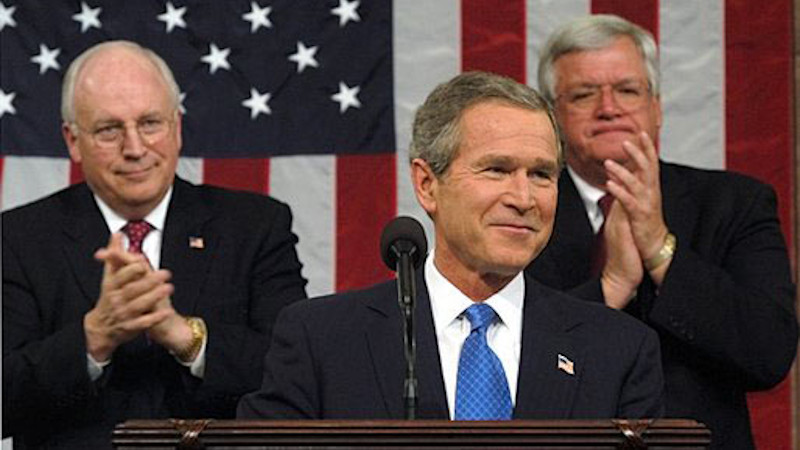
US President George W. Bush delivers 2003 State of Union speech, with Vice President Dick Cheney to left, and Speaker of the House Dennis Hastert to the right. White House photo by Eric Draper

In 2001, after the horrific 9/11 attacks, an apoplectic George W. Bush administration ignored Congress’s narrow authorization to use military force against the perpetrators of the attacks and those who harbored them. Instead, it launched a grandiose global war on terror much broader than those wisely limited legislative instructions. Congress’s authorization attempted to restrict U.S. retaliation to the al Qaeda group sheltering in Afghanistan and their Taliban hosts then ruling that country. Instead, President Bush proclaimed a wider war on terrorist groups having “global reach.”

Bush took advantage of the American public’s blind outrage over the 9/11 attacks on U.S. soil and its ignorance that all Islamist groups, and even some rulers of Muslim countries, were not somehow implicated in the terror strikes on two American cities. Instead of using surgical raids and strikes to decapitate al Qaeda and Taliban leaders in Afghanistan, Bush ignored the failures of the British (in the late 1800s and early 1900s) and the Soviets (in the 1980s) in the “graveyard of empires” by ordering an invasion of that country to topple the Taliban and stand up a working democracy there. This two decades–long nation-building attempt to bring democracy to a country that wasn’t developmentally ready for it yet;cost 243,000 lives and $2.3 trillion and ended in failure—with a resurgent Taliban reinstituting its oppressive rule.

Osama bin Laden, al Qaeda’s main leader, was not killed until 2011 by Bush’s successor, Barack Obama, because, despite the U.S. counterinsurgency quagmire in Afghanistan, Bush soon transferred many key intelligence and military resources to his higher priority invasion of Iraq. Falsely linking Iraq’s ruler Saddam Hussein to the 9/11 attacks, he involved the U.S. military in a costly, long counterinsurgency against Sunni guerrillas, which arose to fight the foreign invaders after Saddam had been toppled. One of these Sunni groups, al Qaeda in Iraq, morphed into the terrorist group Islamic State, or ISIS, which eventually took over vast swaths of land in Syria and Iraq.

Bush also conducted indiscriminate brushfire wars on many other Islamist groups in countless other countries, without regard to whether the groups posed an actual threat to the United States or were motivated by local grievances. In so doing, Bush was merely doubling down on the reason bin Laden had attacked the United States in the first place—excessive U.S. meddling in Islamic countries. Finally, Bush’s over-the-top war on terror also involved illegal surveillance within the United States, jailing suspected terrorist detainees without charges and the legal means to challenge their detention, the use of illegal torture on them, and the use of questionable kangaroo military commissions to try them instead of constitutionally guaranteed civilian trials.

But the war on terror didn’t end when Bush left office. Obama continued all these wars and started his own; his successor, Donald Trump, amped them up further. After seeing and inheriting Bush’s foibles in Afghanistan and Iraq, in a move that proved as disastrous as Bush’s invasion of the latter country, Obama took advantage of the Arab Spring uprisings in 2011 to help eliminate the Libyan dictator Muammar Gaddafi, a previous thorn in America’s side who had been playing ball with the West for some years.

Predictably, when popping the top off an iron-fisted dictatorship that holds a fractious country together, civil war and chaos were likely to ensue—and they did so in Libya as it did in Iraq. In fact, the rise of Islamist groups in the African Sahel, a semi-arid region south of the Sahara Desert, began when Mali fighters, who had defended Gaddafi, returned home to begin a rebellion with the plethora of weapon stocks from the late Libyan leader. Taking advantage of the turmoil, Islamist groups began to take over cities. A foreign intervention by the French pulled in other Western countries, including the United States, and expanded to other nearby West African countries in search of Islamists. Learning nothing from Vietnam, Afghanistan, and Iraq,;France and the United States worked with governments perceived locally as corrupt.

This corruption was the kiss of death for the counterterrorism and counterinsurgency campaign that the French and Americans were prosecuting in the West African Sahel. Unlike conventional war between mass armies, as in Russia’s invasion of Ukraine, the success of such irregular wars, when it can be had, revolves around good governance rather than military suppression of the terrorists or guerrillas. In other words, these irregular forces usually have local grievances with particular governments. And in those brushfire wars, foreign intervention to help the corrupt governments further inflames the jihadists, as has happened as the Islamist rebellion spread against other American or French client states in West Africa. Despite the insertion of American and French troops and hundreds of millions of dollars in military aid, these foreign interventions have failed. Military coups in several Sahel countries (some perpetrated with the help of American-trained local forces) have expelled French and American forces, and al Qaeda and ISIS are resurgent against these new military juntas.

Governments, especially the U.S. superpower, never seem to learn. Instead of admitting that democracy cannot be exported using military force to countries not yet ready developmentally to generate the middle class and political norms for it to arise organically, the U.S. government is merely shifting its nation building projects to countries on the coast of West Africa. The Biden administration is naively offering these coastal nations a 10-year plan to build solar-powered security lighting and new police stations to help nix terrorism.

Of course, the larger issue is that U.S. officials admit that local grievances are fueling the insurgencies rather than Islamist ideology. Thus, even experts say that nation-building approaches, such as water or electrification projects, face daunting odds of succeeding. Moreover, identifying a threat to the United States by these local Islamist groups is difficult. The Chinese may be after minerals and the Russians may be trying to replace the U.S. and France to gain influence, but their efforts are likely to be as much a waste of time and money as that of the United States.

The post The War On Terror Is Still Hamstringing US Foreign Policy – OpEd first appeared on The South Caucasus News.


Categories
Sites

Caitlin Clark, Bullying And The Business Of Basketball – OpEd


Caitlin Clark, Bullying And The Business Of Basketball – OpEd

Caitlin Clark addresses the media in her press conference shortly after being selected first overall in the 2024 WNBA Draft. Photo Credit: JazzyJoeyD, Wikipedia Commons

By Kevin Duffy

Why do people watch sports? My mother believes it’s because “people want to be uplifted.” This may explain why many are upset about how basketball phenom Caitlin Clark, who broke the National Collegiate Athletic Association (NCAA) women’s and men’s scoring records, is being treated—or mistreated—in the Women’s National Basketball Association (WNBA).

As a longtime basketball fan, I’ve rarely given women’s basketball a second thought. Women play below the rim and lack the athleticism and WOW factor of their male counterparts. The WNBA brings in less than one-fiftieth the;revenue;of the National Basketball Association (NBA) for good reason ($200 million compared to;$10.58 billion).

Earlier this year, Clark hit a game winning, buzzer beating, deep three-point shot that got my attention. I kept hitting replay, not believing what I was seeing. This wasn’t a 1950s-style push shot but a jump shot with perfect form that looked like it came from the present-day men’s game. And it was from nearly thirty feet, truly a game changer. The hype surrounding Caitlin Clark was real, and the;viewership records;are no fluke.

Amid much fanfare, Clark was drafted number one by the WNBA and immediately tossed into a grueling schedule playing heavy minutes for the worst team in the league. The;fangs came out;early, even before she stepped foot on the court. Ten games into the season, Chicago Sky guard Chennedy Carter;blindsided;Clark on an inbound play that looked more like roller derby, then went to the bench where she was exuberantly greeted by her teammates. Carter’s coach;downplayed;the cheap shot, and Carter showed;no regrets: “I’m a competitor.;.;.;. It’s basketball. It’s all hoops. After we finish the game it’s all love.”

Whatever it is, it’s not good for business. Charles Barkley, NBA commentator and Hall of Fame player, reacted: “Y’all should be thanking that girl for getting y’all [expletive] private charters, all the money and visibility she’s bringing to the WNBA. Don’t be petty.” A few days later, Barkley;lamented, “Instead of talking about all the good things happening in the WNBA, we’re talking about negativity. There used to be the old saying, ‘All publicity is good publicity.’ No it’s not, not when you’re a niche sport trying to get the consumers to buy into your product.”

With a league in dire need of eyeballs, why would so many (not all) WNBA players be hostile to the one player who brings with her a massive fan base? According to;Clay Travis, founder of;OutKick, “The average WNBA player does not like Caitlin Clark because she is white, because she is straight and because now she is rich and getting a lot of attention. And there is a great deal of;resentment;about that.”

At the root of this;envy;is egalitarianism, the theory that all people are equal and that any differences in outcomes must be unjust and therefore remedied by the state. While;inequality in nature;is the norm, the sport of basketball provides one of the starkest examples on the planet: Victor Wembanyama, the top overall draft pick in the NBA, was paid $12.2 million his first year, 160 times that of;Caitlin Clark;($76,000).

From a free-market perspective, however, outcomes in sports are determined by;voluntary exchanges—fans, sponsors, and media pay for what they value. Only the process can be judged to be “fair” or “unfair.”

The Economics of Sports

The business of sports is highly scalable: games can be streamed to billions of viewers at practically zero marginal cost. Naturally, people have limited free time and prefer the highest quality product so outsized rewards accrue to a limited supply of top athletes. Demand for sports and sport figures is based on multiple factors: excitement, competition, spectacle, inspiration, achievement, fairness, community, relatability, likability, and physical attraction. Marketability of the product as well as individual athletes is based on checking as many of these boxes as possible. In contrast, the egalitarian is only interested in checking as many;victim group;boxes as possible—e.g., female, minority, gay, poor, short, ugly, etc.

Within a league and even within a team, inequality is the rule. Superstar NBA players like Michael Jordan, Lebron James, and Stephen Curry are exceedingly rare, but they can’t win by themselves. Teams need role players to complement their stars. For example, Jordan needed outstanding defenders and rebounders like Dennis Rodman as well as sharpshooters like John Paxson and Steve Kerr. You could not cobble together a more disparate group. Even though Jordan received most of the accolades and a disproportionate share of the financial pie, he elevated everyone around him. Kerr won five championships as a player (three with Jordan) and went on to become a successful NBA commentator and coach, adding another four championships with a team led by Curry. Not bad for a 6′;2″ white guy who can’t jump.

Sports leagues are constantly innovating to add excitement, competitiveness, and fairness. Basketball was once painful to watch as teams would get the lead and try to run out the clock without taking a shot. In 1954, the NBA introduced the twenty-four-second shot clock, ushering in the modern era of professional basketball. In 1951, the lane (an area below the basket where players can only spend three seconds) was widened to counter the dominance of big men like George Mikan and expanded further in 1964 due to Wilt Chamberlain.

During the 1979–80 season, the NBA added the three-point line which was initially dismissed as a gimmick. While its adoption was gradual and took decades, Stephen Curry’s entry into the league in 2009 revolutionized the three-point shot, making it a lethal offensive weapon and focus of the game. Caitlin Clark is the female version of Curry, which explains why she has NBA legends buzzing.

Source: Basketball Reference; WNBA Historical StatisticsSource: Basketball Reference; WNBA Historical Statistics

A Tale of Two Business Models

Following this meritocracy playbook, the NBA became a model of success: It boasts the third highest revenue among sports leagues in the world and attracts a truly global audience. China is its biggest international market with an estimated eight hundred million viewers.

In contrast, the WNBA failed to turn a profit throughout its twenty-seven years in existence,;propped up;ironically by the NBA, which owns 42 percent. Its primary mission is social activism, even if that means turning away paying customers. In February 2022, after;raising;$75 million from investors including Nike,;WNBA commissioner Cathy Engelbert said, “Our strategy is to deploy this capital to continue to drive the league’s brand as a bold, progressive entertainment and media property that embodies diversity, promotes equity, advocates for social justice, and stands for the power of women.”

To many, the WNBA’s brand image is a;welfare league;of angry women. Leaving Caitlin Clark off the Olympic team was another;missed opportunity, surely one of the biggest marketing blunders in sports history.

Despite the WNBA’s ineptitude, market forces threaten to rescue it from extinction. Three years ago, the NCAA allowed college athletes to profit from their name, image, and likeness. Companies like New Balance, LegalZoom, and State Farm feature WNBA players alongside NBA players in commercials. After all these years, the sport of basketball is finally becoming lucrative for a dozen or so women, even though the maximum salary in the WNBA is just $250,000. Clark recently signed a;$28 millionendorsement deal;with Nike.

Among Caitlin Clark’s most ardent defenders are black men associated with the NBA. Never at a loss for words, ESPN analyst;Stephen A. Smith;said,

Caitlin Clark is bringing more attention. When you get on the court with her and you perform and somehow, someway, you’ll find a way to attach yourself to that level of magnetism that she surely has, who knows what could be out there for you? And if suddenly the maximum salary goes from $250,000 to $450,000, and suddenly you’re on chartered jets instead of commercial flights, and suddenly you’re maximizing the potential of your name, image and likeness, what do you care? At the end of the day, the rising tide lifts all boats .;.;.

See how simple it is? It’s capitalism! It’s marketability! It’s taking advantage of the moment! That’s business!;Why be resentful of any of them? What is wrong with people? How do you not see that?

Russell Lamberti recently;tweeted, “Sport is a radical hierarchy of excellence sorted by genetics, upbringing, resources, luck, volition and character. Egalitarians therefore hate sport and are driven relentlessly to disfigure it with ideology.”

These forces are colliding on the basketball court.

Think of this as a teaching moment for the WNBA and its players. Life isn’t fair. Capitalism uplifts and grows the pie for everyone but doesn’t split it equally. The alternative is to tear down the most successful and fight over crumbs.

I hope Caitlin Clark and the profit motive will ultimately win out and that better days lie ahead for the WNBA. If so, perhaps the business of basketball will one day dissuade promoters of equality and zero-sum economics. One can dream.

  • About the author: Kevin Duffy is principal of Bearing Asset Management which he cofounded in 2002. The firm manages the Bearing Core Fund, a contrarian, macro-themed hedge fund with a flexible mandate.
  • Source: This article was published by the Mises Insitute

The post Caitlin Clark, Bullying And The Business Of Basketball – OpEd first appeared on The South Caucasus News.


Categories
Sites

Climate Change And Urban Violence: A Critical Knowledge Gap – Analysis


Climate Change And Urban Violence: A Critical Knowledge Gap – Analysis

children mother family poverty suffering

By Dr Farah Hegazi

Cities will play a key role in humanity’s future. More than half;;of the world’s population (57 per cent) lived in urban areas in 2022 and the share is projected to reach;almost 70 per cent by 2050. Cities already feature in the climate change debate for their carbon footprints and, in many cases, leadership and innovation in the green transition. But they are also uniquely vulnerable to climate change.

There has been little research to date on how climate change could increase the risk of urban violence, but there are many reasons to think that it could do so. As both urbanization and climate change intensify, there is an urgent need to understand this relationship in order to prevent the effects of climate change from becoming yet another source of violence in cities.;

This blog examines one potential set of causal relationships by which climate change might increase the risk of violence being perpetrated by or against the urban poor: perceived governance failures that make them more vulnerable to climate change impacts, causing grievances that eventually result in violence.

Exposure and vulnerability to climate change in cities 

Cities are exposed to a wide variety of climate change effects. Research suggests that the;most important impacts;are likely to be higher average temperatures, heatwaves, flooding from changing rainfall patterns and sea-level rise, and water scarcity.;

An example of how climate change can impact urban residents is flooding. Around the world, about;25 per cent;of the global population lives in high-risk flood zones,;the vast majority in developing countries. Flooding has;myriad effects on cities, including by increasing public health risks and disease outbreaks when water and sanitation systems are compromised, and damaging or destroying property. Flooding can disproportionately impact the urban poor, especially if they live in informal settlements in flood-prone zones.;

While flooding can be the result of heavier rainfall, many of the world’s cities will also be exposed to the effects of sea-level rise. By 2050, it is projected that;about 800 million people;will be living in cities affected by at least half a metre of sea level rise. In Dar es Salaam, Tanzania, for example,;approximately 8 per cent of the city;is currently below sea level, putting at least 143;000 people at risk of coastal flooding. Informal settlements in Dar es Salaam are also growing as a result of a rapidly increasing population,;including in already coastal flood-prone areas. Coastal flooding not only destroys property but it can damage critical infrastructure and;contaminate;the city’s freshwater resources.;

From governance failures to grievances

Poor urban governance and infrastructure can;increase vulnerability to the effects of climate change. For example, in 2023,;Storm Daniel hit the east coast of Libya, bringing with it strong winds and heavy rainfall which led to extensive flooding. The storm caused the failure of a long-neglected dam, which led to the total destruction of whole neighbourhoods in the port city of Derna, with thousands killed and tens of thousands displaced.

Even before Storm Daniel,;poverty rates in Derna were high and other infrastructure was badly maintained. One week after the storm,;grievances against the city government spilled over;when residents of Derna took to the streets to demand accountability for the neglect of the dam and the mismanagement of the crisis. The protests escalated to violence when protesters set the house of the city’s then mayor alight.

Poor governance and neglect often contribute disproportionately to the climate change vulnerability of poor and marginalized urban communities. As well as failing to build these communities’ preparedeness and resilience ahead of time, authorities have often provided inadequate help during crises and post-crisis recovery. For example, during flooding in Accra, Ghana, in June and July of 2006, authorities;provided no concrete assistance;to informal communities, even after complaints were lodged, forcing residents to fend for themselves. Such neglect can fuel grievances, potentially leading to unrest and even violent protest—as well as violent suppression by state or private actors.;

In some cases, official responses to climate change impacts even make the situation worse for affected communities. For example, recent flooding in Nairobi, Kenya, affected;more than 380 000;people across the city, but the government’s response has;created more difficulties;for poor communities. Reportedly;invoking its ‘duty to protect lives’ as justification, the government has;evicted low-income residents;living within 30 metres of riparian zones, demolishing their homes and providing them with temporary shelter. Further fueling grievances and resentment against the government, many affected families have still not received financial compensation;promised;by Kenya’s President William Ruto.

More research is needed on the links to urban violence

There are solid grounds for believing that climate change impacts could increase the risk of violence in affected cities and urban communities. When authorities fail to protect and support communities, and especially when the actions of authorities—or indeed of private citizens or businesses—are perceived as contributing to a community’s marginalization and vulnerability, this can be a source of anger and resentment.;

The research on urban violence shows that such grievances can be a source of violence, direct or indirect. Because the world is rapidly urbanizing, and climate change will increasingly affect cities, it is reasonable to assume that—unless steps are taken to reduce the vulnerability of urban communities, increase their resilience and provide adequate, just responses—climate change could increase grievances among urban communities that in turn spill over into violence.

However, academic research on how climate change contributes to urban violence is very limited. Most of the research focuses on the impacts of urban flooding on unrest, including riots and violent demonstrations, and indicates that;flood-related violence tends to occur in places where affected groups are marginalized.;

However, the limitations of the research leave it unclear how, and even whether, grievances constitute a predictable pathway by which urban marginalization and climate vulnerability lead to unrest and potential violence. More research is therefore needed to understand what these circumstances are and how the climate-related grievance mechanisms play out—for example, when and how grievances might lead to violence and how this can be prevented.;There may also be other mechanisms linking climate change and urban violence that are worth exploring. For example, climate mitigation or adaptation measures could cause grievances if they are poorly planned or perceived as unjust.

Equipped with that understanding, addressing the effects of climate change can be used as an entry point for violence prevention in tomorrow’s cities.

The post Climate Change And Urban Violence: A Critical Knowledge Gap – Analysis first appeared on The South Caucasus News.


Categories
Sites

Judge in Trump classified documents case reprimands prosecutor at hearing – NBC News


The post Judge in Trump classified documents case reprimands prosecutor at hearing – NBC News first appeared on Trump And Trumpism – The News And Times.


Categories
Sites

VOA Newscasts


Give us 5 minutes, and we’ll give you the world. Around the clock, Voice of America keeps you in touch with the latest news. We bring you reports from our correspondents and interviews with newsmakers from across the world.

Categories
Sites

WikiLeaks founder Assange to plead guilty in deal with US  


washington — WikiLeaks founder Julian Assange will plead guilty to a felony charge in a deal with the U.S. Justice Department that will resolve a long-running legal saga that spanned multiple continents and centered on the publication of a trove of classified documents, according to court papers filed late Monday. 

Assange is scheduled to appear in federal court in the Mariana Islands, a U.S. commonwealth in the Western Pacific, to plead guilty to an Espionage Act charge of conspiring to unlawfully obtain and disseminate classified national defense information, the Justice Department said in a letter filed in court. 

The guilty plea, which a judge must approve, abruptly ends a criminal case of international intrigue and the U.S. government’s yearslong pursuit of a publisher whose hugely popular secret-sharing website made him a cause celebre among many press freedom advocates. Investigators, by contrast, have repeatedly asserted that his actions broke laws meant to protect sensitive information and that he put the country’s national security at risk. 

He is expected to return to Australia after his plea and sentencing, which is scheduled for Wednesday morning local time in Saipan, the largest island in the Mariana Islands. The hearing is taking place there because of Assange’s opposition to traveling to the continental U.S., and because of the court’s proximity to Australia.


Categories
Sites

US expected to announce $150M in new military aid for Ukraine


Pentagon — The U.S. is expected to announce a new military aid package for Ukraine valued at up to $150 million as soon as Tuesday, two U.S. officials tell VOA.

The package is being provided to Kyiv under the presidential drawdown authority (PDA), which pulls weapons, ammunition and equipment from U.S. military stockpiles to fulfill Ukraine’s short-term needs. 

One of the officials — who spoke on the condition of anonymity to discuss the package ahead of its planned announcement — said the latest round of aid would include munitions for HIMARS and other critical munitions. It does not include cluster munitions, according to the official.

Asked whether the aid package includes long-range missiles known as ATACMS, the official replied, “For operational security reasons, we aren’t going into further details.”

ATACMS have a range of up to 300 kilometers (about 185 miles) and nearly double the striking distance of Ukraine’s missiles. 

When asked by VOA on June 12 if the United States had provided Ukraine with more ATACMS since mid-March, Chairman of the Joint Chiefs of Staff General C.Q. Brown said, “We’re working through the ATACMS piece, and we continue to provide that capability through our PDAs.” 

Russia has accused Ukraine of using some of the U.S.-provided ATACMS in deadly strikes this week inside Crimea, which Russia illegally annexed in 2014, and in Russia’s Belgorod region bordering Ukraine.

Russia summoned the U.S. ambassador in Moscow on Monday to protest the use of the missiles.

This week’s aid package for Kyiv will dip into the $61 billion in Ukraine funding signed into law by President Joe Biden in April. 


Categories
Sites

Condo safety: Tampa urging associations to comply with law created after Surfside collapse – WFLA


The post Condo safety: Tampa urging associations to comply with law created after Surfside collapse – WFLA first appeared on The Condo Law.