
The post Russia Hits Ukraine’s Power System for Eighth Time Since March – Yahoo Finance first appeared on The Russian World.
Day: June 22, 2024
Пострадавших и разрушений нет.
The post Богомаз: над Брянской областью уничтожили ещё девять беспилотников first appeared on The Russian World.
Принцу Луи и принцессе Шарлотте предстоит найти себе занятия, не связанные с королевской семьей.
The post Daily Beast: принц Уильям решил выгнать детей из Букингемского дворца first appeared on The Russian World.
Categories
NPR News: 06-22-2024 7PM EDT
NPR News: 06-22-2024 7PM EDT
Learn more about sponsor message choices: podcastchoices.com/adchoices
The post NPR News: 06-22-2024 7PM EDT first appeared on The South Caucasus News.

By Christy Lee
A new defense pact signed between Russia and North Korea this week publicly laid out Moscow’s willingness to engage in full-fledged military cooperation with Pyongyang, in contrast to their denials prior to the summit, analysts said.
Before Russian President Vladimir Putin visited Pyongyang for a summit with North Korean leader Kim Jong Un on Wednesday, it was already widely believed that Moscow was transferring military technology to Pyongyang for weapons upgrades.
In 2023, North Korea launched the solid-fuel Hwasong-18 missile for the first time. After analyzing the shape and color of the smoke at the tail of the missile, experts said these technologies appeared to have come from Russia.
At the same time, U.S. and other officials have accused North Korea of providing Russia with large quantities of conventional munitions for its war in Ukraine.
In September, Kim showed an interest in various military assets during his tour of Russia’s satellite launch site, fighter jet factory, and Pacific Fleet equipped with nuclear-capable bombers and hypersonic missiles.
Both Russia and North Korea denied any arms dealings between them prior to Putin’s visit to Pyongyang.
It is still uncertain exactly what types of military technology Moscow could provide Pyongyang.
But at the summit, Moscow made explicit its willingness to prop up Pyongyang’s military in return for continued flow of munitions to use against Ukraine, according to Bruce Bechtol Jr., a former intelligence officer at the U.S. Defense Intelligence Agency and now a professor at Angelo State University in Texas.
In the Treaty of Comprehensive Strategic Partnership signed between Putin and Kim at their summit, the two agreed to set up “mechanisms” for undertaking “measures” for “strengthening the defense capabilities.”
They also agreed to develop and cooperate in the areas of science and technology, including space.
At a joint press conference following their summit, Putin said Moscow “does not rule out developing military and technical cooperation” with Pyongyang as agreed on in the pact in response to the U.S. and other NATO countries’ allowing weapons that they supplied to Ukraine being used against targets inside Russia.
Kim and Putin also agreed in the treaty to intervene militarily if either North Korea or Russia is invaded. But Bechtol said the most significant part of the treaty “is military cooperation.”
“We’re not going to invade North Korea. We’re not going to invade Russia. It’s all about the military cooperation, the arms deals” that have “no limits” and will be made in a “barter” form rather than in a “cash and carry” arrangement, he said.
Any arms exports or imports by North Korea would violate U.N. Security Council resolutions.
Putin trade proposal;
In an article by Putin published by North Korea’s state-run newspaper;Rodong Sinmun;on Tuesday ahead of his arrival in Pyongyang, Putin said Russia and North Korea would develop a trade and payment system not controlled by the West. This would make it easier to circumvent international sanctions on both countries.
Joshua Stanton, a Washington-based attorney who helped draft the North Korea Sanctions and Policy Enforcement Act of 2016, said, “Russia and North Korea have been talking about setting up ruble-based and renminbi-based payment systems for at least a decade.”
He continued: “It never worked before. It would probably violate U.N. sanctions, and if our Treasury Department is willing to impose secondary sanctions on the banks that facilitate it, it will fail again.”
Moscow and Pyongyang are likely to exchange military hardware using railways rather than sea routes to avoid “any kind of interdiction,” said David Maxwell, vice president of the Center for Asia Pacific Strategy. He said the idea of interdiction could be discussed when Washington, Seoul and Tokyo meet on the sidelines of a NATO summit in July.
Putin said at a press conference in Pyongyang this week that Russian Railways will participate in the upgrade of the Khasan-Rajin railway crossing between the two countries.
‘High intensity of commitment’;
Even without the treaty, military cooperation — including arms transfers from Russia to North Korea — was likely to have gone forward, according to Bechtol and other analysts.
“I frankly don’t think that the treaty makes a huge difference,” said Michael Kimmage, who from 2014 to 2016 served on the Secretary’s Policy Planning Staff at the U.S. State Department, where he held the Russia-Ukraine portfolio.
“It’s signaling a high intensity of commitment” and “a longevity of commitment,” which “in and of itself is quite significant,” but “I don’t think the treaty itself is that dramatic of a turning point,” he said.
Bruce Bennett, a senior defense analyst at the RAND Corporation, said, “It is hard to imagine this new agreement makes it easier for Russia to transfer military technologies to North Korea, given the transfers in recent years of Iskander missile technology, liquid oxygen and petroleum fuel for satellite launchers, repair of satellite launcher problems, GPS jammers, and 24 mm MRL precision guidance.”
He continued: “I think the bottom line is not the greater feasibility of weapons technology transfers but the Russian government’s greater political willingness to make the transfers.”
Putin’s outspoken willingness to cooperate militarily with Pyongyang has prompted deep concerns in both Seoul and Washington.
A senior South Korean presidential official said on Thursday that Seoul will now consider sending arms directly to Ukraine. Seoul has withheld providing lethal weapons to Ukraine since Russia invaded the country in February 2022.
A spokesperson for the South Korean foreign ministry told VOA’s Korean Service on Thursday that Seoul is “gravely concerned” about the treaty and the declaration of military technology cooperation “that outrightly violates U.N. Security Council resolutions.”
A State Department spokesperson told VOA Korean on Wednesday that “deepening cooperation between Russia and the DPRK is a trend that should be of great concern.” The Democratic People’s Republic of Korea (DPRK) is North Korea’s official name.
In contrast, Liu Pengyu, a spokesperson for the Chinese Embassy in Washington, told VOA on Thursday that Moscow and Pyongyang have “a normal need for exchanges, cooperation and a closer relationship.”
The post Russia-North Korea Defense Pact Moves Military Cooperation Out Of Shadows first appeared on The South Caucasus News.
By Rahim Rahimov
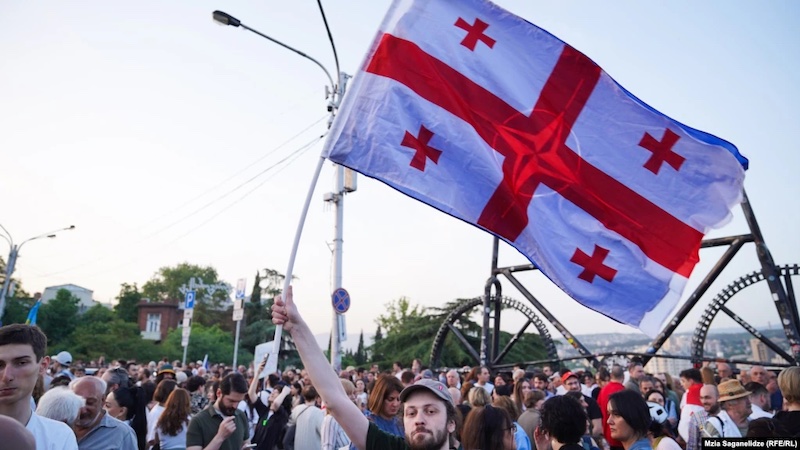
On June 2, Speaker of the Georgian Parliament Shalva Papuashvili signed into law the controversial bill “On Transparency of Foreign Influence” as the parliament overrode Salome Zourabichvili’s presidential veto (see EDM, May;13,;22). The Russian-style “foreign agents” bill was originally withdrawn in 2023 under intense public pressure but was reintroduced by the ruling Georgian Dream party in 2024 (Csf.ge, February 21, 2023;;1tv.ge;;Venice.ceo.int;;Imedi.ge, May 21;;Rustavi2.ge;;JAM-news, June 3).The law on foreign influence and, more importantly, the aggressive way in which it was pushed through have sharpened social divisions and fueled anti-government protests. The law reflects a series of controversial policies that the Georgian Dream government has forced on civil society, including laws on family values, offshore transfers, amendments to the media law, and changes to the electoral code.
Analysis of the recent developments highlights Georgia’s growing confrontation with a civilizational dilemma. The law on foreign influence is not only a manifestation of the domestic struggle for power in Georgia but also a reflection of two competing world views—a democratic, pro-Western movement, on the one hand, and a non-democratic perspective, on the other (see EDM, April;9,;24,;May 1). In a political sense, how informal rules and practices as well as cultural norms and structures play out in the struggle for power are the main distinction between the two predominant views. Georgian civil society, which is the primary target of the Georgian Dream law, currently performs its traditional function in countering the concentration of power in only a few hands as the division of power has become merely formal and opposition parties are weak and fragmented. Defining the level and scale of informal practices and norms currently at play is crucial in determining whether a particular political regime is democratic or non-democratic.
The informal practices in today’s Georgia are epitomized by billionaire Bidzina Ivanishivili, who has been dubbed the country’s de facto leader though he does not hold public office (see EDM,;January 18,;February 6). Prime Minister Irakli Kobakhidze’s lamentations that Ivanishvili’s $2 billion assets are effectively under Western sanctions can be interpreted in two, albeit not mutually exclusive ways. First, Kobakhidze’s statements primarily attribute current tensions with the West, including the adoption of the foreign agents law, to Ivanishvili’s business interests. Second, the premier’s words downplay the Russian factor in Tbilisi’s decision-making, as the ruling Georgian Dream party does not want to appear to be directly associated with Moscow (Agenda.ge, December 30, 2023;;Civil.ge, April 29;;Sakartvelosambebi.ge, May 13;;Gov.ge, May 14;;Transparency.ge, accessed June 18). The split in the country’s geopolitical orientation threatens to destabilize the domestic situation further in the face of upcoming parliamentary elections in October.
Georgian Dream Feigns Continued European Course
On December 13, 2023, the European Union officially granted candidate status to Georgia (see;EDM, November 14, 2023). In an immediate response, Irakli Garibashvili, then-prime minister and current Georgian Dream party chair, stated, “The future of Georgia lies in the European Union, and there is no alternative to it. Our nation and my government expect that EU member states will take a strategic and forward-looking decision this week that will firmly anchor Georgia … with the family of European democracies” (Garibashvili.ge, December 13, 2023). Two weeks later, Georgian Dream created the position of honorary chair with Ivanishvili assuming the “ceremonial” position.
Since then, the ruling party has taken a completed U-turn (see EDM,;February 6,;April 9,;May 1). Illustratively, Garibashvili soon changed tone, remarking: “We are not ready to become a member country” (Interpressnews.ge, April 20). Civil society organizations in Georgia have tried to mitigate the damage done by government rhetoric pushing back on EU membership. They continue to contribute to promote European values and practices within Georgian society to ensure that the country, even informally, remains on a European course.
The Georgian Orthodox Church, however, has opposed many of civil society’s efforts. The church itself enjoys widespread moral authority throughout Georgia, and that role is recognized and enshrined in the country’s constitution. Yet, while the constitution recognizes the Georgian Orthodox Church’s special role in the country’s history, it does call for the church to operate independent from the state (Matsne.gov.ge, June 29, 2020;;Caucasuswatch.de, February 24, 2022;;JAM-news, January 30, 2023; see;EDM, March 13;;Georgefox.edu, accessed June 19).
The church is historically linked to and enjoys warm relations with the Russian Orthodox Church. Indeed, the Patriarchate of the Georgian Orthodox Church has not recognized the autocephaly of the Orthodox Church of Ukraine granted by the Ecumenical Patriarch of Constantinople in 2019, which made the Ukrainian church independent from the Russian Orthodox Church (JAM-news, April 24, 2022;;Sova.news, March 27, 2023). According to Georgian scholars Beka Mindiashvili and Gigi Ugulava, the Russian and Georgian churches are connected through the shared ideology of “political orthodoxy” (Ostwest.space, November 28, 2023).
As such, church officials have publicly supported the law on foreign influence (Interpressnews.ge;;Facebook.com/sazupatriarchate, April 27). Incidentally, former Georgian President Eduard Shevardnadze recalled in his memoirs that Ivanishvili made donations to renovate the Sameba church in Tbilisi, apparently in a move to curry favor with church leadership. The most transformative and pro-western Georgian leader, former President Mikheil Saakashvili, also sought to appease the Patriarchate of Georgia. He increased state funding for the Patriarchate to a record level and, more importantly, approved the change of the national flag to the current iteration as encouraged by Catholicos-Patriarch of All Georgia Ilia II. Shevardnadze had earlier declined to approve the flag change. The Georgian Dream government raised the state funding for the Patriarchate once again in 2024, upholding the tradition of Georgian government’s paying homage to the church’s power and influence (Civil.ge, October 20, 2021; Frontnews.ge, March 19).
Another vivid manifestation of the clashing two world views is seen in Georgian Dream’s dogmatic approach to the country’s sovereignty and the national aspiration to integrate with the European Union. The dogmatic approach is vivid in the adoption of the law on foreign influence. The Georgian Dream government regards sovereignty as the end goal and sees it exclusively as the state’s complete independence and control over civil society. In the name of that sovereignty, the ruling government tends to monopolize power and decision-making while ignoring another equally important aspect of sovereignty—namely, the sovereignty of the people.
In contrast, democratic states tend to take an instrumental approach to sovereignty to serve the welfare of citizens. The instrumental approach would allow the government to use its sovereignty to uphold Article 78 of the Georgian Constitution to facilitate European integration and serve its citizens’ aspirations. Georgian Dream officials, however, have framed the foreign agents law as serving to consolidate state sovereignty. Such a stance resonates strongly with the Georgian Orthodox Church’s framing of sovereignty as “complete state independence,” without which “no good deed will come out for the country.” Seemingly competing with that view, Article 78 of the constitution obligates the government to “take all measures within the scope of its competences to ensure the full integration of Georgia into the European Union” (Matsne.gov.ge, June 29, 2020;;Civil.ge, April 29). At the time of writing, it remains unclear how the ruling party intends to walk this tightrope.
The Georgian Dream’s approach to sovereignty is intended to take Georgia away from the European integration (see EDM,;February 6, May;10,;25, 2023). The ruling party, nevertheless, does not want to make that decision. Instead, it wants to provoke the European Union to reject prospective Georgian membership and pin the blame on Brussels. Georgian Dream officials are clearly aware that, as a supranational organization, the European Union requires member states pool together parts of their national competences for the common good. The European Union’s policies on the Schengen Area are instructive in this regard. Those member states that have become a part of Schengen have agreed to delegate part of their sovereignty to Brussels. The dogmatic approach would block the free movement of people among EU member states. The applied instrumental approach, in contrast, facilitates full free movement to serve the welfare of citizens.
The European Union granted candidate status to Georgia even before it satisfied the necessary requirements for the candidacy (see EDM,;November 14, 2023;;January 8). The Georgian Dream leaders rushed to take credit for it ahead of the parliamentary elections (Eurasianet, November 10, 2023;;OC-media.org, December 14, 2023). Brussels had previously granted visa-free travel to Georgia in 2017. In the early 2010s, Russian President Vladimir Putin had publicly requested a visa-free regime with the European Union, later complaining that Brussels had not granted his request. He claimed that a visa-free travel regime was critical to “beginning the process of real integration between Russia and the European Union” (Kommersant, November 17, 2011;;TASS, January 19, 2014). On March 31, 2024, Bulgaria, a Christian Orthodox country and EU member state, celebrated partially joining the Schengen Area after 13 years of waiting (Novinite.com, June 20). Other Orthodox countries, including Greece, Cyprus, and Romania, have enjoyed numerous benefits as EU members. While EU membership has had its own complications for these countries, the benefits have far exceeded the costs largely due to the access to the huge single market, economic and investments opportunities, as well as strengthened cooperation on defense and security. As Cristian Ghinea, who served as the Romanian minister for European funds, put it “EU funds for us is like gas money for Russia, or oil money for Saudi Arabia” citing new roads, running water in rural areas, and new or improved waste management systems as among the concrete benefits of membership (Ekathimerini.com, January 6, 2022).
Overall, it is Georgia’s sovereign choice, including that of the government and the people, to pursue or end aspirations for EU membership. Currently, official Tbilisi’s discourse and behavior create an impression that Georgian Dream officials do not want to officially initiate the abandonment or refusal of the country’s European course themselves. Instead, they seem to be angling to provoke the European Union to refuse Georgia’s European perspective. Illustratively, Kobakhidze claimed that the law on foreign influence will in fact “create a better basis for ensuring Georgia’s accession to the European Union” (Agenda.ge, May 28). He rationalized this position by alleging that the law “will contribute to the fulfillment of the main recommendation of the European Union—depolarization.” Thus, it will strengthen the democratic institutions through “pacification of the country.”
In the case of Brussels’ suspension or withdrawal of Georgia’s candidate status and/or potential refusal to open accession talks, Georgian Dream would use that to try to discredit the European Union in the eyes of the Georgian population, on the one hand, and rally popular support for its controversial policies, on the other. This is why granting Georgia candidate status even though the government failed to satisfy the necessary requirements was a prudent and preemptive act (Eeas.europa.eu, September 20, 2022;;Georgiatoday.ge, November 22, 2023). As Georgian expert Kornely Kakachia evaluated last year, Georgian Dream was “aiming for EU candidacy status, if only to claim credit for it ahead of parliamentary elections” (Caliber.az, December 12, 2023).
Georgian Dream’s Perspective on Moscow
An increasingly public debate has centered on the question of whether Georgian Dream acts in direct collaboration with Moscow (see EDM,;August 11, 2022, February;6,;22, May;15,;25,;July 3,;August 10, 2023,;February 15,;March 19,;April 9). No solid proof yet confirms or rejects the notion that the foreign agents law and Georgian Dream’s policies are directly connected to the Kremlin. Even so, an overlapping consensus is already emerging between official Tbilisi and Moscow. As any other state, Russia pursues its own interests and, therefore, sees an added strategic value in Georgia following the withdrawal of Russian peacekeepers from Azerbaijan and Armenia’s pivot to the west.
The Georgian Dream government is keen to seize this opportunity (Chegem.su, May 2;;Chatham House, May 23). In this context, media speculation and related reports have resurfaced suggesting the possibility of the creation of a confederation between Georgia and the self-proclaimed, Russian-recognized breakaway regions of Abkhazia and South Ossetia (see;EDM, June 17). Theoretically, such a scenario might be possible. In its April 27 statement in support of the law on foreign influence, the Patriarchate of the Georgian Orthodox Church emphasized the aspiration “to live in a united state with our Ossetian and Abkhazian brothers.” This was echoed in Kobakhidze’s Independence Day address, in which he proclaimed, “let us live … together with our Abkhazian and Ossetian brothers and sisters.” Whether Georgian society would agree, Abkhazia and South Ossetia would accept that arrangement, and Russia would seriously consider such a scenario remain open questions (Civil.ge, December 12, 2006;;Kavkaz-uzel, March 8; see;EDM, March 19;;Ekhokavkaza.com, April 3;;Chegem.su, May 15;;YouTube, May 26). Such speculations may be intended to check the public reaction and simultaneously divert attention from the law on foreign influence.
Nonetheless, as Abkhazian expert Inal Khashig put it, “the Georgian choice must be between those who choose a European future and those who are ready to continue dreaming about Abkhazia” (Chegem.su, May 27).The law on foreign influence, among other intentions, seeks to affect civil society primarily by countering potential domestic objection to that status for Abkhazia. Almost simultaneously, a similar law is under consideration in the Abkhazian parliament (Sakartvelosambebi.ge, February 8;;Abkhazworld.com;;Ekhokavkaza.com, May 15).
Russia’s most realistic interest in the confederation scenario is to influence Georgia’s foreign policy orientation through the purported confederate regions (Korrespondent.net, March 7, 2014). Russian leaders, including Putin and Foreign Minister Sergei Lavrov, have repeatedly claimed that Moscow needs a legally binding obligation from the West that NATO will not expand into the post-Soviet republics (Kremlin.ru, February 10, 2007;;Mid.ru, September 1, 2017;;Geopoliticalmonitor.com, May 25, 2018). When this was declined, the Kremlin considered overriding the foreign policy decisions of those states through setting up a confederative structure with pro-Russian regions in those countries. This was apparent in Moscow’s vision of Ukraine through the Minsk agreements that were presented before the full-scale invasion in February 2022.
Wider Impact on South Caucasus
In the South Caucasus, each country has its own comparative advantage and strategic value. Armenia’s comparative advantage is found in its large and powerful diaspora and related bonds with the United States and France as well as countries across the Middle East and Europe. That of Azerbaijan is connected to its energy resources and alliance with Türkiye. In contrast, Georgia’s comparative advantage is based on emerging (until recently), albeit vulnerable European-style democracy; partnerships with the transatlantic community; and its key geographic location. The Georgian Dream law has seriously challenged these advantages. The lack of further integration with Europe could severely limit Georgia’s strategic value in the region.
For Armenia and Azerbaijan, the law on transparency of foreign influence itself is not the chief worry. Rather, the related distancing of Georgia from Europe is the main source of concern. Georgia is the door for landlocked neighbors Armenia and Azerbaijan to the Black Sea and Europe. The central reasoning of the transnational infrastructure projects that underpin the Azerbaijani-Georgian strategic partnership is to diversify transit supply and export routes away from Russia. In the current circumstances, this might be challenged. For their part, Moscow and Tehran hope to restore a railway line from Russia to Armenia and Georgia via Abkhazia and then extended further into Iran. This challenges Baku’s proposal to open the Zangezur Corridor and further develop Azerbaijani portion of the North-South International Transport Corridor (see EDM,;March 19,;January 25,;February 22, 2021;;Al-Monitor, December 2, 2023;;Gfsis.org, February 2024;;Iarex.ru;March 14).
Georgian Dream’s recent policies may serve to inflame several unresolved regional disputes. For example, the disagreement between Baku and Tbilisi over the status of the David Gareji monastery on their shared border has yet to be resolved (see EDM,;July 8,;July 30, 2019). Under the constitutional agreement between the state and the church, “monasteries (acting and non-acting), their remains, and the land they are built on” are the possession of the Georgian Orthodox Church (Forbcaucasus.wordpress.com, August, 2014).
Georgia’s relations with Armenia have traditionally been ambivalent The Armenian and Georgian churches have a series of unresolved disputes over property ownership (Azatutyun.am, June 13, 2011). Currently, Nikol Pashinyan’s government and the Georgian Dream appear to be pursuing ideologically divergent paths at a time when Yerevan’s apparent pivot to the West necessitates stronger ties with Georgia. Additionally, the European Union has pledged to investing more in improving Armenian-Georgian connections (Al-Monitor, April 13).
Azerbaijan’s closest ally, Turkish President Recep Tayyip Erdogan, has refrained from endorsing the Georgian Dream’s recent policies. At a meeting with Kobakhidze in Ankara, Erdogan voiced “hope and desire for the developments to conclude in favor of the Georgian people.” He reaffirmed continuous support for “Georgia’s efforts to integrate with Euro-Atlantic structures.” Just days later, Kobakhidze lamented that Türkiye had considered an even stricter draft bill on foreign influence than that of Georgia but faced no criticism from the West (Tccb.gov.tr, May 16;;Imedi.ge, May 23). This is symptomatic of other related disagreements between Tbilisi and Ankara.
In the wider picture, focusing solely on the Russian factor in Georgia carries an adversarial effect. Doing so ultimately downplays the agency of Georgian society. Two domestic factors will primarily matter in turning the October parliamentary elections into Georgia’s watershed moment: whether citizens will flood to polling stations and maximize voter turnout and whether the opposition parties will be able to overcome their differences and unify ahead of the elections.
Conclusion
The need for high-voter turnout in Georgia and the political opposition to unite becomes particularly vivid against the backdrop of a civil society that has remained vibrant and Western partners have demonstrated an unequivocal position. Protest rallies alone are not enough to be a game-changer. Businesses, civil servants, and other segments of the population have not voiced their position clearly for diverse reasons. Only 11 universities supported protests rallies while over 35 did not. An almost negligible number of civil servants and businesses have spoken out against the Georgian Dream’s policies. Archbishop Zenon (Yarajuli) is the only high-ranking clergy who opposed the foreign agents law (Netgazeti.ge, April 24; Imedi.ge, May 14;;JAM-news, May 27). Thus, the results of the October elections will crystallize the country’s future course and provide a definitive decision on whether Georgia turns irreversibly authoritarian or reinstates its democratic path. As history has confirmed again and again, citizens’ indifference and political passiveness manifested through low-voter turnout is capitalized upon by a hybrid regime in choosing which path to follow.
Unsurprisingly, Western sanctions and incentives have yet to cause Georgian Dream to repeal the law on foreign influence. The imposition of sanctions may be symbolically important but, if not meticulously designed, may make little practical difference (Accentnews.ge, May 21;;1tv.ge, May 25; Idfi.ge, May 27). The main sensible benefits of sanctions and incentives could materialize if the opposition concentrates and instrumentalizes those sanctions and incentives to convince Georgian citizens to vote. Zourabichvili has shown strong leadership in that regard. Some hobbling attempts have been made by the opposition parties themselves but have yet to produce any tangible results. While opposition parties trade accusations against each other, Georgian Dream officials demonize the opposition as a whole (Interpressnews.ge, May 30, 2021; Civil.ge,;April 29,;May 24;;Agenda.ge, May 10;;YouTube, May 21;;1tv.ge, May 22;;Rustavi2.ge;;Georgiatoday.ge;;Sakartvelosambebi.ge, June 3).
The ruling Georgian Dream party likely bets not on purported collaboration with Russia but mainly on citizens’ indifference manifested through low-voter turnout, opposition parties’ inability to unite, and related failures to convert massive public protests into political capital. That said, the ruling party appears to be preparing for diverse scenarios, including a united opposition, overwhelming voter turnout, and disputed election results. Illustratively, the government’s amendments to the current electoral code provide for the abolishment of the Central Election Commission advisory group and the position of deputy head, who was to be nominated from the opposition. The currently fragmented opposition is a strong advantage for Georgian Dream in the lead-up to the October 26 elections dubbed as a “referendum for or against Europe.” In contrast, the Georgian Dream’s main disadvantage is the vast popular support for European integration manifested through public protests and various opinion polls. Whether those poll results will correlate with the election results depends on Georgian citizens, who simultaneously aim to resolve the country’s civilizational dilemma.
- About the author: Rahim Rahimov is a political analyst focusing on the South Caucasus and Russia. He tweets @r_rahimov.
- Source: This article was published by The Jamestown Foundation
The post Georgia’s Civilizational Dilemma: For Or Against Europe? – Analysis first appeared on The South Caucasus News.
By Maksym Savchuk and Maksym Dudchenko
(RFE/RL) — Russian firms shipped tens of thousands of tons of wheat and peas out of occupied parts of Ukraine in 2023 to EU member Spain, NATO member Turkey, and Azerbaijan, the investigative unit of RFE/RL’s Ukrainian Service, Schemes, and its partners have found.
Similar amounts of barley and corn reached Moscow allies Iran and Syria, which have an established track record of buying Ukrainian grain appropriated by Russia, Schemes, the Ukrainian hacker group KibOrg, the Belarusian Investigative Center, and Vyortska, an independent Russian-language media outlet, determined in an investigation based on official Russian documents and other sources.
At least 6.4 million tons of wheat alone were harvested from Russian-occupied Crimea and Russian-held parts of the Donetsk, Kherson, Luhansk, and Zaporizhzhya regions in 2023, according to satellite estimates by NASA’s Harvest program, which tracks food-security threats. SeaKrime, a nongovernmental Ukrainian project that tracks Russia’s illegal grain shipments from Ukraine, has reported that 2 million tons of that harvest were shipped abroad from Crimea’s ports.
Such sales undermine Ukraine’s war-battered economy and provide Russia with revenue to finance the full-scale invasion of Ukraine, now in its third year.
For 2023, Schemes and its partners documented Russian sales of nearly 35,000 tons of wheat, barley, corn, and peas from the Kherson region and Crimea at discounted customs rates.
Hacked documents from Kherson’s occupation administrators, leaked Russian customs data, and information from the online trade database Import Genius confirmed the role of at least four Russian companies – Agro-Fregat, Pallada, Sim-Trans Group, and TD Fregat – in these transactions.
One of these companies, Pallada, has a remote connection to the general contractor for construction of a massive residential complex on Russia’s Black Sea coast known as “Putin’s palace.”
Though Russian customs and occupation-administration documents show that the products came from the Kherson region and Crimea, rather than from Russia, whether the buyers ever questioned the origins of the products they were purchasing is unclear. None agreed to discuss the matter.
How It Works
The Kherson region, part of Ukraine’s breadbasket, boasted a record harvest of 3.1 million tons of grain in 2021 – a bounty that attracted Russian firms once Russian forces occupied parts of the southern region in 2022.
Satellite data in 2022 showed trucks traveling from Kherson and the neighboring Zaporizhzhya region, also partially Russian-occupied, to Crimea for shipment abroad.
In 2023, Russian companies shipped an estimated 6.2 million euros ($6.7 million) worth of agricultural products from the Kherson region at discounted Russian customs rates or duty-free, according to Russian customs data and contracts from the occupation administration.
Volodymyr Saldo, an ex-mayor of the city of Kherson who is the top occupation official in the Russian-held part of the region, has the power to approve or reject the decisions of a commission that assigns these discounts.
In 2023, about a dozen Russian companies applied for the special rates.
The commission’s decisions enabled Schemes and its partners to trace Russian companies’ illegal sales of Kherson’s agricultural products abroad.
European Union
Since Russia’s full-scale invasion of Ukraine in February 2022, the European Union has banned over 91.2 million euros ($97.6 million) worth of Russian imports but has avoided barring Russian-EU trade in food and health products “in order not to harm the Russian population,” an EU explainer states.
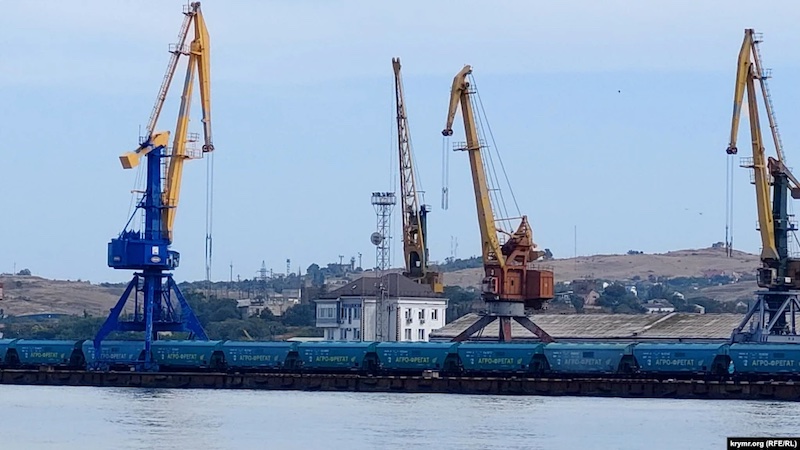
That spells opportunity for Russia’s Agro-Fregat, a wholesale agricultural exporter, whose train cars RFE/RL’s Ukrainian Service has photographed in Crimea. In a 2022 article, Oleksiy Makeyev, a Ukrainian Foreign Ministry special envoy on sanctions, denounced Agro-Fregat, based in southwestern Russia’s Rostov region, and seven other Russian firms for exporting “stolen grain” from Ukraine.
Peas also make up that portfolio. Russian export data shows that, in September 2023, Agro-Fregat sent, as part of a 4,500-ton shipment to Spain, nearly 2,674 tons of peas from the Crimean port of Sevastopol. Agro-Fregat has been receiving Russian quality certifications for Crimean peas since 2022, according to Russia’s Federal Accreditation Service.
In 2022-23, Spain ranked as the second-largest importer of peas exported by Russia after Turkey, the Russian news agency Interfax reported.
A cargo manifest obtained by SeaKrime, a section of the Myrotvorets group, identified Agro-Fregat’s Spanish customer as Cereales Y Harinas Garsan S.L., a company in Spain’s southeastern city of Lorca that says it distributes foodstuffs to 12 countries.
Cereales Y Harinas Garsan did not respond to a request for comment. In a May 25 phone call with Schemes, Agro-Fregat CEO Dmitry Lapkin denied any knowledge of shipments from the Kherson region.
Turkey, Too
But Agro-Fregat routinely exports from the Kherson region: In June and July 2023, it requested permission from the commission to export 25,000 tons of wheat and meslin, a mixture of cereals and legumes, at discounted rates. The buyer, according to occupation administration documents, was the Turkish company Velar Tarim Sanayi ve Tic. A.S (Velar), headquartered in the city of Adana.
Turkey, which exports military goods to Ukraine, ranked in 2022-23 as the main importer of grain exported by Russia, according to agribusiness consultants APK-Inform.
At least 9,554 tons of the wheat and meslin for Velar, according to a Russian government itinerary confirmed by tracking by MarineTraffic, a shipping intelligence site, traveled on August 7, 2023, from Crimea’s Sevastopol Bay to Russia’s Port Kavkaz on the Kerch Strait on board the Alfa M, and thence, two days later, on to Turkey’s Mediterranean port of Mersin on board the St. Olga.
Velar did not respond to questions about this shipment.
Azerbaijan
Turkey’s South Caucasus ally Azerbaijan, which has close ties with Moscow, has described itself as “a loyal and dear friend to Ukraine.” It also is a regular customer for Russian-expropriated wheat from Ukraine.
Wheat imports classified as Russian, in fact, narrowly outranked petroleum products in 2022 as Azerbaijan’s main Russian import, valued at $294 million, according to the trade data site OEC.
The Moscow-based Sim-Trans Group describes itself as one of the top three wheat exporters to Azerbaijan. In 2023, it exported the ruble equivalent of just under $410,000 worth of grain, according to an official Russian foreign trade database, to the Baku-registered company Diba.
The origin of all these wheat shipments is unclear. But in 2023, Sim-Trans Group received permission from the commission to send Diba up to 2,200 tons of grain from Kherson, occupation-administration documents show.
Sim-Trans Group did not answer phone calls about this shipment. Diba did not respond to requests for comment.
Iran And Syria
One Russian company, Pallada, LLC, which sent at least 15,400 tons of Kherson barley under a discounted Russian customs rate in 2023 to Iran’s Persian Gulf port of Bandar Imam Khomeini, has a distant connection to sanctioned Croatian businessman Kresimir Filipovic, who Russian media have reported was involved in the construction of a luxury estate in Gelendzhik on Russia’s Black Sea coast that was allegedly built for Russian President Vladimir Putin.
Pallada was registered as a grain wholesaler in the southwestern Russian city of Rostov-on-Don a few weeks before the full-scale invasion of Ukraine.
Its minority owner is Megapolis-Invest, a Russian corporate management firm that previously controlled a company, Waveform Investments, formerly majority owned by Filipovic, according to the business database KonturFocus.
The independent media outlet Proyekt has identified a Filipovic-owned business, Velesstroi, as the general contractor for construction of “Putin’s palace.”
The extent of Filipovic’s involvement in Pallada, if any, is unclear.
The firm’s majority owner, according to the Russian business registry SBIS, is Sergei Kuznetsov, a 47-year-old Muscovite.
Kuznetsov did not respond to Vyorstka’s May 31 question via Telegram about whether he is Pallada’s nominal owner in favor of Megapolis-Invest and Filipovic.
Another Russian exporter, the Moscow-based TD Fregat LLC, also declined to comment. In May 2023, it received a customs-duty discount on 3,000 tons of Kherson corn as part of an 8,000-ton export from Crimea to the Syrian port of Latakia.
TD Fregat, which says it “specializes in complex operations in the grain industry,” did not respond to a request for elaboration.
Written by Elizabeth Owen
- Maksym Savchuk is a correspondent for Schemes, the investigative unit of RFE/RL’s Ukrainian Service, based in Kyiv. He is the author of 1937, a book about the political and business activities of Viktor Medvedchuk after the Revolution of Dignity. He was born in the village of Baryshivka in the Kyiv region. He graduated as an engineer at the National Transport University and a philologist at the National Pedagogical University. He worked at the Svydomo bureau of journalistic investigations, in the newspaper Ukraine Moloda, and in the investigative journalistic program Exclamation Mark on the TV channel TVi.
The post How Russia Exports Ukrainian Grain As Its Own – Analysis first appeared on The South Caucasus News.
By Jason Gutierrez
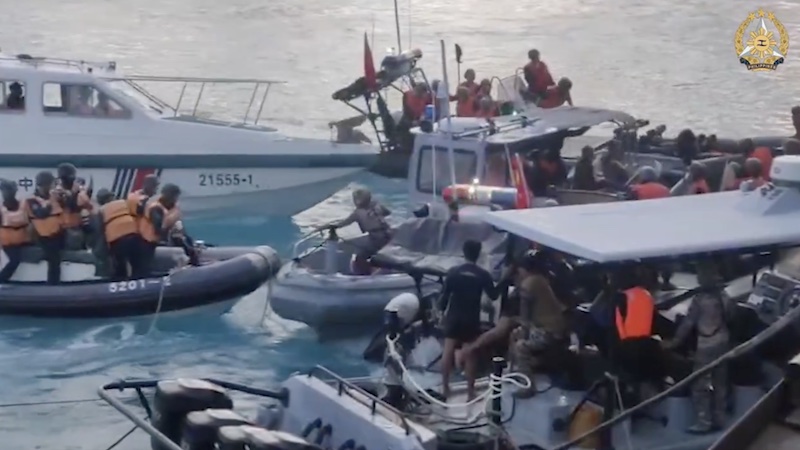
The Philippines dismissed calls Friday to invoke a defense treaty with the United States over a highly charged confrontation between the Chinese coast guard and Filipino navy personnel in disputed waters during which a sailor was injured.
After the Philippine military released footage on Wednesday of the chaotic;June 17 standoff;at Second Thomas Shoal in the South China Sea, Philippine nationalist groups and hawkish politicians have been clamoring for the Marcos administration to use that to invoke the;Mutual Defense Treaty.;
The treaty, signed in 1951, binds Manila and Washington to come to each other’s military aid in the event of an attack by an external power. On Monday in the U.S. capital, officials at the White House and State Department condemned China’s alleged conduct at the shoal as “escalatory and irresponsible actions.”;;
“We are not yet ready to consider this as an armed attack,” Lucas Bersamin, the executive secretary of the Philippines who reports to President Ferdinand Marcos Jr., told reporters on Friday when asked if the incident would trigger the treaty with Manila’s oldest security ally.
The Armed Forces of the Philippines (AFP);claimed that during the;encounter, one of its boats was forcibly towed, looted and damaged, and that Chinese personnel used machetes, blades and pikes to threaten sailors and damage equipment. A Filipino sailor lost a finger during the standoff, the AFP said.
The incident was “probably a misunderstanding or accident,” Bersamin said.
A day earlier, Senate President Francis Escudero had described the escalating tensions between Manila and Beijing in the South China Sea as alarming, while he requested a full briefing from the foreign affairs department about the incident.;;
He said the department should now “go beyond the filing of diplomatic protests each time an incident occurs.”
Bersamin said the foreign office had not received an official response from China about the incident, although Beijing had publicly defended its coast guard’s actions in the shoal, which lies within the Philippines’ exclusive economic zone but is claimed by both countries.;
The incident occurred only two days after China’s coast guard began enforcing a;new regulation;authorizing its personnel to intercept and detain foreign boats and crews suspected of “trespassing” in South China Sea waters claimed by Beijing.
For their part, the Chinese accused the Philippine side of attempting to transport firearms and material needed to refurbish the BRP Sierra Madre, a rusting World War II-era navy ship that Manila deliberately grounded at the shoal in the late 1990s to mark its territorial claim there.
A contingent of Philippine marines is stationed aboard the ship, and rotated in and out of the shoal, which is known as Ayungin to Filipinos and Ren’ai Jiao to the Chinese.
“The Philippine vessels secretly carried construction materials and even weapons and equipment, and they deliberately rammed Chinese vessels. The Philippine side threw water and hurled objects [at] Chinese enforcement personnel. These acts clearly escalated tensions at sea, and severely threatened the safety of Chinese personnel and vessels,” Lin Jian, a spokesman for China’s foreign ministry,;said;in a news briefing on Thursday.
“The Chinese side took necessary measures in accordance with law to safeguard its sovereignty, which was lawful and justified and done in a professional and restrained manner. It was beyond reproach,” he said.
During Monday’s incident, which occurred close to the Sierra Madre, small boats from China’s coast guard intercepted a rigid-hulled inflatable boat belonging to the Philippine Navy.
Initial reports from the AFP said that seven Filipino troops were hurt in the skirmish at sea, but on Friday Philippine officials clarified that the sailor who lost a finger was the lone casualty among the Filipinos.;
The Philippines runs regular rotation and resupply missions to the;Sierra Madre. The old ship serves as Manila’s military outpost in the contested waters and lies near Mischief Reef, an artificial island where Beijing built a naval base in the 1990s.
“I think this is a matter that can be easily resolved very soon by us and (if) China wants to work with us, we can work with China,” Bersamin told reporters after he chaired a meeting of the National Maritime Council, a government body established in March to boost Philippine security in the West Philippine Sea.;
Manila refers to South China Sea waters within its exclusive economic zone (EEZ) as the West Philippine Sea.
“As a result of the meeting today, the [National Maritime Council] agreed on policy recommendations for the President’s consideration,” Bersamin said.;
“Among these recommendations is the announcement of the rotation and reprovision missions to the BRP Sierra Madre in Ayungin Shoal, which will remain routinary and scheduled regularly.”;
“We will not yield and will not be deterred in fulfilling this duty,” he said, adding that it would be wise for the president to accept the recommendations and publicize the schedule of the government’s activities.
Jojo Riñoza and Mark Navales contributed reporting from Manila.
The post Manila Dismisses Calls To Invoke Defense Treaty With Washington Over Sea Encounter first appeared on The South Caucasus News.
The post Trump says he’s decided on his running mate – The Hill first appeared on Trump And Trumpism – The News And Times.
