Categories
Sites

Canada Adds Iran’s Revolutionary Guards To Its List Of Terrorist Groups


Canada Adds Iran’s Revolutionary Guards To Its List Of Terrorist Groups

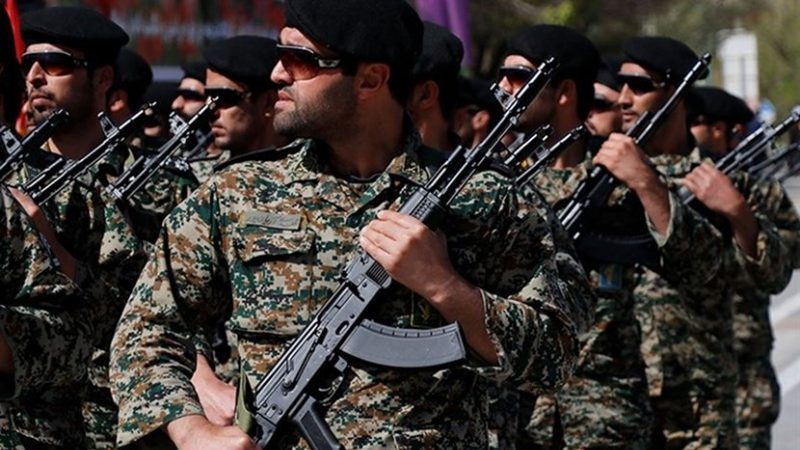
Members of Iran's Islamic Revolution Guards Corps (IRGC). Photo Credit: Tasnim News Agency

(RFE/RL) — Canada has listed Iran’s Islamic Revolutionary Guards Corps (IRGC) as a terrorist entity and advised any Canadians in Iran to leave the country.

Public Safety Minister Dominic LeBlanc made the;announcement;on June 19 at a news conference in Ottawa, saying the decision to declare the IRGC as a terrorist organization is based on “very strong and convincing evidence.”

LeBlanc told reporters that Canada “uses all possible means to fight the terrorist acts of the IRGC.”

Foreign Minister Melanie Joly noted at the same news conference that Ottawa broke off diplomatic ties with Tehran several years ago. She urged Canadians against travel to Iran and said those in the country now should “come back home.”

The designation of the IRGC as a terrorist group has long been sought by Iranian expats and relatives of those killed on a flight brought down in January 2020 by Iranian forces shortly after takeoff from Tehran, killing all 176 passengers and crew, about half of them Canadians.

The Association of Families of Ukrainian Flight PS752 said in a;statement;on June 19 that it was grateful to the government for making the designation and to “all political parties, activists, and individuals who contributed to this achievement.”

The statement added that that the association is “also grateful to the brave people of Iran who have stood up against this oppressive organization and have continuously supported the families of the victims.”

The association also said it continues to insist on its other demands, including pursuing the case of the downed flight in the International Court of Justice and before other international courts.

Prime Minister Justin Trudeau’s government had been reluctant to designate the IRGC as a terrorist organization over concern that listing it as such would have unintended consequences that could inadvertently impact Iranians in Canada opposed to the regime.

Trudeau signaled the move earlier this year at a memorial service for the victims of the downed plane, saying that his government was looking for ways to add the IRGC to the list of terrorist organizations.

“We know there is more to do to hold the regime to account and we will continue our work, including continuing to look for ways to responsibly list the IRGC as a terrorist organization,” Trudeau said on January 8.

Once a group is placed on Canada’s terrorism list, police can charge anyone who financially or materially supports the group and banks can freeze assets.

Ottawa has previously listed the Quds Force, a branch of the IRGC, as a terrorist entity, and in 2022 permanently denied entry to more than 10,000 Iranian officials, including members of the IRGC.

Ottawa severed diplomatic relations with Tehran in 2012.

The post Canada Adds Iran’s Revolutionary Guards To Its List Of Terrorist Groups first appeared on The South Caucasus News.


Categories
Sites

UN Human Rights Office: Israeli Airstrikes In Gaza May Have Violated ‘Laws Of War’


UN Human Rights Office: Israeli Airstrikes In Gaza May Have Violated ‘Laws Of War’

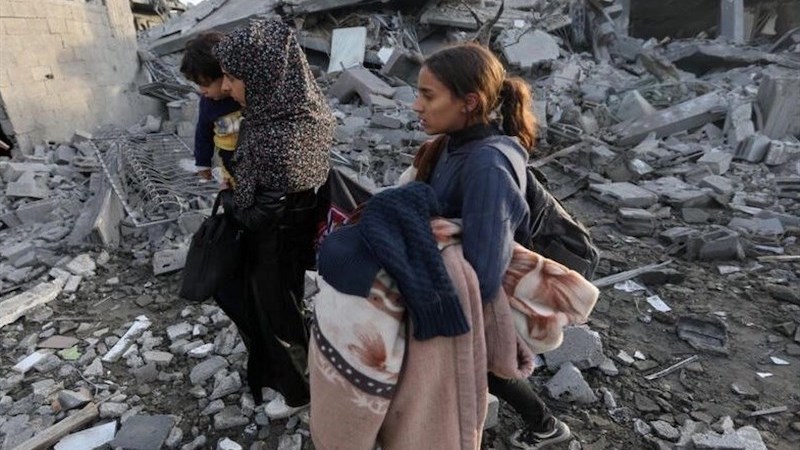
A family in Rafah, Gaza. Photo Credit: Tasnim News Agency

The United Nations human rights office says Israeli airstrikes on Gaza “may have repeatedly violated fundamental principles of the laws of war.”

A report released Wednesday examined six airstrikes conducted by the Israeli Defense Forces between October and December of last year during the opening weeks of the war in Gaza. More than 200 people were confirmed by the human rights office to have been killed in the airstrikes, whose targets included residential buildings, a school, a market and refugee camps.

U.N. High Commissioner for Human Rights Volker Turk said it appeared Israel made no attempt to “effectively distinguish” between Palestinian civilians and Hamas fighters in its bombing campaign of Gaza.

“Civilian lives and infrastructure are protected” under international human rights law, Turk said. “This law lays out the very clear obligations of parties to armed conflicts that make protection of civilians a priority.”

The report said the six attacks involved the suspected use of heavy bombs between 113-kilograms and 907-kilograms.

The report also says continued missile attacks towards Israel by Palestinian armed groups is “inconsistent with their obligations under international humanitarian law.”

Health authorities in the Hamas-controlled Gaza Strip say more than 37,266 people have been killed and 85,102 have been injured since the start of the Israeli ground and aerial campaign that began soon after the October 7 Hamas terror attack on Israel, which killed 1,200 people and took more than 250 hostages, Israeli authorities say.

The post UN Human Rights Office: Israeli Airstrikes In Gaza May Have Violated ‘Laws Of War’ first appeared on The South Caucasus News.


Categories
Sites

The Petrodollar’s Precarious Perch: A Multipolar Future For Oil Trade? – OpEd


The Petrodollar’s Precarious Perch: A Multipolar Future For Oil Trade? – OpEd

petrodollars

The petrodollar system, the bedrock of global finance since the 1970s, faces an uncertain future. The recent expiration of the U.S.-Saudi petrodollar pact in June 2024 marks a turning point, prompting a reassessment of the dollar’s role in oil trade and the broader geopolitical landscape. This article delves beyond the narrative of a simple decline, exploring the complex interplay of factors driving a potential transition towards a multipolar financial order.;

Beyond the Cracks: Structural Shifts and Geopolitical Tensions

While the waning U.S. dominance in oil production and the strained U.S.-Saudi relationship are significant factors, a deeper analysis reveals a more nuanced picture. The rise of unconventional oil and gas extraction methods like shale fracking in the U.S. has disrupted traditional supply chains. This, coupled with growing environmental concerns and the pursuit of energy independence by major economies, has led to a decrease in global dependence on OPEC oil. The International Energy Agency (IEA) forecasts a peak in oil demand by 2027, followed by a gradual decline as renewable energy sources gain traction.;

Furthermore, the petrodollar’s vulnerabilities are amplified by the increasing influence of alternative payment systems. China’s ongoing efforts to internationalize the yuan, the creation of regional payment networks like the BeiDou Navigation Satellite System, and the burgeoning popularity of cryptocurrencies like petro (Venezuela) all challenge the dollar’s hegemony. While the current use of cryptocurrencies in oil transactions remains limited, their potential volatility and regulatory uncertainties hinder widespread adoption. However, the underlying technology of blockchain could influence future payment systems for commodities like oil.;

The Rise of the Multipolar Order: A Fragile Balance

The decline of the petrodollar doesn’t necessarily translate to a single-currency replacement. A more likely scenario is the emergence of a multipolar financial order, where oil is priced and traded in a basket of currencies reflecting the evolving power dynamics.;

China, the world’s largest oil importer, is actively pursuing this path. The Shanghai International Energy Exchange (INE) has launched yuan-denominated oil futures contracts, attracting participation from major producers like Russia and Iran. This strategy aims to not only bolster the yuan’s international standing but also establish China as a key player in the global energy market. Additionally, China’s Belt and Road Initiative (BRI) seeks to create a vast infrastructure network connecting Asia, Europe, and Africa, potentially creating a yuan-denominated trade bloc for oil and other commodities.;

However, navigating a multipolar system presents its own challenges. Balancing the interests of diverse stakeholders with potentially conflicting agendas will be crucial. For instance, Russia, a major oil producer with strained relations with the West, may prioritize alternative pricing mechanisms that challenge U.S. dominance. Additionally, the lack of a single dominant currency could lead to increased market volatility, impacting both oil producers and consumers. Producers may face difficulties in budgeting and planning investments due to exchange rate fluctuations. Consumers, on the other hand, could be exposed to higher energy prices as a result of short-term market gyrations.;

The U.S.: Adapting to a New Reality

The Biden administration has acknowledged the changing landscape and is actively pursuing strategies to maintain the dollar’s relevance. These include:;

• Renewed focus on clean energy:;Investments in renewable energy development and research can help the U.S. position itself as a leader in the transition towards a low-carbon future. This not only reduces dependence on imported oil but also creates new economic opportunities in clean energy technologies. The recently passed Inflation Reduction Act allocates significant funding towards clean energy initiatives, signaling a commitment to this strategy.;

• Strengthening alliances:;Building stronger economic and political ties with key oil producers outside of the Middle East, such as African nations with growing reserves, could diversify U.S. energy partnerships. This could potentially lead to oil being priced in a basket of currencies reflecting the contributions of these new partners.;

• Embracing financial innovation:;The U.S. Federal Reserve and financial institutions are exploring the potential of central bank digital currencies (CBDCs) to maintain the dollar’s competitive edge in the evolving digital payments landscape. A CBDC could offer a secure and efficient alternative to traditional payment systems, potentially enticing foreign entities to continue using the dollar for oil transactions.;

The success of these strategies will depend on the U.S.’s ability to adapt to a world where oil no longer reigns supreme and to demonstrate its continued value as a reliable economic and political partner.;

The Road Ahead: Scenarios and Implications

The trajectory of the petrodollar system remains uncertain, with several potential scenarios unfolding:;

• A Gradual Shift:;A slow move away from dollar dominance, with a basket of currencies used for oil pricing, alongside the continued use of the dollar in some transactions. This scenario would likely lead to increased volatility in the short term but could stabilize in the long run. The success of this scenario would depend on international cooperation and the ability of major oil producers and consumers to agree on a transparent and stable pricing mechanism.;

• A Regionalized System:;The emergence of regional blocs like BRICS establishing their own oil pricing mechanisms, potentially undermining the dollar’s global influence. This could fragment global energy markets and complicate trade flows. For instance, a BRICS-led oil pricing mechanism could be denominated in a basket of currencies like the yuan, rupee, and ruble, primarily used for transactions within the bloc. This scenario would create challenges for countries outside these blocs, potentially leading to higher energy prices and increased geopolitical tensions.;

• A Black Swan Event:;An unforeseen event, like a major geopolitical crisis or a breakthrough in clean energy technology, could drastically accelerate the decline of the petrodollar. This scenario would be the most disruptive, leading to significant economic and political instability. For instance, a major conflict in the Middle East disrupting oil supplies could trigger a global energy crisis, forcing a rapid shift away from the dollar-denominated oil trade.;

Implications of a Changing Petrodollar System

The implications of a changing petrodollar system are far-reaching. A decline in the dollar’s dominance could lead to:;

• Higher borrowing costs:;The U.S. government and businesses may face higher interest rates as investors seek alternative safe-haven currencies. This could slow down economic growth and potentially lead to fiscal challenges.;

• Shifting geopolitical power:;A weakened dollar could translate into diminished U.S. influence on international financial institutions like the International Monetary Fund (IMF) and the World Bank. This could lead to a more multipolar world order with new power centers emerging.;

• Increased market volatility:;A transition period with no clear dominant currency could create uncertainty and instability in global energy markets. This could lead to price fluctuations that impact both producers and consumers.;

• Reshaping of Global Trade:;The decline of the petrodollar system could lead to a diversification of global trade patterns. Countries may prioritize trade deals with partners offering alternative currencies for oil transactions.;

Conclusion: Navigating a New Era

The petrodollar system’s decline is not a sudden collapse, but rather a complex transformation driven by a confluence of economic, technological, and geopolitical factors. The road ahead is paved with uncertainty, with the potential for a gradual shift, a regionalized system, or even a more disruptive scenario. The success of the transition will depend on the ability of major players to adapt, cooperate, and innovate.;

The U.S. needs to focus on clean energy development, strengthen strategic alliances, and embrace financial innovation to maintain its economic and geopolitical influence. Meanwhile, countries like China are actively positioning themselves to play a larger role in the global energy market. The coming years will likely see a period of experimentation and negotiation as new pricing mechanisms and trade partnerships emerge. This transition presents both challenges and opportunities, with the potential to reshape the global financial landscape and redefine the balance of power in the international arena.

The post The Petrodollar’s Precarious Perch: A Multipolar Future For Oil Trade? – OpEd first appeared on The South Caucasus News.


Categories
Sites

North Korea’s Kim Hails Russia Alliance, Promises Putin Support On Ukraine


North Korea’s Kim Hails Russia Alliance, Promises Putin Support On Ukraine

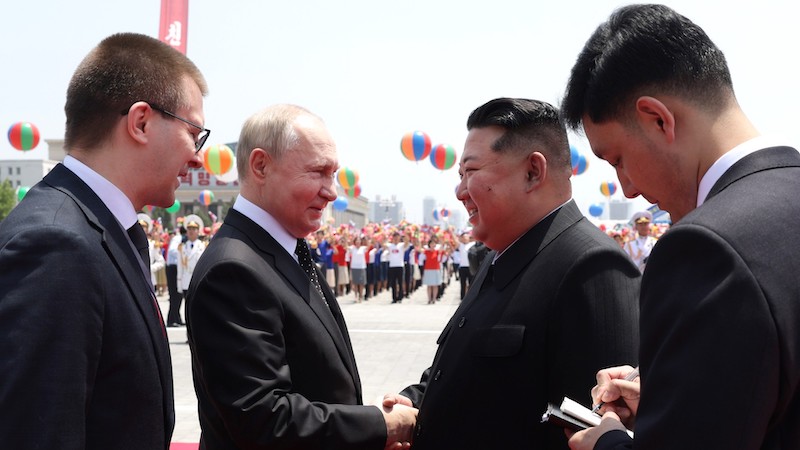
Russia's President Vladimir Putin officially welcomed by Chairman of State Affairs of the Democratic People’s Republic of Korea Kim Jong-un. Photo Credit: Kremlin.ru

By Taejun Kang

North Korean leader Kim Jong Un hailed a “new, high level of alliance” with Russia on Wednesday as he promised President Vladimir Putin full support for his war in Ukraine, media reported.

Putin, on his first visit to isolated North Korea in 24 years, said after one-on-one talks with Kim that lasted for about two hours that a new comprehensive strategic partnership pact would form the basis of relations for years to come, said a correspondent from Russia’s RIA Novosti news agency.

Kim said the pact signed by the two leaders was historic and he reaffirmed “full support and firm solidarity with the Russian government, armed forces and people in their struggle to defend their sovereignty, security interests and territorial integrity in Ukraine,” according to a video of summit remarks released by media outlets.

“In the future, we will continue to strengthen and deepen strategic communication with the Russian leadership and Russia and unconditionally support all of Russia’s policies, regardless of the complex international situation,” Kim said.

Kim said relations were “at an all-time high, unparalleled even in the past relations with the Soviet Union,” adding that he was confident Putin’s visit would “further solidify the friendship and people-to-people foundation of the two countries.”

Putin thanked Kim saying he appreciated North Korea’s support.

“We very much appreciate your systematic and permanent support of Russian policy, including on the Ukrainian issue,” Russian media quoted Putin as telling Kim at the start of their meeting, AFP reported.;

The;United States says that North Korea has supplied Russia;with large amounts of weapons for its war in Ukraine, in particular artillery rounds and ballistic missiles, although both Russia and North Korea deny that.

In exchange for its weapons, North Korea is suspected of getting Russian technological assistance for its space program.;

In May, the North’s attempt to launch a military spy satellite ended in failure with the rocket exploding on liftoff. But in November last year, North Korea successfully placed a spy satellite into orbit, and it had planned to launch three more satellites in 2024.

Earlier on Wednesday, the two leaders attended; a welcome ceremony at Pyongyang’s massive Kim Il Sung Square, complete with an honor guard and rows of North Korean citizens with balloons. Buildings around the square were bedecked with the countries’; flags and huge portraits of the two men, pictures in Russian state media showed.

Crowds in red, white and blue shirts waved flowers and flags as the two leaders passed by, standing in an open-top limousine.

‘Solid friendship’

Both Russia and North Korea are facing wide-ranging sanctions, the former for its invasion of Ukraine and the latter for its development of nuclear bombs and the missiles to deliver them around the world.

In an apparent reference to the sanctions, Putin, in a commentary published on the eve of his visit in North Korea’s state-run Rodong Sinmun newspaper, called for unity in resisting “illegal and unilateral restrictions”, while vowing to build alternative systems for trade and settlements with North Korea out of the control of the West.

Kim said bilateral ties were “entering their best period ever,” calling Putin’s visit “the most significant strategic step for world peace and security.”

“The government of the Democratic People’s Republic of Korea appreciates the important mission and role of the powerful Russian Federation in maintaining strategic stability and balance in the world,” Kim said.

The Russian leader added that he was confident of the success of his talks with Kim and extended an invitation for the next North Korea-Russia summit to take place in Moscow.

“Russia and North Korea have been tied for several decades by a solid friendship and close neighborhood [relations],” said Putin who heralded bilateral cooperation “based on the principles of equality and mutual respect of interests.”

It is Putin’s first trip to North Korea since July 2000, when he met the then leader, Kim Jong-il, the late father of the current leader. It also comes nine months after Kim traveled to Russia’s Far East for a summit with Putin.

The rare visit by a foreign leader to North Korea and boosts a relationship that offers Pyongyang an alternative to its close ties to Beijing, analysts say.

North Korea and the former Soviet Union signed a treaty of friendship and mutual assistance in 1961 which included a provision for so-called automatic military intervention, under which if one side is under armed attack, the other provides troops and other aid without hesitation.

North Korea and Russia signed a new treaty of bilateral ties in 2000, but it did not contain such a provision as it centered on economic, scientific and cultural cooperation.

Experts said the two leaders could discuss; North Korean workers going to Russia. The North is desperate for foreign currency due to the international sanctions, while Russia has been facing a labor shortage exacerbated by the war in Ukraine.

The post North Korea’s Kim Hails Russia Alliance, Promises Putin Support On Ukraine first appeared on The South Caucasus News.


Categories
Sites

VOA Newscasts


Give us 5 minutes, and we’ll give you the world. Around the clock, Voice of America keeps you in touch with the latest news. We bring you reports from our correspondents and interviews with newsmakers from across the world.

The post VOA Newscasts first appeared on The News And Times.

The post VOA Newscasts first appeared on Trump And The FBI – The News And Times.


Categories
Sites

CDK Global cyberattack: Cleveland will not negotiate with cyberattackers | What happens if they don’t pay the – AS USA


The post CDK Global cyberattack: Cleveland will not negotiate with cyberattackers | What happens if they don’t pay the – AS USA first appeared on Trump And The FBI – The News And Times.


Categories
Sites

Ascension Ransomware Attack: Initial Access Vector and Data Theft Confirmed – HIPAA Journal


The post Ascension Ransomware Attack: Initial Access Vector and Data Theft Confirmed – HIPAA Journal first appeared on Trump And The FBI – The News And Times.


Categories
Sites

‘Absurd and extreme dangerous’: Eric Holder on Donald Trump’s Presidential Immunity claims hold up – MSNBC


The post ‘Absurd and extreme dangerous’: Eric Holder on Donald Trump’s Presidential Immunity claims hold up – MSNBC first appeared on Trump And Trumpism – The News And Times.


Categories
Sites

Donald Trump’s big stunt takes a dump


shirley-kennedy-100x100.jpg

Donate to Democratic candidate Adam Frisch.

Donate to Palmer Report.


“It’s all lies, smoke, and mirrors,” Jeff Timmer (senior advisor at Lincoln Project) wrote on X. He’s not the only one who sees Trump’s church scam for what it was. David Frum, former George W. Bush speechwriter, had this to say about Trump’s “stunt” as he called it: “He created a completely fake media event, he rented a church, he bussed in people who were wearing not church clothes but rally clothes, they were obviously not locals. You don’t have to do that if you have support.” Frum had some other things to say, most of which centered around Donald Trump’s lies, saying: “When you have to tell so many lies, when you have to bus in people, it tells me you probably don’t have a lot of indigenous support in that town.” Of course, he doesn’t. Trump was merely putting on a show for his crazy supporters. Besides, Trump really has nothing to offer but lies, and people need to be very clear about that.

Now that he’s done with his lies in Detroit, Trump has moved on removing taxes from tips-if, again, you dare to believe him. HuffPost tells us why we shouldn’t. His latest schtick, which started in Nevada, is ensuring that service workers aren’t taxed for tips, but when he was in the White House, he made sure they never got benefit of most of their tips. Trump enacted a policy that allowed employers to have control over workers’ tips. Restaurants were allowed to take the tips earned by waitstaff and “share” them with people who didn’t earn tips, such as cooks and dishwashers. If these employers felt they weren’t paying their other staff enough, they should have raised their salaries instead of taking money from other employees. This sounds like one of the worst ideas ever but consider the source. According to HuffPost, the Trump administration also buried an analysis that predicted tipped workers would lose billions in wages under his new plan. Democrats tried to lessen the impact by including a provision that stopped employers from pocketing tips. If Trump had truly cared about these people, why didn’t he simply raise the minimum wage? Because he didn’t care, unlike President Biden who reversed most of this rule.


. . .


Nothing has changed with Donald Trump, and there is no way he is going to create tax free tips. The last thing Trump is worried about is an ordinary citizen, and he’s definitely not concerned about Black people. He didn’t even recognize the pastor who allowed him to come to his church. He just wants their votes, which the next guest to the church said. Dr. Wendell Anthony, who is also a pastor and president of the Detroit NAACP said this: “Trump didn’t articulate any policy. He articulated the fact that he wanted to come and get some Black votes. We don’t need people to stand up on frivolity. We need you to come in and talk about policy. Don’t fall for the snake because every time you do, you get bit.” I couldn’t have said it any better myself.

The post Donald Trump’s big stunt takes a dump appeared first on Palmer Report.


Categories
Sites

Ukraine war latest: Huge explosion reported in Russian city – amid escalation in fighting; Vietnam criticised over Putin visit – Sky News


The post Ukraine war latest: Huge explosion reported in Russian city – amid escalation in fighting; Vietnam criticised over Putin visit – Sky News first appeared on The Russian World.