
Day: May 10, 2024
Black Twitter will not save us for what’s to come. As the days towards the 2024 presidential election draw near and the rage-filled screams of college students fill the halls of the nation’s most prestigious institutions, the United States finds itself at a crossroads. Will the most powerful country in the world revert back to when Donald Trump won the White House, or will we vote for Joe Biden to maintain his stronghold? This is the question that every American must answer before and on November 5.
[time-brightcove not-tgx=”true”]
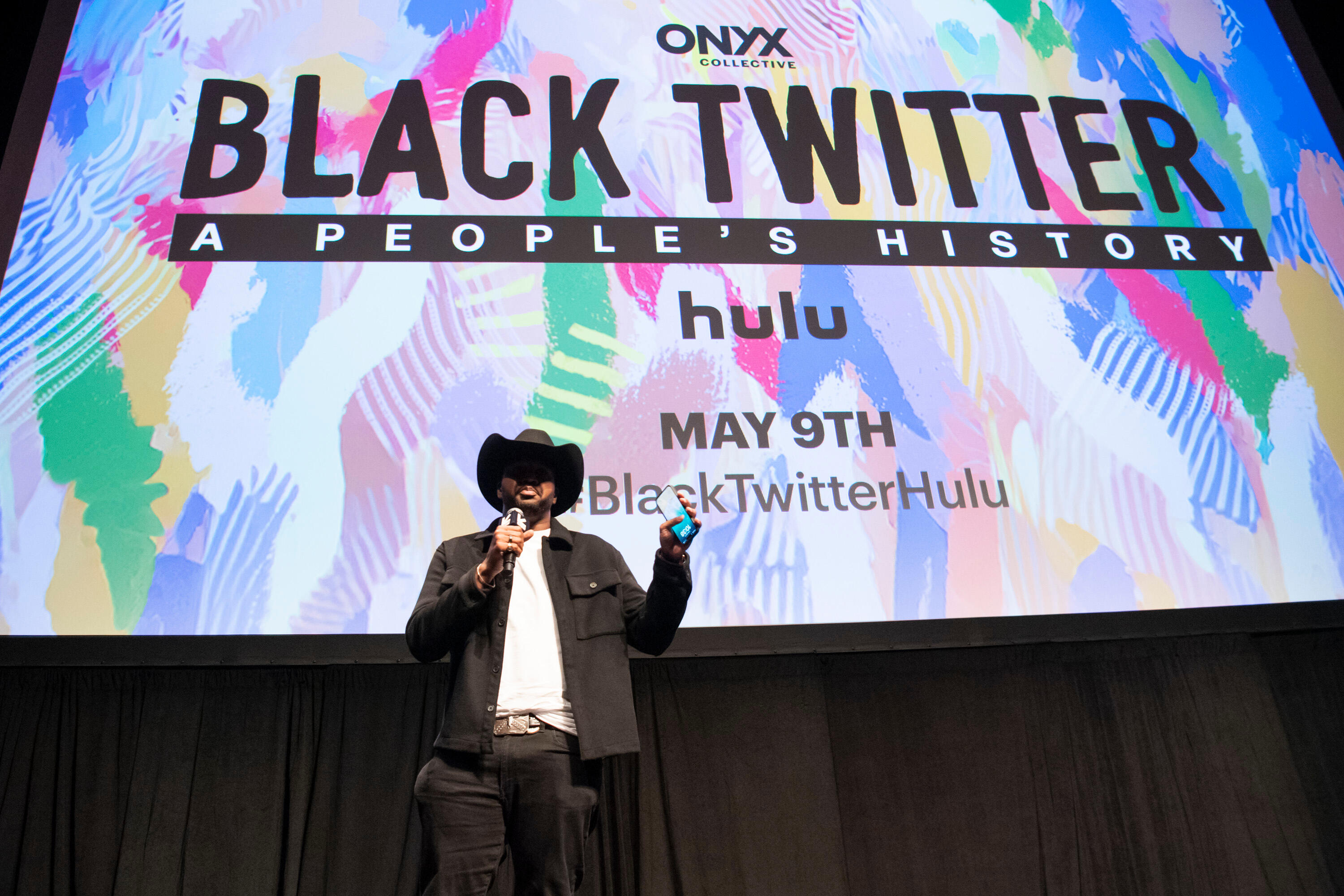
If the everyday American (specifically the everyday Black American) was undecided about which candidate to vote for, it only takes one watch of Black Twitter: A People’s History, a three part docuseries based on journalist Jason Parham’s 2021 WIRED article “A People’s History of Black Twitter,” to understand that we must vote for Biden.
The series attempts to archive, document, and chronicle the force that is known as Black Twitter, two words that have been used to characterize Black digital life on the social media platform. It’s a platform that the series will remind you was not created by Black people, but brought into prominence by the attitudes, mannerisms, and behaviors of Black users on Twitter. But despite incessant commentary about how Black people are not a monolith, the docuseries—in its attempt to associate the Black Twitter community with an era that supposedly no longer exists—ultimately treats Black Twitter as such.
Creation is at the core of the series’ story. The words of Amiri Baraka’s “Technology & Ethos” essay are repeated and paraphrased throughout the three-part series in a fashion similar to a mother reading her child’s favorite tall tale before tucking them into bed. The essay opens with the following: “Machines (as Norbert Weiner said) are an extension of their inventor-creators. That is not simple once you think. Machines, the entire technology of the West, is just that, the technology of the West.” Baraka continues: “Nothing has to look or function the way it does. The West man’s freedom, unscientifically got at the expense of the rest of the world’s people, has allowed him to xpand his mind–spread his sensibility wherever it cdgo, & so shaped the world, & its powerful artifact-engines.”
The next line is where Black Twitter, or more broadly the relationship between Black people and technology, come into play. “Political power is also the power to create—not only what you will—but to be freed to go where ever you can go—(mentally physically as well). Black creation—creation powered by the Black ethos brings very special results.”
In the case of both Twitter the platform and also Twitter the company—where Black people acquired leadership positions at one of the fastest growing tech companies in the world, used their presence online to enact change in the areas of racial justice and police reform, and increased diversity and representation from Hollywood to Silicon Valley and everywhere in between—what did those very special results bring? That answer is complicated, and one that the docuseries tries to grapple with but falls short.
As seen in the series, #OscarsSoWhite corrected a decades long practice of exclusion by the Academy and created opportunities for actors of color to receive membership into the voting body that decides the Oscars. In the nine years since the hashtag’s creation, gradual efforts were made towards greater representation on screen. Yet, the subsequent mass exodus of women of color in Hollywood leadership positions and the low number of films directed by women and people of color seems to contradict the docuseries’ overarching narrative of a hashtag’s singular impact. Yes, the hashtag narrative as an idiom to bring forth change is powerful, but the counter response to them is just as telling.
The most blatant example of this is the #BlackLivesMatter portion of the docuseries. The docuseries chronicles the pivotal role Twitter played in the rise of citizen journalism, particularly during the murders of Trayvon Martin, Michael Brown and Eric Garner. It also looks at the creation of #SayHerName, a social media response to the erasure of Black women, such as Sandra Bland, and Black trans women, like Mya Hall, who lost their lives to police violence, but were often overlooked by the male-centered BLM movement.
This is where Baraka is felt the most: Black creators have harnessed the power of technology, in order to counteract the West’s political power, which puts them in danger of losing their lives. Minute after minute, frame after frame, the docuseries asks the viewer to bear witness to the ways in which Black Twitter, through the creation and utilization of hashtags, on-the-ground reporting, and 24/7 news coverage, has long been victimized by police violence.
But like Baraka said, the machine is an extension of its inventor-creator, and the creator, or in this case the executive producers of the docuseries, have a hand in its invention. It’s a creation that feels foreign to those who birthed and have maintained Black Twitter as a living and breathing cultural archive of Black digital life. A life that has no singular partisan belief or political agenda. A life that, in many ways, bites the hand of the docuseries creators. It’s a hand that delicately weaves the ascension of Barack Obama to the presidency with the birth and rise of Black Twitter. The two are in a covenant of holy matrimony.
Just ask Brad Jenkins, former associate director of the White House Office of Public Engagement, who frequently appears throughout the docuseries. Or Carri Twigg, the former Associate Director of Public Engagement of the White House, who serves as one of the series’ executive producers. There is no direct mention that the Black Lives Matter movement started under the Obama administration—or acknowledgment of the overwhelming collective action by Black students at the University of Missouri during that time, as well as the solidarity actions that occurred across college campuses in the U.S.
The series goes on to connect the rise of misinformation, the proliferation of Russian bots, and the 2016 election of Donald Trump as a reaction to the Obama presidency and Black Twitter. In fact, the series’ somber moments—where anti-Black sentiment is seen in reports of algorithms being altered to increase traffic towards users that display racist and misogynistic behaviors online, and clips of white women calling the police to inflict harm and violence on Black people for simply living—are linked to the Trump portion of the series. But that is ahistorical in and of itself because Black women have been calling attention to the ways in which they are subjected to anti-Black violence and harassment online since the 1990s. BBQ Becky is just Carolyn Bryant by another name.
Read More: Twitter Offers More Transparency on Racist Abuse by Its Users, but Few Solutions
If the Obama years of Black Twitter were fun, the docuseries posits, the Trump years of Black Twitter were hell. From the COVID-19 pandemic to the global uprisings over the deaths of George Floyd and Breonna Taylor, the year 2020 within the docuseries is marked by culture shifts towards violence, including the misogynoir Megan Thee Stallion experienced online after she came forward about being physically assaulted by Tory Lanez. The year is also peppered with glimmers of a Black Twitter of yesteryear: a communal moment of gathering to live tweet “Verzuz” challenges or to watch The Last Dance as a family. Communal moments that are thought to be associated with the Obama administration.
And just like that, the docuseries pivots to showcase the Black voters in South Carolina, who are thanked for their votes for Biden in the 2020 election. Biden is even described as Obama’s right hand man. It is in this moment that the series wants the audience to remember the joy of the Obama years, the hope of the Obama years, and most importantly, the impact of Black voters in the Obama years.
I do not mean to spoil the climax of the 2020 section of the docuseries, but Biden won and Elon Musk replaced Trump as the villain of the series. Musk’s acquisition of Twitter, now known as X, is met with despair, exodus, and rage. Efforts to humble and humiliate Musk are flashed across the screen as former Black employees at Twitter in one-on-one interviews discuss the destruction of their years of labor and hard work to diversify the platform. Black academics, celebrities, and personalities lament as they say a goodbye to the good days of Twitter. Mastodon, BlueSky, Spill, LinkedIn, and of course TikTok are depicted as places of solace for Black users who feel unwelcome on X. (X has since eliminated any protections for marginalized and disenfranchised users on the platforms.)
Four years after the election of Biden to the presidency and with the forthcoming election looming, the series bids Black Twitter adieu with the foresight that Black people will always continue to innovate, despite not being given the tools or resources to create. This is exemplified by a reference to soul food, and a call to action to create our own archives—the thesis of Black Twitter: A People’s History.
But what Black Twitter fails to realize—and simply can’t capture—is that we are not in 2008 anymore. Or 2012. Or 2020. The Obama coalition is dead. The Biden coalition is falling apart by the day and culturally resonant programming falls flat compared to the citizen-led reporting that is coming to life in front of our very eyes. Just look at the actions of the student journalists at WKCR, the Columbia University radio station that covered the raid of Hamilton Hall by the New York Police Department. Or the wave of anti-war protests by Black students at HBCUs. Guess where these students learned how to organize from? Black Twitter. They’re not just archiving their own stories—they’re creating them.
But that’s the flaw of content like this. It doesn’t have the capacity to capture the legacy of a movement because it’s a movement that isn’t over. It is still unfurling—still morphing and coming to life in front of our very eyes. These are children who came of age on Black Twitter. They’re still using those tools to make us laugh, to inspire change, to create community.
If there is anyone who will save us (and in turn, if there’s anything worth saving), it’s them. Not Black Twitter.
CERT Polska warns of a large-scale malware campaign against Polish government institutions conducted by Russia-linked APT28.
CERT Polska and CSIRT MON teams issued a warning about a large-scale malware campaign targeting Polish government institutions, allegedly orchestrated by the Russia-linked APT28 group.
The attribution of the attacks to the Russian APT is based on similarities with TTPs employed by APT28 in attacks against Ukrainian entities.
“the CERT Polska (CSIRT NASK) and CSIRT MON teams observed a large-scale malware campaign targeting Polish government institutions.” reads the alert. “Based on technical indicators and similarity to attacks described in the past (e.g. on Ukrainian entities), the campaign can be associated with the APT28 activity set, which is associated with Main Directorate of the General Staff of the Armed Forces of the Russian Federation (GRU).”
The threat actors sent emails designed to pique the recipient’s interest and encourage them to click on a link.

Upon clicking on the link, the victims are redirected to the domain run.mocky[.]io, which is a free service used by developers to create and test APIs. The domain, in turn, redirects to another legitimate site named webhook[.]site which allows logging all queries to the generated address and configuring responses.
Threat actors in the wild increasingly rely on popular services in the IT community to evade detection and speed up operations.
The attack chain includes the download of a ZIP archive file from webhook[.]site, which contains:
- a Windows calculator with a changed name, e.g.
IMG-238279780.jpg.exe, which pretends to be a photo and is used to trick the recipient into clicking on it, - script
.bat(hidden file), - fake library
WindowsCodecs.dll(hidden file).
If the victim runs the file fake image file, which is a harmless calculator, the DLL file is side-loaded to run the batch file.
The BAT script launches the Microsoft Edge browser and loads a base64-encoded page content to download another batch script from webhook.site. Meanwhile, the browser shows photos of a woman in a swimsuit with links to her genuine social media accounts, aiming to appear credible and lower the recipient’s guard. The downloaded file, initially saved as .jpg, is converted to .cmd and executed.
Finally, the code retrieves the final-stage script that gathers information about the compromised host and sends it back.
“This script constitutes the main loop of the program. In the loop for /l %n in () it first waits for 5 minutes, and then, similarly as before, downloads another script using the Microsoft Edge browser and the reference to webhook.site and executes it. This time, the file with the extension .css is downloaded, then its extension is changed to .cmd and launched.” continues the report. “The script we finally received collects only information about the computer (IP address and list of files in selected folders) on which they were launched, and then send them to the C2 server. Probably computers of the victims selected by the attackers receive a different set of the endpoint scripts.”

The CERT Polska team recommends network administrators to review recent connections to domains like webhook.site and run.mocky.io, as well as their appearance in received emails. These sites are commonly used by programmers, and traffic to them may not indicate infection. If your organization does not utilize these services, it’s suggested to consider blocking these domains on edge devices.
Regardless of whether your organization uses these websites, it’s also advised to filter emails for links to webhook.site and run.mocky.io, as legitimate use of these links in email content is very rare.
Last week, NATO and the European Union condemned cyber espionage operations carried out by the Russia-linked threat actor APT28 (aka “Forest Blizzard”, “Fancybear” or “Strontium”) against European countries.
The Federal Government condemned in the strongest possible terms the long-term espionage campaign conducted by the group APT28 that targeted the Executive Committee of the Social Democratic Party of Germany.
“The Federal Government’s national attribution procedure regarding this campaign has concluded that, for a relatively long period, the cyber actor APT28 used a critical vulnerability in Microsoft Outlook that remained unidentified at the time to compromise numerous email accounts.” reads the announcement published by the German Bundesregierung.
The nation-state actor exploited the zero-day flaw CVE-2023-23397 in attacks against European entities since April 2022. The Russia-linked APT also targeted NATO entities and Ukrainian government agencies.
The Czech Ministry of Foreign Affairs also condemned long-term cyber espionage activities by the group APT28. The Ministry’s statement also confirmed that Czech institutions have been targeted by the Russia-linked APT28 exploiting the Microsoft Outlook zero-day from 2023.
The APT28 group (aka Fancy Bear, Pawn Storm, Sofacy Group, Sednit, BlueDelta, and STRONTIUM) has been active since at least 2007 and it has targeted governments, militaries, and security organizations worldwide. The group was involved also in the string of attacks that targeted 2016 Presidential election.
The group operates out of military unity 26165 of the Russian General Staff Main Intelligence Directorate (GRU) 85th Main Special Service Center (GTsSS).
Follow me on Twitter: @securityaffairs and Facebook and Mastodon
(SecurityAffairs – hacking, malware)

Since the start of the year, Google released an update to fix the fifth actively exploited zero-day vulnerability in the Chrome browser.
Google this week released security updates to address a zero-day flaw, tracked as CVE-2024-467, in Chrome browser. The vulnerability is the fifth zero-day flaw in the Google browser that is exploited in the wild since the start of the year.
The vulnerability is a use-after-free issue that resides in the Visuals component. The flaw was reported by an anonymous researcher on May 7, 2024.
“Google is aware that an exploit for CVE-2024-4671 exists in the wild.” reads the advisory published by Google. As usual, the IT giant has not revealed details about the attacks exploiting this vulnerability.
The company addressed the vulnerability with the release of 124.0.6367.201/.202 for Mac/Windows and 124.0.6367.201 for Linux, with the updates rolling out over the coming days/weeks.
Below is the list of actively exploited zero-day in the Chrome browser that have been fixed this year:
- CVE-2024-0519: an out of bounds memory access in the Chrome JavaScript engine. (January 2024)
- CVE-2024-2887: a type confusion issue that resides in WebAssembly. Manfred Paul demonstrated the vulnerability during the Pwn2Own 2024. (March 2024)
- CVE-2024-2886: a use after free issue that resides in the WebCodecs. The flaw was demonstrated by Seunghyun Lee (@0x10n) of KAIST Hacking Lab during the Pwn2Own 2024. (March 2024)
- CVE-2024-3159: an out-of-bounds memory access in V8 JavaScript engine. The flaw was demonstrated by Edouard Bochin (@le_douds) and Tao Yan (@Ga1ois) of Palo Alto Networks during the Pwn2Own 2024 on March 22, 2024. (March 2024)
Follow me on Twitter: @securityaffairs and Facebook and Mastodon
(SecurityAffairs – hacking, Google)


Sergei Karaganov, a political scientists who has been hired by the Kremlin to study how to ‘deter the West’, said in the past that such an attack on Europe would save the world from a full-blown war.
The post Putin hires hardline professor who suggested nuking Europe to ‘test NATO’s resolve’ for Kremlin role ‘deterring the West’ first appeared on The Trump Investigations – trumpinvestigations.net – The News And Times.
Will Donald Trump Take the Stand at His Trial? New York Magazine
The post Will Donald Trump Take the Stand at His Trial? – New York Magazine first appeared on The Trump Investigations – trumpinvestigations.net – The News And Times.
