Categories
Sites

Astana offers itself for Yerevan-Baku talks. What’s the reason?


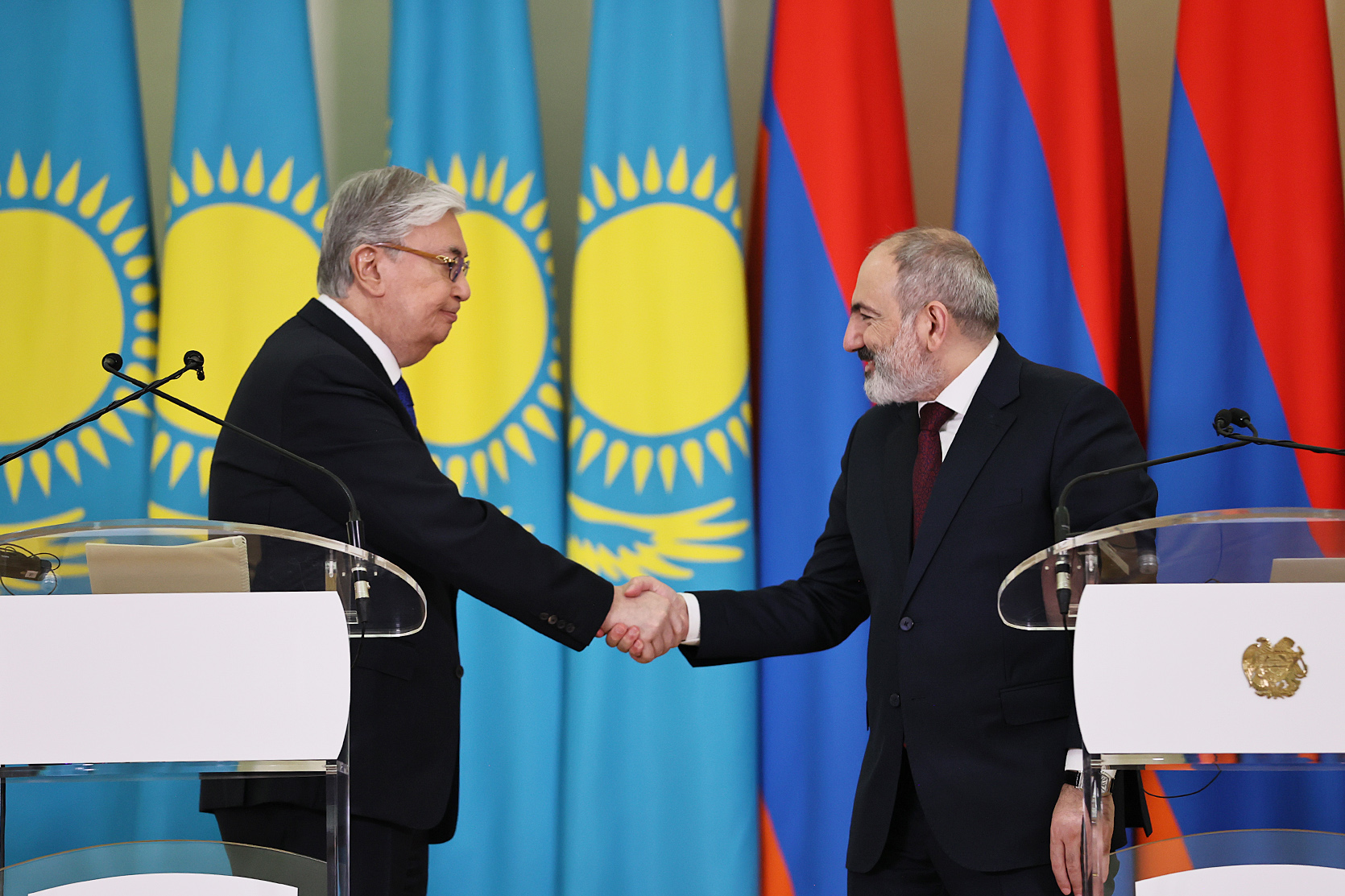
Tokayev’s visit to Yerevan

“Kazakhstan is ready to provide maximum assistance and take on the mission of goodwill, meaning to offer a platform for negotiations between Armenia and Azerbaijan,” stated Kassym-Jomart Tokayev in Yerevan.

This was his first official visit to Armenia. After talks with prime minister Nikol Pashinyan, the president of Kazakhstan welcomed Yerevan and Baku’s intention to conclude a peace agreement. “Our main goal is to bring our friendly countries closer together, to pave the way for unbreakable good-neighborly relations, peace, and sustainable development,” he said.

Political observer Hakob Badalyan doubts that Astana can play a “significant and effective” role in Armenian-Azerbaijani negotiations. According to Badalyan, Astana lacks the necessary potential and is itself a “direction of geopolitical struggle”. Therefore, he wonders with which of its partners the president of Kazakhstan coordinates such a proposal – with Russia, China, the UK, or Turkey.

“These players are currently engaged in a very tough and cruel struggle for every centimeter or gram of infrastructure, political, economic, and other opportunities,” Badalyan told JAMnews.


Kazakhstan welcomes the “Crossroads of Peace” project

After negotiations, the president of Kazakhstan stated that transportation logistics are of great importance for strengthening mutually beneficial cooperation:

“We highly appreciate Armenia’s desire to restore transportation links in the South Caucasus. In this regard, we welcome the ‘Crossroads of Peace’ initiative promoted by prime minister Nikol Pashinyan.”

Both the prime minister of Armenia and the president of Kazakhstan discussed their intention to deepen economic cooperation. Tokayev assured that Kazakhstan is ready to increase its exports to Armenia to $350 million:

“We need to explore new directions that will give a new impetus to trade volume growth.”

Additionally, he emphasized the importance of implementing joint investment projects and enhancing contacts between businessmen from both countries.

Nikol Pashinyan stated that he discussed with his colleague the issue of ensuring security and stability in the South Caucasus. According to him, Yerevan and Astana share common positions regarding the sovereignty and independence of states, and both countries are interested in diversifying regional infrastructure.

“Our goals and interests coincide in terms of regional and international peace and security,” confirmed Kassym-Jomart Tokayev.

Commentary

The highlight of the Kazakh president’s visit was the statement that Astana is ready to play a role in the Azerbaijani-Armenian negotiation process, according to political commentator Hakob Badalyan.

“This is related to the strategic problem of unlocking regional communications, which is the key and most painful point of the Armenian-Azerbaijani conflict from the perspective of the interests of geopolitical actors.“

The expert notes that by offering its mediation services in the Armenian-Azerbaijani process, Kazakhstan is trying to enhance its role among geopolitical players, especially those interested in the Caspian-Caucasus-Central Asia route and fighting for control over communications:

“To understand Kazakhstan’s potential, it is necessary to understand what geopolitical support the statement it made has among the players who are fighting for the Caucasus.”

According to Badalyan, Kazakhstan is influenced by four geopolitical centers – Russia, China, Great Britain, and Turkey.

“In relation to these four countries, how does Kazakhstan position itself in its work in the Caucasus? This is a significant question that will allow a specific answer to the question of what Tokayev’s visit to Yerevan represented,” he explained.

For example, according to the expert, Great Britain openly stated that it is important for them to form the Central Asia-Azerbaijan-Armenia-Turkey Middle Corridor. The goal is to weaken the influence of Russia and Iran in the Caucasus and the Middle East. Badalyan suggests revising the generalized wording of the “Crossroads of Peace” and finding out which actor, with what strategy, and in what way is ready to work in the region.

Badalyan evaluates Yerevan’s “Crossroads of the World” project as an attempt to show the world that Armenia advocates for unlocking roads, not “for the strategic victory” of one or another geopolitical center:

“The main question is how realistic the application of this regime is in practice. When someone declares support for the ‘Crossroads of Peace,’ the meaning of the statement is clear. But very specific questions arise. Because the power centers that are currently fighting for global influence – economic, political, military-political, etc. – have very different views on this.“

Tokayev’s visit to Yerevan

The post Astana offers itself for Yerevan-Baku talks. What’s the reason? first appeared on The South Caucasus News.


Categories
Sites

Zelenskyy calls for same defense from allies as for Israel – Voice of America – VOA News


Categories
Sites

Protecting Israel won’t stop Biden from pushing on Gaza – POLITICO


Categories
Sites

WATCH LIVE: White House holds news briefing as Israel threatens response to Iranian attack – PBS NewsHour


Categories
Sites

Why has Israel killed Iranian generals in Syria and who are the Quds Force? – The Indian Express


Why has Israel killed Iranian generals in Syria and who are the Quds Force?  The Indian Express The post Why has Israel killed Iranian generals in Syria and who are the Quds Force? – The Indian Express first appeared on The News And Times Review – NewsAndTimes.org.

The post Why has Israel killed Iranian generals in Syria and who are the Quds Force? – The Indian Express first appeared on The Puerto Rico Times – The News And Times.


Categories
Sites

FBI opens criminal investigation into collapse of Francis Scott Key Bridge in Baltimore


The FBI has opened a criminal investigation on the container ship that took down Baltimore’s Francis Scott Key Bridge last month, looking to determine if the ship’s crew left the port knowing the vessel was troubled. Officials are reviewing the events that led up to the massive, 980-foot-long Dali container ship colliding with one of the key… […]

The post FBI opens criminal investigation into collapse of Francis Scott Key Bridge in Baltimore first appeared on The Puerto Rico Times – The News And Times.


Categories
Sites

CIA’s Burns Spurs Spy Agencies to Embrace Book Learning, Data Extraction


Robert Redford as a CIA researcher on the run from assassins in Three Days of the Condor (Paramount Pictures))

Share

Although largely overlooked in spy thrillers, Open Source Intelligence, or OSINT—vacuuming up publicly available reports, books, and data—remains an enduring and high value component of any spy organization. Perhaps we can blame James Bond, who only read The Times of London, for OSINT’s perceived second class standing among the intelligence disciplines. Though to be fair, the peripatetic 1970s-era conspiracy spectacle Three Days of the Condor, despite starring a young and bookish Robert Redford, clearly did little to burnish the reputation of open source.

“I am not a spy. I just read books,” Redford’s CIA character, an open source practitioner, bemoans, wondering why on Earth somebody wants to kill him. And to be blunt, he does seem rather bland alongside Max von Sydow’s cold and dapper assassin. 

Although there is no denying espionage and covert action possess a certain cloak-and-dagger charm in their mystery and clandestine derring-do, open source has a long history of intelligence successes. And as the recently released report, Open Source Strategy for 2024 -2026, promises, the role of OSINT has a bright future in U.S. intelligence. Prepared by the Office of the Director of National Intelligence and Central Intelligence Agency, the report outlines a strategy that includes what could be described as an aggressive expansion of effort and capability with CIA Director William J. Burns serving as “Functional Manager” of the campaign.

The way forward, as Burns explained it, is a distributed and cooperative effort spanning the entirety of the IC to include all 18 intelligence organizations.  “As the IC’s Functional Manager for OSINT, I know the critical role that OSINT plays in defending our country and values,” he said in a prepared, albeit boilerplate statement. “In this pivotal moment, when OSINT is increasingly important and growing in demand, an IC-wide OSINT strategy is key to helping the IC move forward in a coordinated and determined way.”

We’ve heard this for some time now. Fact is, the spy agencies have always valued “intelligence gleaned from highly classified sources, rather than information that’s openly available on the internet or elsewhere,” as the Federal News Network put it last August. “Right now, our customer really believes that the only valuable content that the IC produces comes from super classified sources,” Ellen McCarthy, a former ​​chief of the State Department’s Bureau of Intelligence and Research, was quoted as saying, “and that’s just frankly not the case.” Gathering and making sense of, say, rumors of violent protests by rural Chinese factory workers, gleaned from provincial news reports by a skillful Mandarin-reading CIA analyst, can be just as valuable.

U.S. intelligence agencies seem to be finally coming around to that view. The strategic focus described in the report includes four areas for action: 


Read more

The post CIA’s Burns Spurs Spy Agencies to Embrace Book Learning, Data Extraction first appeared on JOSSICA – The Journal of the Open Source Strategic Intelligence and Counterintelligence Analysis.


Categories
Sites

US defense official had ‘Havana syndrome’ symptoms during a 2023 NATO summit, the Pentagon confirms – Lakeland TODAY


The post US defense official had ‘Havana syndrome’ symptoms during a 2023 NATO summit, the Pentagon confirms – Lakeland TODAY first appeared on JOSSICA – The Journal of the Open Source Strategic Intelligence and Counterintelligence Analysis.


Categories
Sites

In Havana syndrome patients, NIH scientists find no physical trace of harm – Michigan Public


The post In Havana syndrome patients, NIH scientists find no physical trace of harm – Michigan Public first appeared on JOSSICA – The Journal of the Open Source Strategic Intelligence and Counterintelligence Analysis.


Categories
Sites

CIA’s Burns Spurs Spy Agencies to Embrace Book Learning, Data Extraction – SpyTalk


The post CIA’s Burns Spurs Spy Agencies to Embrace Book Learning, Data Extraction – SpyTalk first appeared on JOSSICA – The Journal of the Open Source Strategic Intelligence and Counterintelligence Analysis.