Categories
Sites

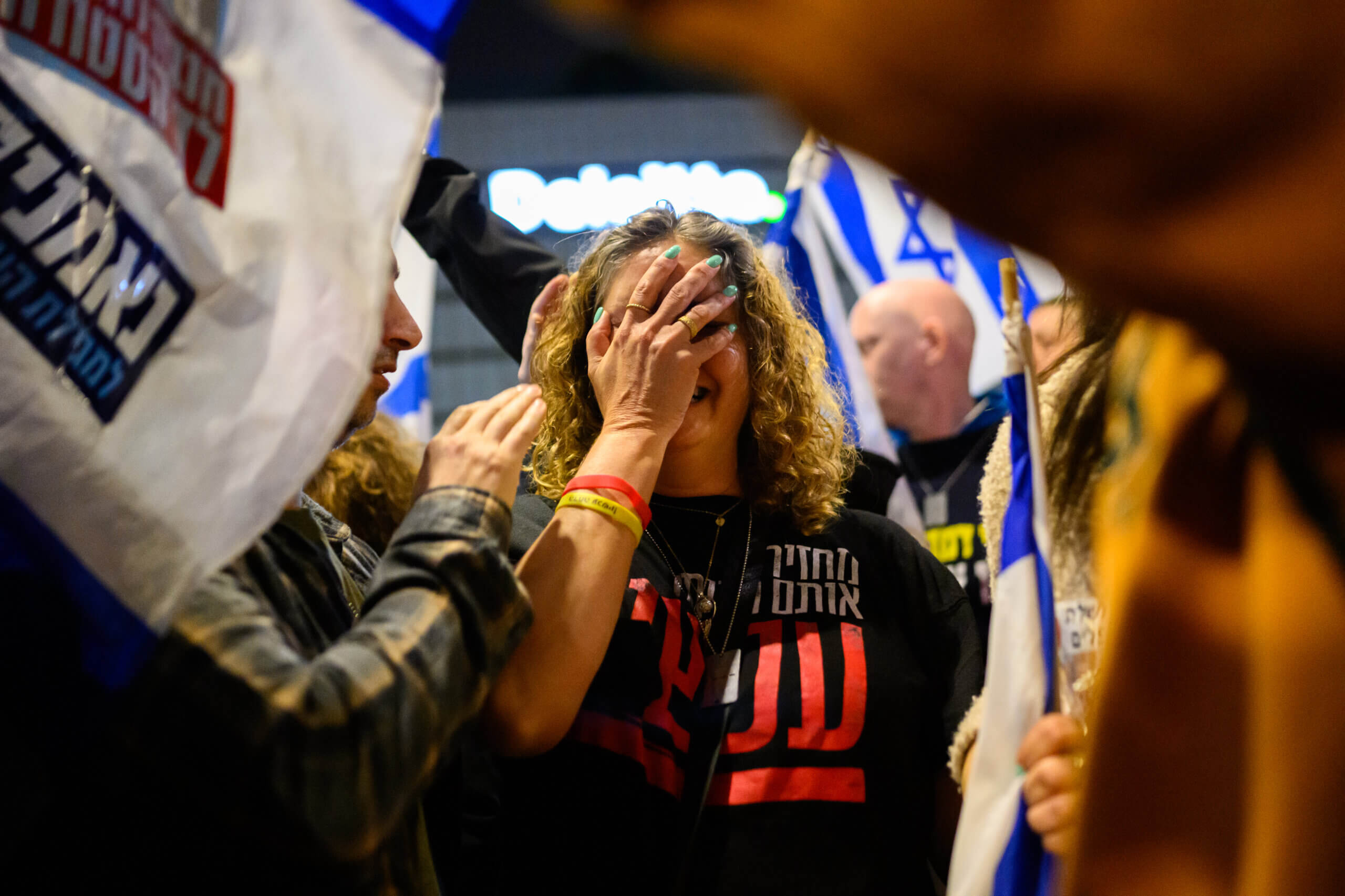
‘An act of faith’: I attended my first anti-Netanyahu protest — and confronted my own complacency


Israel-hostage-protest-anti-netanyahu-Ge

“Another week we’re here — how fun,” Mai Albini, the grandson of 79-year-old hostage Chaim Peri, said sarcastically. “Are you all having fun?”

I was among hundreds of protesters in Jerusalem’s Paris Square attending a weekly Saturday night demonstration demanding the release of the more than 100 remaining hostages in Gaza. I clutched a banner with a photo of 4-year-old hostage Ariel Bibas, who has been rumored but not confirmed to have been killed. Albini’s vulnerability gripped me.

“I don’t want to be afraid to say this anymore,” he said.“There are many dear and good people in Israel and the diaspora working in extraordinary ways to return the hostages — and the government is not part of them.”

“They hear us, and they know, and they don’t care,” he said at a different point, “and we know they don’t care.”

On my way to the protest, I’d questioned what I expected from it. I want Hamas eliminated, the hostages home, innocent Gazans fed, and Netanyahu gone. 

But isn’t the Israeli government already fighting for the first three, I wondered? And wouldn’t new elections, at this stage, only distract from the other aims? 

Listening to Albini, I realized that these protesters aren’t just pursuing practical goals. They’re after a sense of agency and hope at a time when they feel authorities — and the world — have abandoned them.

The crowd chanted “shame” in Hebrew in response to Albini’s critique of the government’s failure to bring back the hostages. The new Hebrew word I learned from the speakers that night was “nimasti”: “I’m fed up.”

Protesting as ‘an act of faith’

That protest was my second of the evening. I first attended one outside the President’s residence, which took aim at Netanyahu and called for new elections. Weary eyes interrogated my arrival in my Shabbat attire, a white button-down shirt and white-knit kippah. Though many men wore kippot, it seemed I was the only one among the largely secular crowd dressed as a Religious Zionist. 

On the stage, two women were calling for new elections. They had lost any faith in our leadership, they said.

Their calls echoed the wishes of most Israelis: 71% want elections much earlier than November 2026, when they are next scheduled to occur. They were a reminder of how profoundly support for Netanyahu had declined; a recent poll suggested nearly half of Israelis believe Netanyahu is delaying a hostage deal over his own political considerations. 

“I feel pretty pessimistic about Israel’s future,” a fellow protester, whom I met as the anti-Netanyahu rally began winding down, told me as we marched toward the second rally for the hostages at Paris Square. 

But while he wants Netanyahu’s ouster, he said, “ I’m not hopeful that any government replacing Bibi would be much better.”

He doubts the war’s ability to secure Israel’s long-term protection, fears the way in which it is harming Israel’s standing with Palestinians and the international community alike, and doesn’t trust Israeli leaders. What, I asked, does he — or others like him — gain from attending a rally like this?

“When you have a whole bunch of people who feel helpless,” he said, “this is where we turn to. Protesting is an act of faith.”

I had only ever considered pragmatic reasons to protest. To fight and generate change — definitely. But to show belief in an ideal I might not practically expect to be achieved? Never. 

At Paris Square, hostages’ family members spoke in turn from the podium, each speech ending with the same rallying cry: “Bring them home now.” The crowd chanted in response: “Achshav! Achshav! Achshav!” — “Now! Now! Now!” 

The chorus reminded me of the Hallel prayer I recited last week in shul: “Please, God, save us now,” the chazzan shouted, and we followed in dutiful repetition. 

Out on the streets, I felt the faith that the protester spoke of. With attendees returning week after week, praying for a miracle, protesting is all they have left.

‘People are starting to forget’

As I began heading home after the rally ended, I noticed dozens of protesters blocking a major intersection in Paris Square. They formed a circle, their arms locked as they shouted in unison: “There is no routine until there is a hostage deal!” 

Their screams merged with drivers’ blaring horns and furious shouts. I cautiously joined the swarming onlookers to watch from the sidewalk. 

Police arrived and struggled to redirect traffic. The scuffles turned to brawls, as officers hauled flailing, defiant protestors away from the intersection — only for many to race back as soon as the officers turned their heads.

I was doubtful of the unrestrained protest’s effectiveness. Blocking traffic and resisting officers was disruptive, sure, but also seemed unhelpful — how could it actually move forward efforts to secure the hostages’ return? But then I thought back to their chants: Why would anyone remain passive while our brothers and sisters lie in terrorists’ clutches? Almost six months into the war, 134 hostages still remain in Gaza — more than 30 of them believed to be dead. 

Earlier that night, Evgenia Kozlov, mother of the Russian-Israeli hostage Andrey Kozlov, spoke to us through a Russian translator. “Five months have passed, people are starting to forget, the wind has destroyed our posters… people are continuing with their lives,” she said. “But we are still living in Oct. 7.”

As the chaos unfolded outside Paris Square, her words made me question why this was the first time I had joined in a rally. Have I been complacent about the plight of the hostages — and the country? How could I — or anyone — possibly help push the government toward a different path? 

Police eventually regained control of the intersection, and the traffic flow resumed — until one protester darted back into the streets with his arms above his head in a last-ditch effort to block cars once more. 

While police hauled him away once more, I looked on with discomfort. I instinctively labeled the man“crazy” in my mind, seeing a reckless action with little hope of making actual change. But then I thought back to all the hostages hopelessly and indefinitely stuck in Gaza, and thought instead: Maybe I’m the crazy one for not joining him.

The post ‘An act of faith’: I attended my first anti-Netanyahu protest — and confronted my own complacency appeared first on The Forward.

The post ‘An act of faith’: I attended my first anti-Netanyahu protest — and confronted my own complacency first appeared on The News And Times.


Categories
Sites

Russia’s Election Monitor Calls Presidential Elections ‘Imitation’


The independent election watchdog group Golos called last week’s Russian balloting an “imitation” of an election. President Vladimir Putin won his reelection bid in a campaign that was never in doubt. Kateryna Besedina has the story, narrated by Anna Rice. VOA footage by Artyom Kokhan.

The post Russia’s Election Monitor Calls Presidential Elections ‘Imitation’ first appeared on The News And Times.


Categories
Sites

Mexican Journalist, Son Receive Official US Asylum Papers After 15-Year Journey


Categories
Sites

20% of students use financial aid for betting, experts say


LAS VEGAS (KLAS) — At least one-fifth of college students tap into their financial aid funds for betting, according to Nevada Council on Problem Gambling statistics.

The NCAA men’s basketball tournament is the largest betting event in the country, experts say. 38 states and Washington D.C. allow some form of legal sports betting, and as it becomes more prevalent in the US, so too have calls to gambling-addiction hotlines.

“I’ve been addicted to sports gambling since 2017,” said Saul Malek, a recovering sports betting addict. He is not alone, said Ted Hartwell, Executive Director of the Nevada Council on Problem Gambling.

“About two-thirds of college students who live on campus are actually betting on sports now, and most of them are not of legal age to do so,” said Hartwell.

Experts say that as many as 20 percent of students use their financial aid on betting, using the money allocated to their education for gambling.

Malek was a sophomore in college in Texas when he started sports betting. “Within the first five to six months, there was a point where I recognized I felt uneasy when I wasn’t gambling,” he said.

After coming to terms with his addiction during a breakup with his girlfriend, he said he knew it was time to get help. Malek has not bet since 2019, he said, reiterating his mission to help others avoid his mistakes.

Calls to one sports betting addiction hotline have increased since the COVID-19 pandemic, with a few key factors playing in. Hartwell said easier access to sports betting on smartphones and major league sports teams coming to the Las Vegas valley both play their part in the increase.

Hartwell said sports betting addiction is the type of gambling where they see the most self-reported problematic behavior. He says it’s on the rise not just in southern Nevada but throughout the country as well.

“There’s this effect of people thinking, ‘Well, if I gamble more eventually, I am going to win,’ and the opposite is actually true,” said Hartwell.

For many like Malek, recovery is a continuous journey, and he is giving his time to students through speaking engagements about the dangers of sports betting addiction.

“You should always expect to lose your money when you gamble,” Hartwell said. “So that should always be disposable income.”

Only about 25 percent of colleges and universities have policies in place regarding gambling, explained Hartwell. The Nevada Council on Problem Gambling would like to see questions added to health forms regarding gambling habits in an effort to discover problem gambling earlier.

Anyone who needs help or knows someone who might need help with gambling addiction, more information is available on the Nevada Council on Problem Gambling website or via phone at (800) GAMBLER, via text at 800-GAM, or online chat at 1800GAMBLERCHAT.org

The post 20% of students use financial aid for betting, experts say first appeared on The News And Times.


Categories
News Review from The World Web Times

Rio de Frades Map – Stream – Aveiro District, Portugal – Mapcarta


Rio de Frades is a stream in Aveiro District, Portugal. Rio de Frades is situated nearby to Covelo de Paivó and Cabreiros. Mapcarta, the open map.

Categories
Sites

Destruction of Russian UAV in southern direction. VIDEO


Soldiers of the Kherson air defense missile brigade of the Armed Forces of Ukraine destroyed a Russian drone in the southern direction.

The post Destruction of Russian UAV in southern direction. VIDEO first appeared on JOSSICA – The Journal of the Open Source Strategic Intelligence and Counterintelligence Analysis.


Categories
Sites

General Staff: There were 67 combat engagements in frontline over last day. Most Russian attacks were repelled in Novopavlivka direction – 18


Over the past day, the Ukrainian Defense Forces repelled 67 Russian attacks on the combat line. The Novopavlivka direction remained the most active, with 18 attacks by the Russian army stopped there.

The post General Staff: There were 67 combat engagements in frontline over last day. Most Russian attacks were repelled in Novopavlivka direction – 18 first appeared on JOSSICA – The Journal of the Open Source Strategic Intelligence and Counterintelligence Analysis.


Categories
Sites

Why Super Micro Computer, Advanced Micro Devices, and Other Artificial Intelligence (AI) Stocks Tumbled on Tuesday – The Motley Fool


The post Why Super Micro Computer, Advanced Micro Devices, and Other Artificial Intelligence (AI) Stocks Tumbled on Tuesday – The Motley Fool first appeared on JOSSICA – The Journal of the Open Source Strategic Intelligence and Counterintelligence Analysis.


Categories
Sites

AI detector: YouTube unveils rules to identify deepfake, artificial intelligence content – Asbury Park Press


The post AI detector: YouTube unveils rules to identify deepfake, artificial intelligence content – Asbury Park Press first appeared on JOSSICA – The Journal of the Open Source Strategic Intelligence and Counterintelligence Analysis.


Categories
Sites

Apple’s AI Focus Could Crimp Profit Margins, Analyst Says – Investor’s Business Daily


The post Apple’s AI Focus Could Crimp Profit Margins, Analyst Says – Investor’s Business Daily first appeared on JOSSICA – The Journal of the Open Source Strategic Intelligence and Counterintelligence Analysis.